Grade 7 Science
Study Bibles 26
Reading: Science Literacy Preface: Put Yourself in This Scene
This is a Science Literacy reading. Students read it on their own over about a week, alongside the investigation lessons, then do the exercise page and talk it over.
Words to know
- chemical
- a substance produced by a chemical process or producing a chemical effect
- chlorine
- an element that occurs as a gas and makes up bleach and disinfectants
- concentration
- the density of a material in another substance
- dehydration
- the process of removing water demonstrate understanding in discussion and through writing
- dilute
- to make thinner
Teacher’s plan for this reading
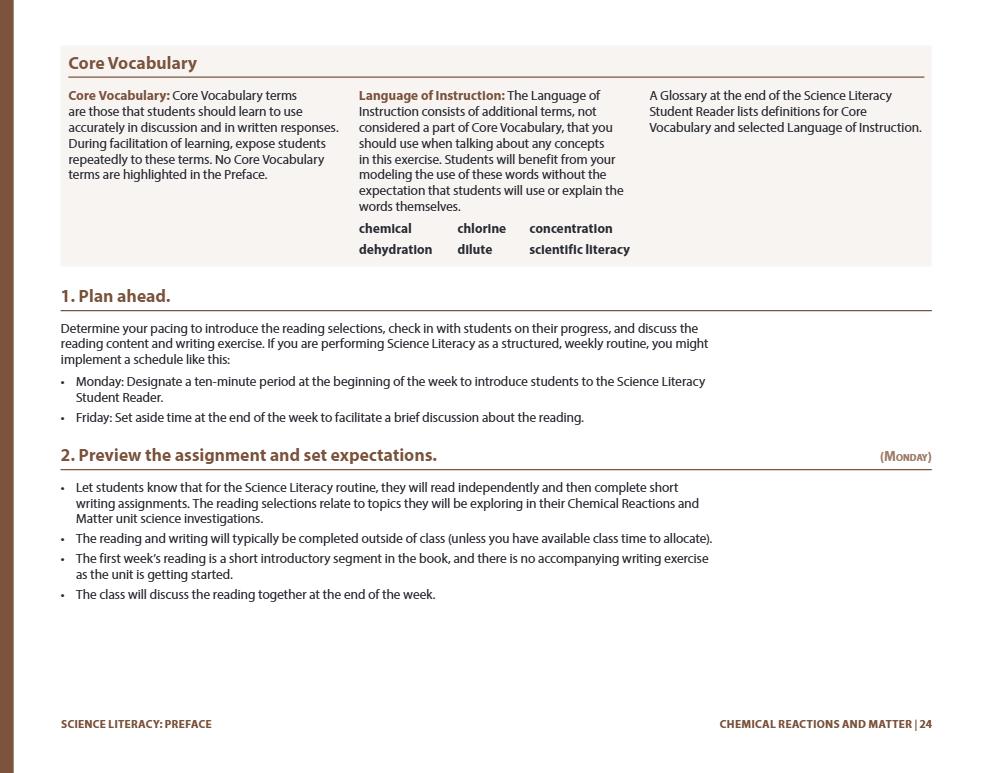
Read this first: the steps, materials, timing and discussion questions, straight from the Teacher Guide.
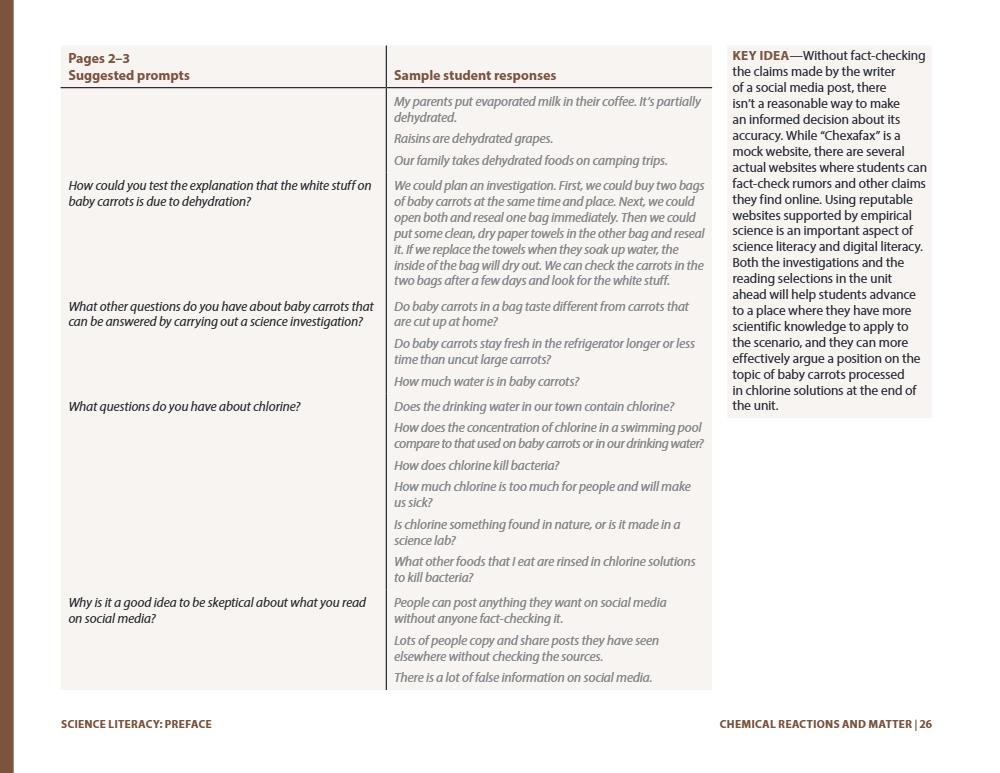
Read: Science Literacy Student Reader, Preface: “Put Yourself in This Scene”
Read it aloud together, or let your student read on their own. Pictures and maps are part of the lesson — talk about them too.
Text version (for read-aloud apps and screen readers)
Put Yourself in This Scene
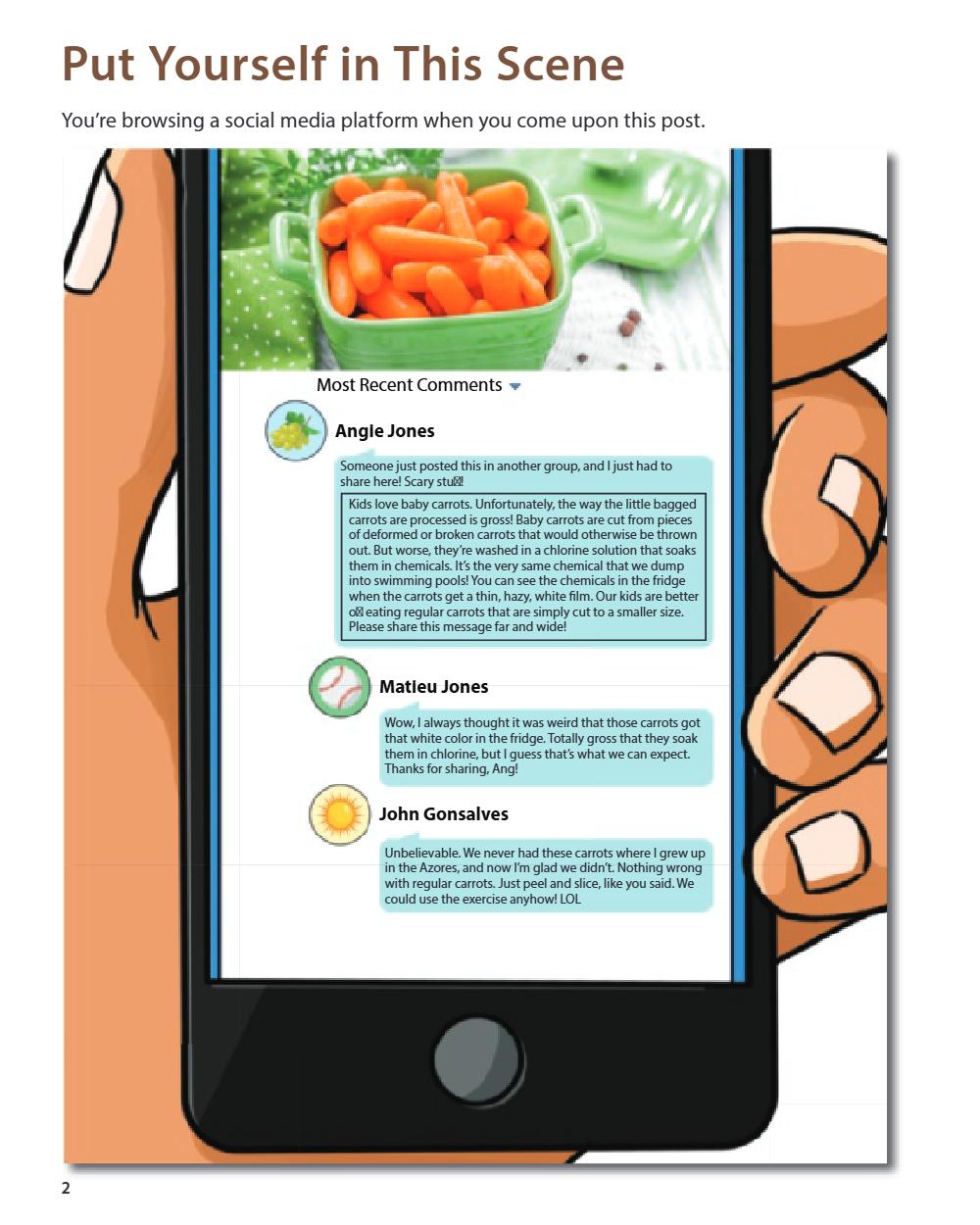
You’re browsing a social media platform when you come upon this post.
Most Recent Comments
Angie Jones
Someone just posted this in another group, and I just had to
share here! Scary stu !
Kids love baby carrots. Unfortunately, the way the little bagged
carrots are processed is gross! Baby carrots are cut from pieces
of deformed or broken carrots that would otherwise be thrown
out. But worse, they’re washed in a chlorine solution that soaks
them in chemicals. It’s the very same chemical that we dump
into swimming pools! You can see the chemicals in the fridge
when the carrots get a thin, hazy, white film. Our kids are better
o eating regular carrots that are simply cut to a smaller size.
Please share this message far and wide!
Matieu Jones
Wow, I always thought it was weird that those carrots got
that white color in the fridge. Totally gross that they soak
them in chlorine, but I guess that’s what we can expect.
Thanks for sharing, Ang!
John Gonsalves
Unbelievable. We never had these carrots where I grew up
in the Azores, and now I’m glad we didn’t. Nothing wrong
with regular carrots. Just peel and slice, like you said. We
could use the exercise anyhow! LOL
2
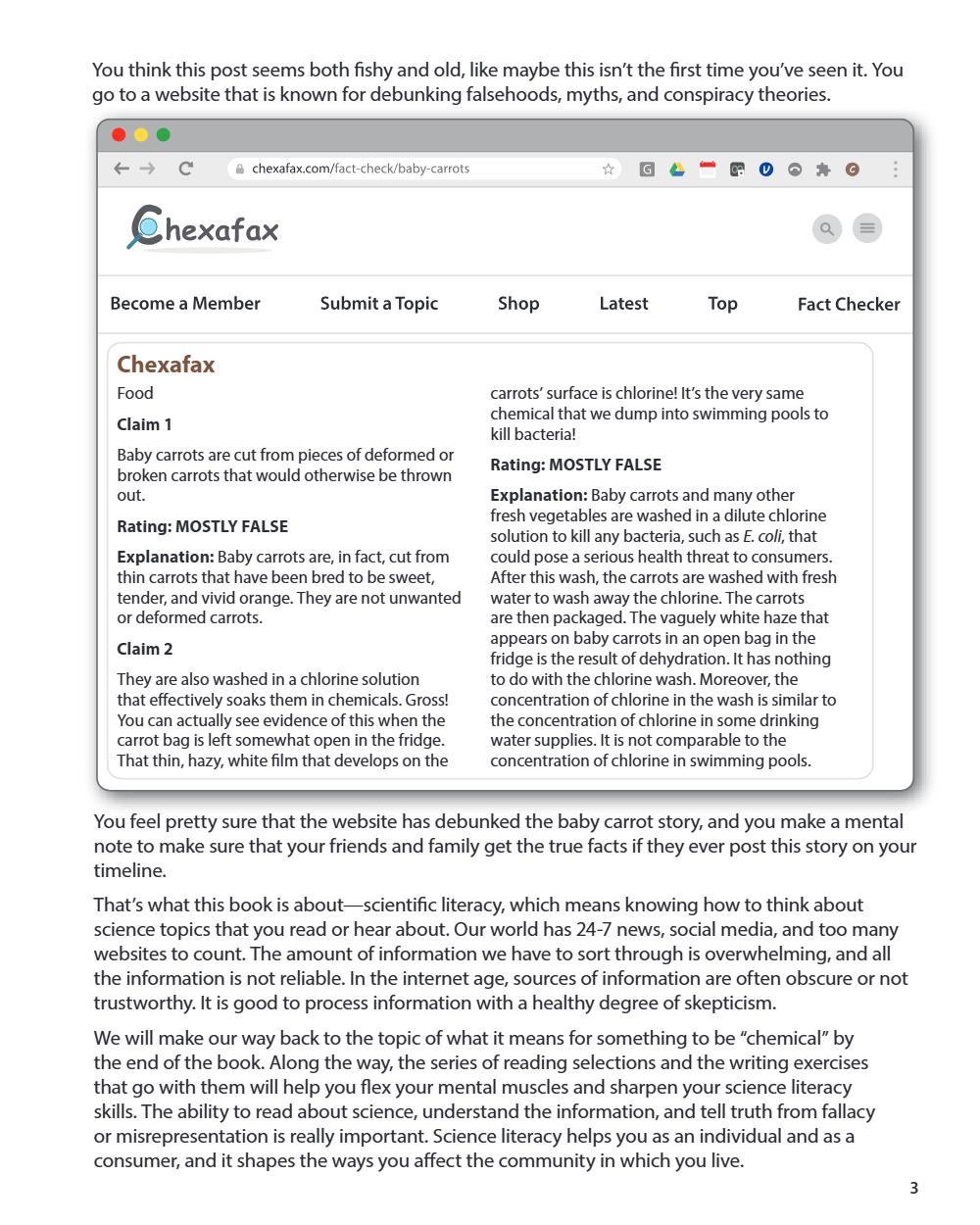
You think this post seems both fishy and old, like maybe this isn’t the first time you’ve seen it. You
go to a website that is known for debunking falsehoods, myths, and conspiracy theories.
Chexafax
Food
Claim 1
Baby carrots are cut from pieces of deformed or
broken carrots that would otherwise be thrown
out.
Rating: MOSTLY FALSE
Explanation: Baby carrots are, in fact, cut from
thin carrots that have been bred to be sweet,
tender, and vivid orange. They are not unwanted
or deformed carrots.
Claim 2
They are also washed in a chlorine solution
that effectively soaks them in chemicals. Gross!
You can actually see evidence of this when the
carrot bag is left somewhat open in the fridge.
That thin, hazy, white film that develops on the
carrots’ surface is chlorine! It’s the very same
chemical that we dump into swimming pools to
kill bacteria!
Rating: MOSTLY FALSE
Explanation: Baby carrots and many other
fresh vegetables are washed in a dilute chlorine
solution to kill any bacteria, such as E. coli, that
could pose a serious health threat to consumers.
After this wash, the carrots are washed with fresh
water to wash away the chlorine. The carrots
are then packaged. The vaguely white haze that
appears on baby carrots in an open bag in the
fridge is the result of dehydration. It has nothing
to do with the chlorine wash. Moreover, the
concentration of chlorine in the wash is similar to
the concentration of chlorine in some drinking
water supplies. It is not comparable to the
concentration of chlorine in swimming pools.
You feel pretty sure that the website has debunked the baby carrot story, and you make a mental
note to make sure that your friends and family get the true facts if they ever post this story on your
timeline.
That’s what this book is about—scientific literacy, which means knowing how to think about
science topics that you read or hear about. Our world has 24-7 news, social media, and too many
websites to count. The amount of information we have to sort through is overwhelming, and all
the information is not reliable. In the internet age, sources of information are often obscure or not
trustworthy. It is good to process information with a healthy degree of skepticism.
We will make our way back to the topic of what it means for something to be “chemical” by
the end of the book. Along the way, the series of reading selections and the writing exercises
that go with them will help you flex your mental muscles and sharpen your science literacy
skills. The ability to read about science, understand the information, and tell truth from fallacy
or misrepresentation is really important. Science literacy helps you as an individual and as a
consumer, and it shapes the ways you affect the community in which you live.
3
Check for understanding
- Pick one of today’s words and use it in a sentence of your own.
For offline study
Download these once and you can teach this unit without the internet.
CKSci 6–8 was originally developed and authored by OpenSciEd (www.openscied.org), licensed under a Creative Commons Attribution 4.0 International License (CC BY 4.0). Additions marked “Core Knowledge Science Literacy” are the work of the Core Knowledge® Foundation (www.coreknowledge.org), made available through licensing under a Creative Commons Attribution-NonCommercial-ShareAlike 4.0 International License. This does not in any way imply that OpenSciEd or the Core Knowledge Foundation endorses this work. PGAMO added the lesson pages, study packs and quizzes layout, and shares them under the same license. CC BY-NC-SA 4.0 · Core Knowledge Science (OpenSciEd). Free for everyone — this course may never be sold.