Grade 6 History & Geography
Study Bibles 26
Chapter 1: What Is a Desert?
What features determine whether an area of land is a desert?
Keep this question in mind as you read. You’ll answer it at the end.Words to know
- polar
- relating to a geographic pole or the area around itThe polar area has cool to cold summers and cold to very cold winters.
- climatologist
- a scientist who studies weather patterns over timeThe climatologist studied how the weather of the Sahara has changed over the last one hundred years.
- evaporation
- the process by which a liquid changes to a vapor or gasWater turning into steam is an example of evaporation.
- precipitation
- water falling to Earth’s surface as rain, hail, snow, or sleetThe forecast called for precipitation, so Emma brought her umbrella.
- desertification
- natural or human processes that turn fertile land into a desertOvergrazing land can cause desertification.
- semiarid
- describing locations with little precipitation, but with enough moisture to support the growth of grasses, shrubs, and a few scattered treesSemiarid regions typically receive between ten and twenty inches of annual rainfall.
Read: Chapter 1, “What Is a Desert?”
Read it aloud together, or let your student read on their own. Pictures and maps are part of the lesson — talk about them too.
Text version (for read-aloud apps and screen readers)
Chapter 1
What Is a Desert?
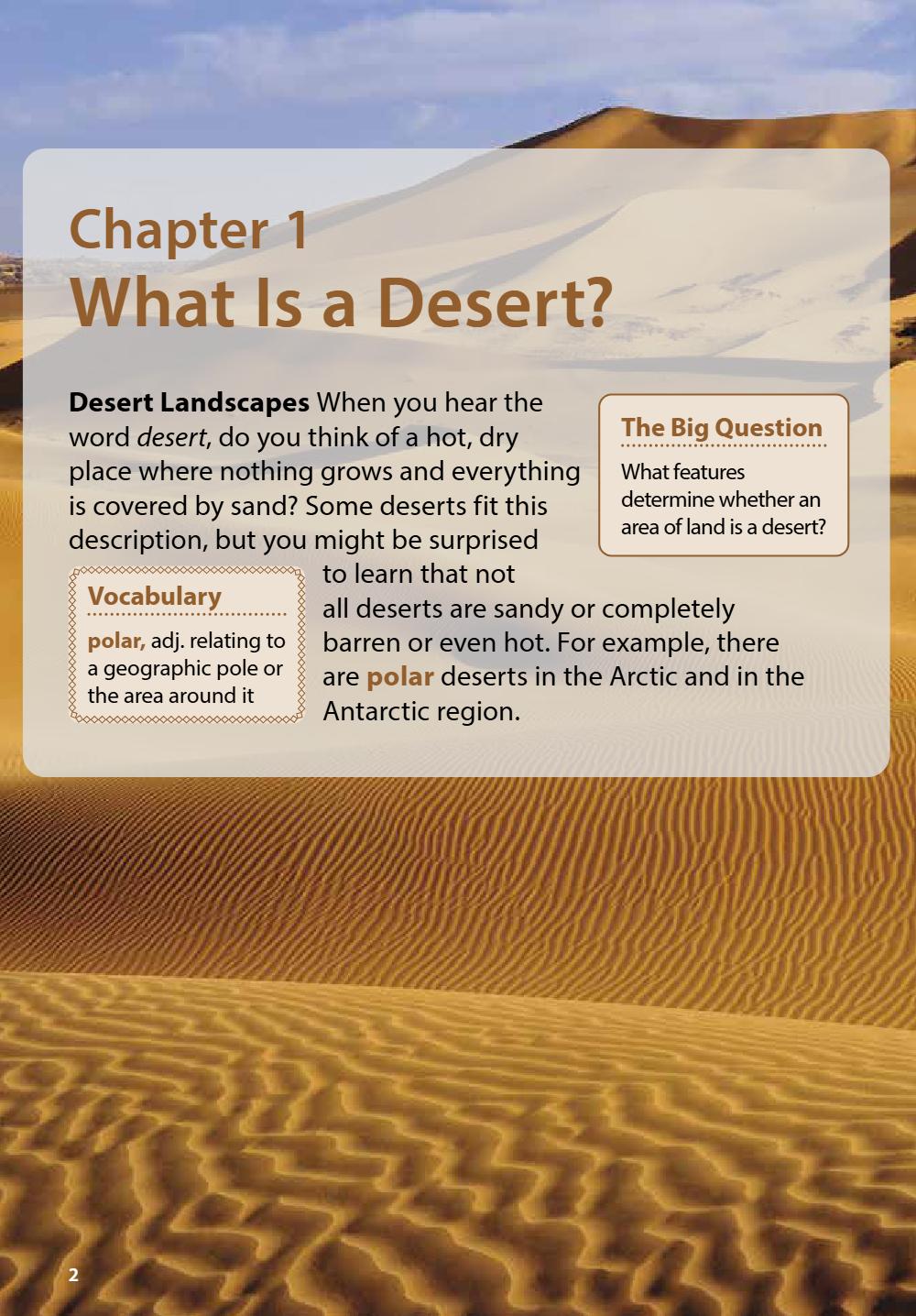
Desert Landscapes When you hear the
The Big Question
word desert, do you think of a hot, dry
place where nothing grows and everything What features
determine whether an
is covered by sand? Some deserts fit this
area of land is a desert?
description, but you might be surprised
to learn that not
Vocabulary
all deserts are sandy or completely
polar, adj. relating to
barren or even hot. For example, there
a geographic pole or
are polar deserts in the Arctic and in the
the area around it
Antarctic region.
2
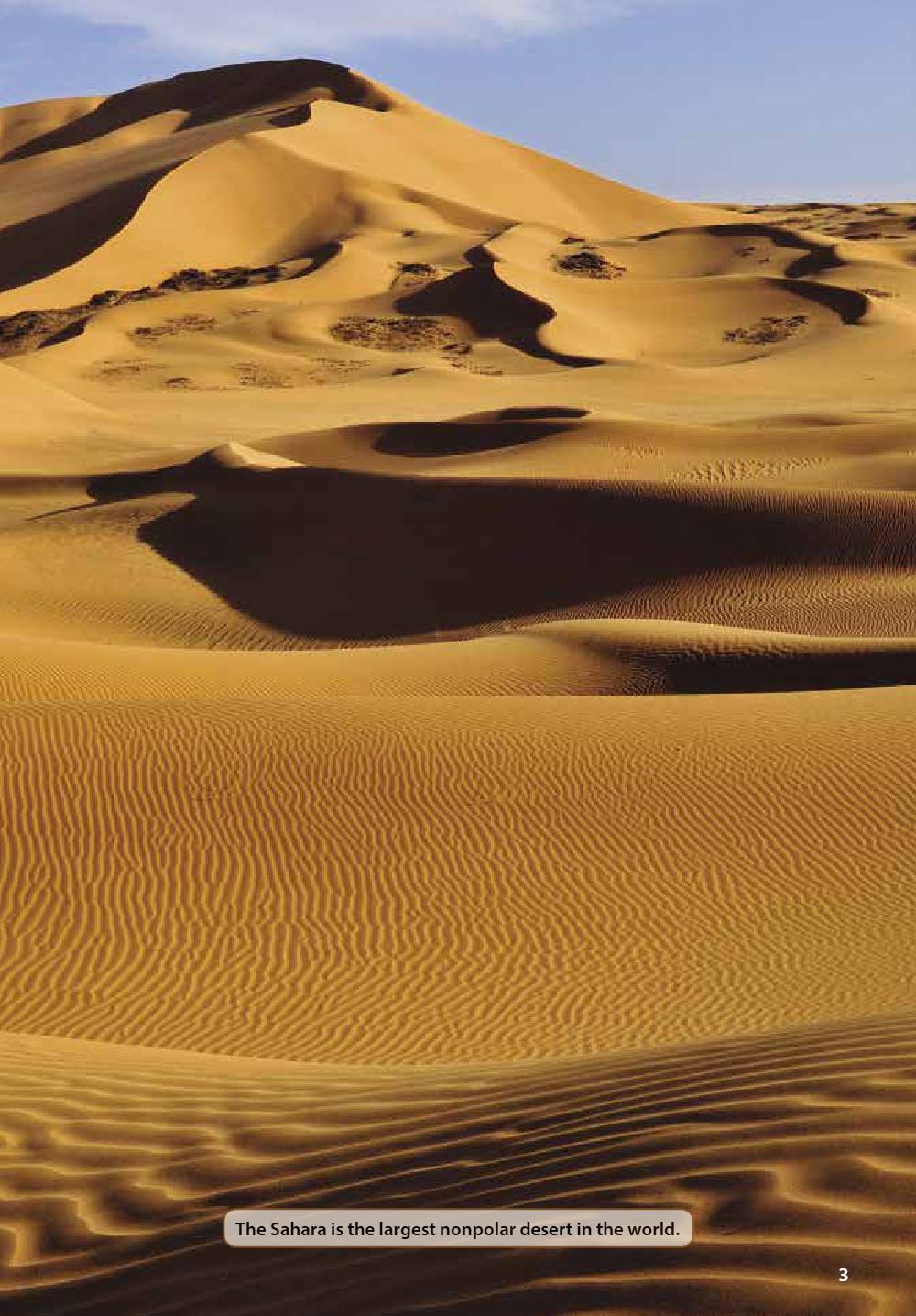
The Sahara is the largest nonpolar desert in the world.
3
Most climatologists define the word desert as a place where evaporation
exceeds precipitation. One feature of a desert can be its dryness, or aridity.
One way of assessing the dryness of a place is by measuring how many
inches of precipitation it gets in an average year.
Most deserts get less than ten inches of
precipitation a year—this is also true of the Arctic
and the Antarctic region. Compare that meager
ten inches with the average yearly precipitation in
some major American cities:
City
Average Yearly Precipitation
New Orleans
61 inches
New York City
42 inches
Chicago
35 inches
Dallas
29 inches
San Francisco
20 inches
Los Angeles
15 inches
Vocabulary
climatologist, n.
a scientist who
studies weather
patterns over time
evaporation, n. the
process by which a
liquid changes to
a vapor or gas
precipitation, n.
water falling to
Earth’s surface as
rain, hail, snow,
or sleet
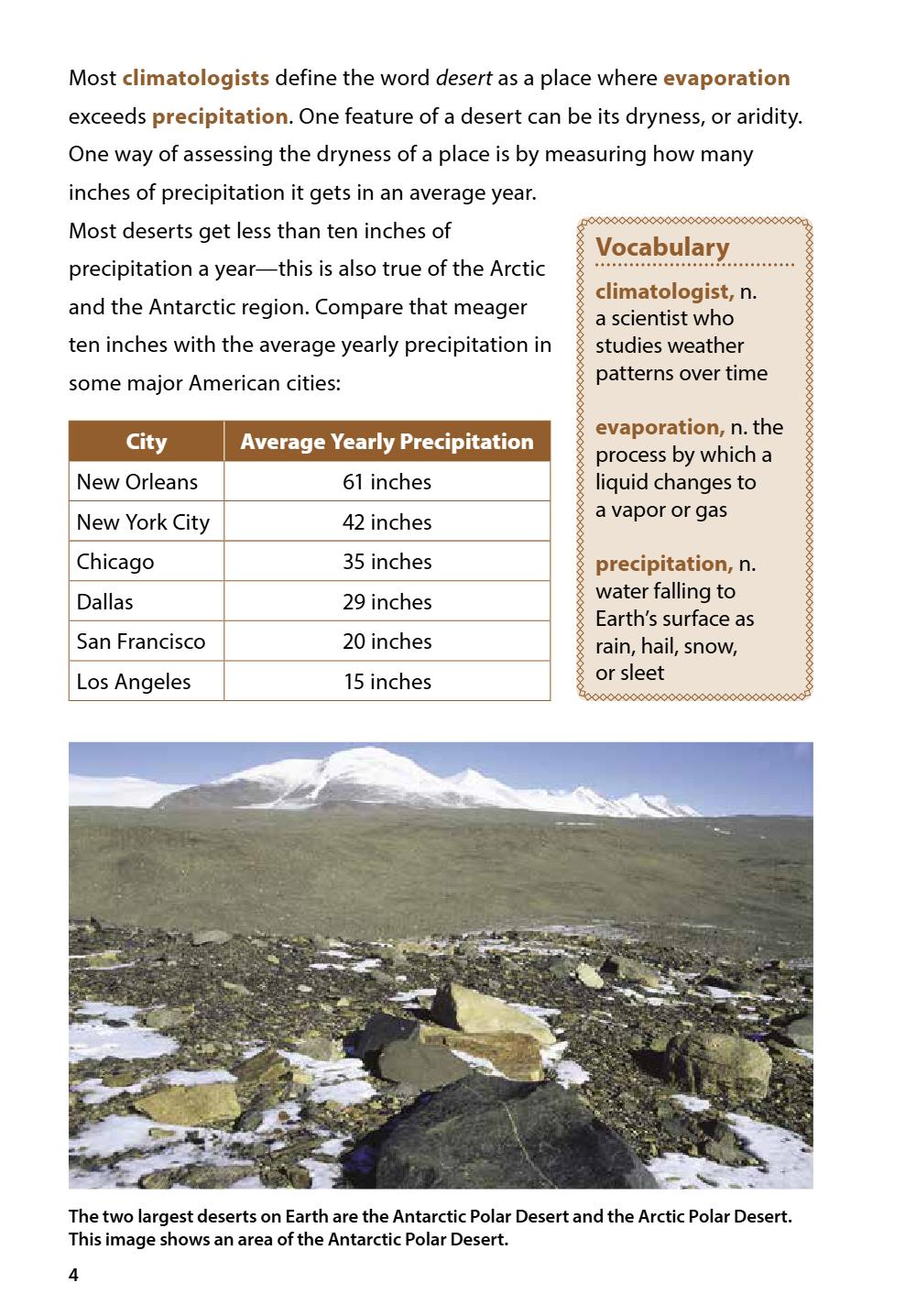
The two largest deserts on Earth are the Antarctic Polar Desert and the Arctic Polar Desert.
This image shows an area of the Antarctic Polar Desert.
4
Even when it does rain in a desert, plants and animals are often only able to
use a small amount of the rainwater. For example, sudden thunderstorms
can cause heavy rainfall, but the water quickly runs off in flash floods and
does not soak into the ground. When a light shower falls over a dry desert
area, most of the rain evaporates before it touches the ground because the
air is so dry.
The strength of the sun is also a factor. When temperatures are very high,
as they are in many deserts, evaporation speeds up. Because of this, the water
has less time to soak into the parched soil.
Desert Temperatures
Many deserts are hot as well as dry. Not surprisingly, deserts near the equator
are very hot. In the Sahara in Africa, daytime temperatures routinely soar
well above 100° Fahrenheit (F). However, the highest recognized recorded
temperature was measured on July 10, 1913, at Greenland Ranch in Death
Valley, California. On that day, the temperature reached 134°F.
Deserts far from the equator tend not to have the scorching hot temperatures
of the Sahara. In fact, during the winter, these deserts can be freezing cold.
The average winter temperature in the Gobi in northern China is 10° to l5°F.
And then there are the polar deserts. In the Arctic Polar Desert, the winter
temperature can drop below -60°F.
One feature that both “hot” and “cold” deserts share is a dramatic change
between daytime and nighttime temperatures. At night, the temperature in
a hot desert can drop anywhere from 30° to 70°F. Clouds keep warm air near
the ground. Desert skies, whether they are hot or dry, are often cloudless, so
at night much of the heat rises into the sky, leaving the desert much colder
than it is in the daytime.
5
6
W
S
N
E
PACIFIC OCEAN
Chihuahuan
Desert
Sonoran
Desert
Mojave
Arctic Desert
Atacama
Desert
ATLANTIC
OCEAN
Mediterranean
Sea
Patagonia
SOUTH
AMERICA
Caribbean Sea
NORTH
AMERICA
Death Valley
ARCTIC OCEAN
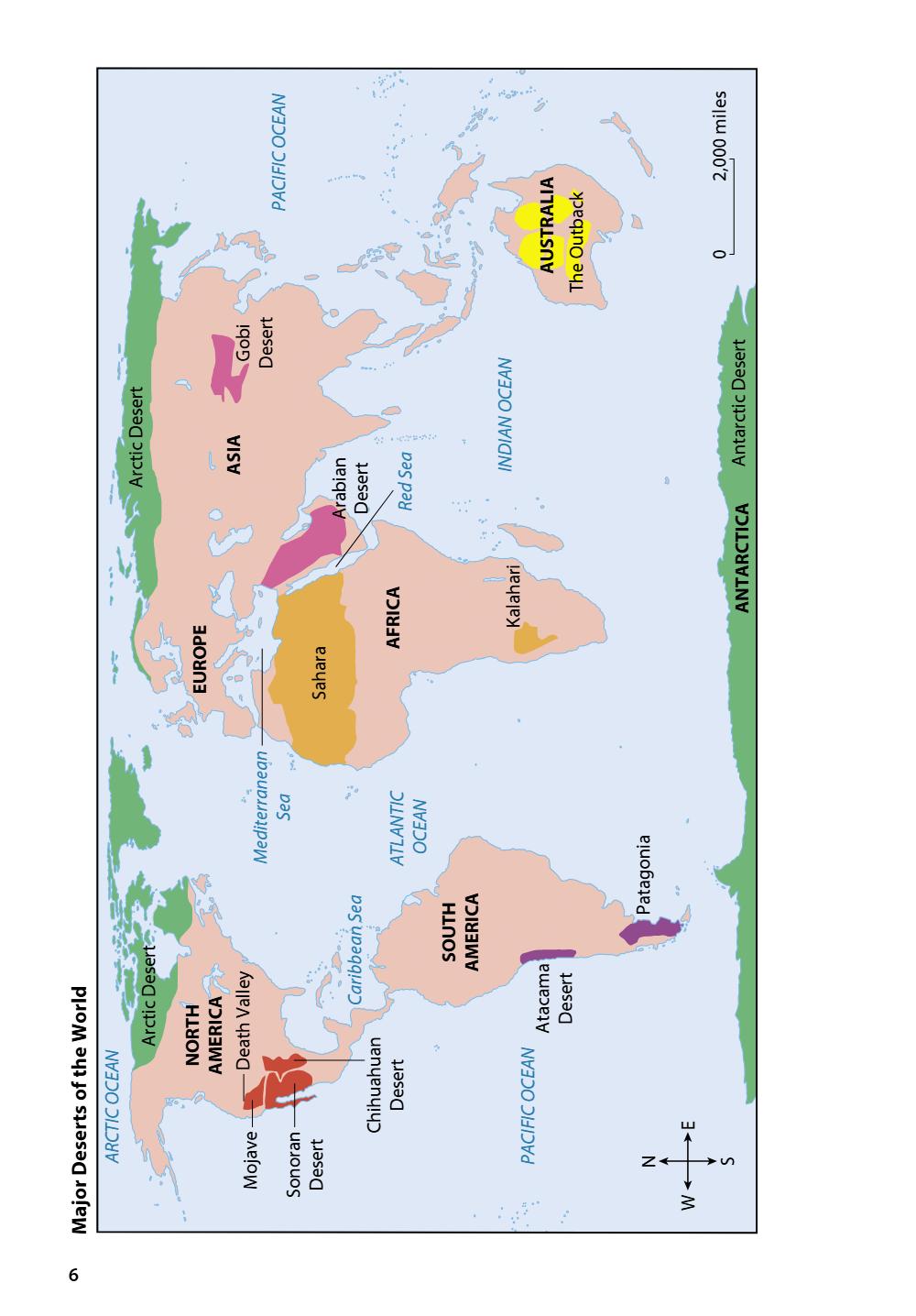
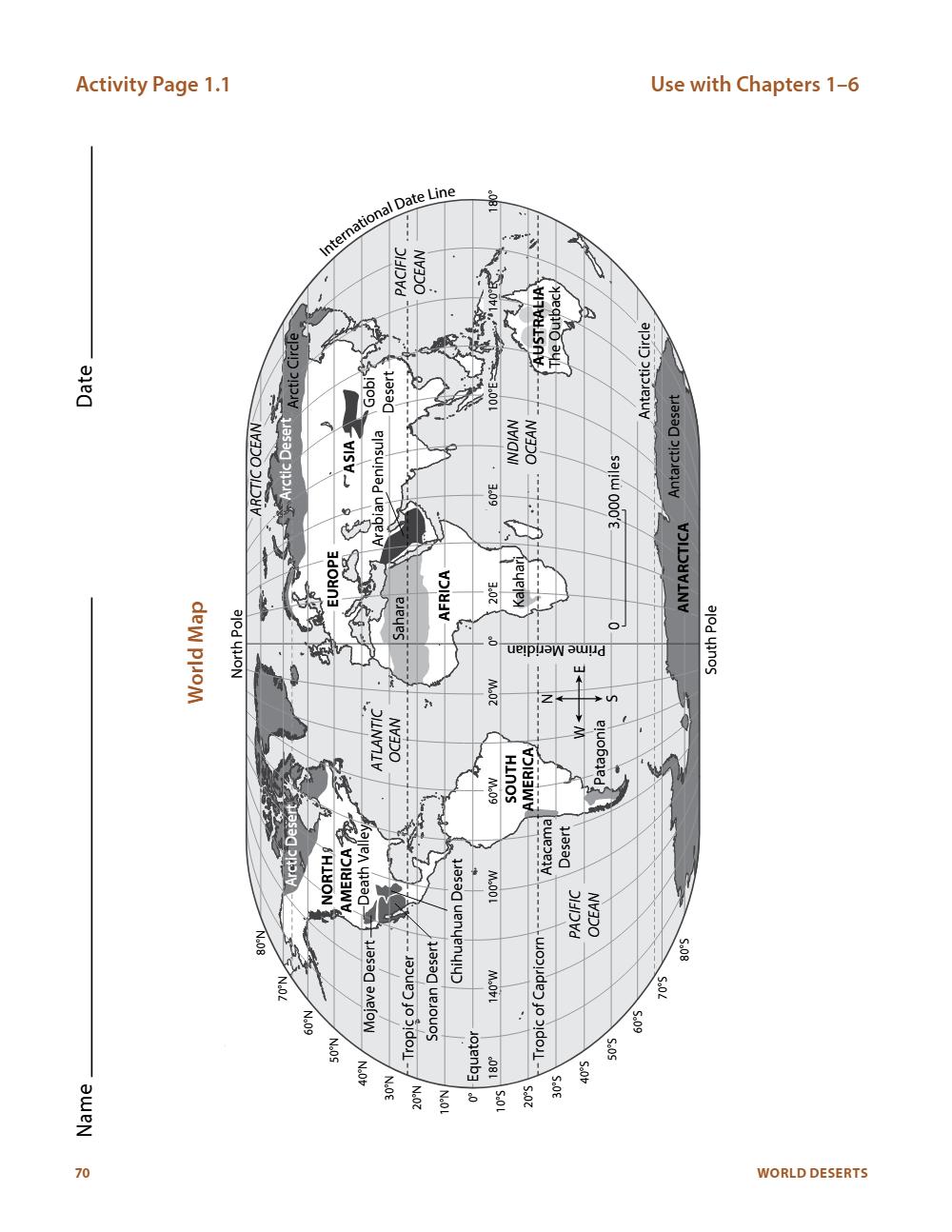
Major Deserts of the World
ASIA
Gobi
Desert
Antarctic Desert
INDIAN OCEAN
Red Sea
Arabian
Desert
ANTARCTICA
Kalahari
AFRICA
Sahara
EUROPE
Arctic Desert
0
The Outback
2,000 miles
AUSTRALIA
PACIFIC OCEAN
Desert Landforms
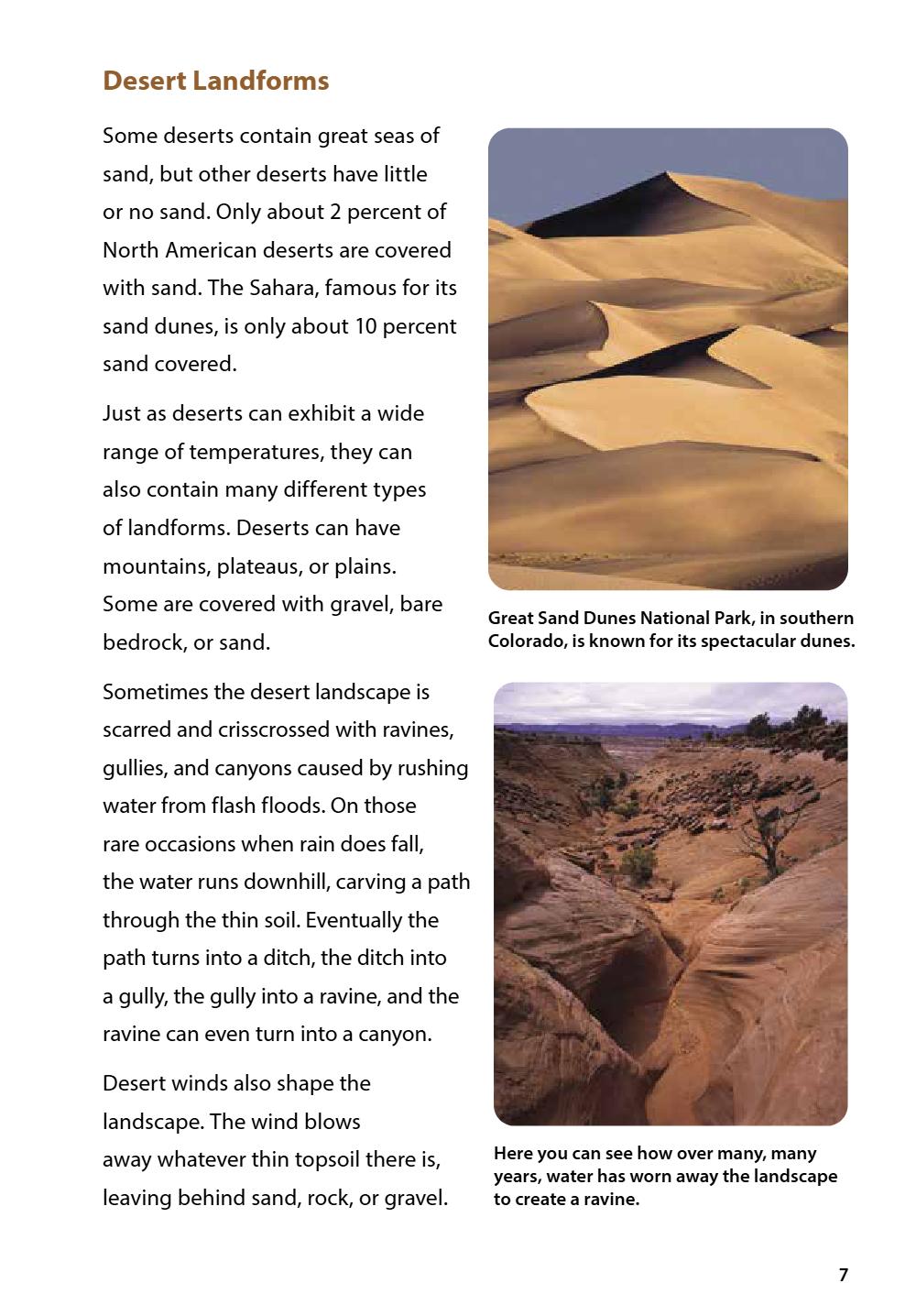
Some deserts contain great seas of
sand, but other deserts have little
or no sand. Only about 2 percent of
North American deserts are covered
with sand. The Sahara, famous for its
sand dunes, is only about 10 percent
sand covered.
Just as deserts can exhibit a wide
range of temperatures, they can
also contain many different types
of landforms. Deserts can have
mountains, plateaus, or plains.
Some are covered with gravel, bare
bedrock, or sand.
Great Sand Dunes National Park, in southern
Colorado, is known for its spectacular dunes.
Sometimes the desert landscape is
scarred and crisscrossed with ravines,
gullies, and canyons caused by rushing
water from flash floods. On those
rare occasions when rain does fall,
the water runs downhill, carving a path
through the thin soil. Eventually the
path turns into a ditch, the ditch into
a gully, the gully into a ravine, and the
ravine can even turn into a canyon.
Desert winds also shape the
landscape. The wind blows
away whatever thin topsoil there is,
leaving behind sand, rock, or gravel.
Here you can see how over many, many
years, water has worn away the landscape
to create a ravine.
7
Life in the Desert
Although some deserts of the world can be difficult places to live, over
thousands of years groups of people, as well as animals and plants, have found
ways to survive. The key to survival is the ability to adapt to the environment.
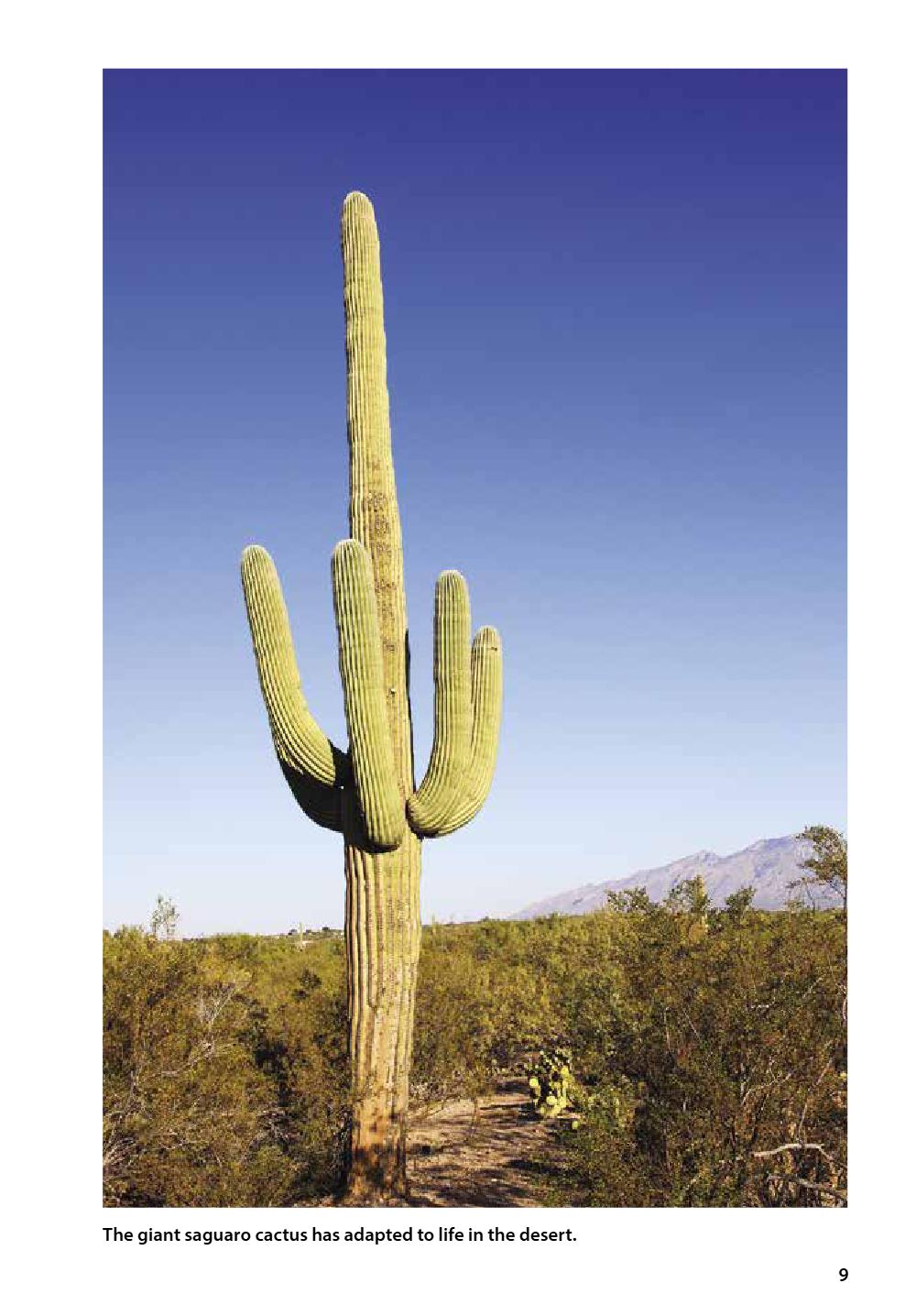
The giant saguaro (/suh*war*oh/) cactus grows in the deserts of southern
Arizona and northern Mexico. To survive in the desert, the cactus has
adapted to the environment in several ways. Its stem is fleshy and thick,
allowing it to store enormous amounts of water. It has no leaves that could
lose moisture. It also spreads its roots in a wide area near the surface of the
soil. This enables it to absorb, or take in, as much water as possible during
the infrequent rains.
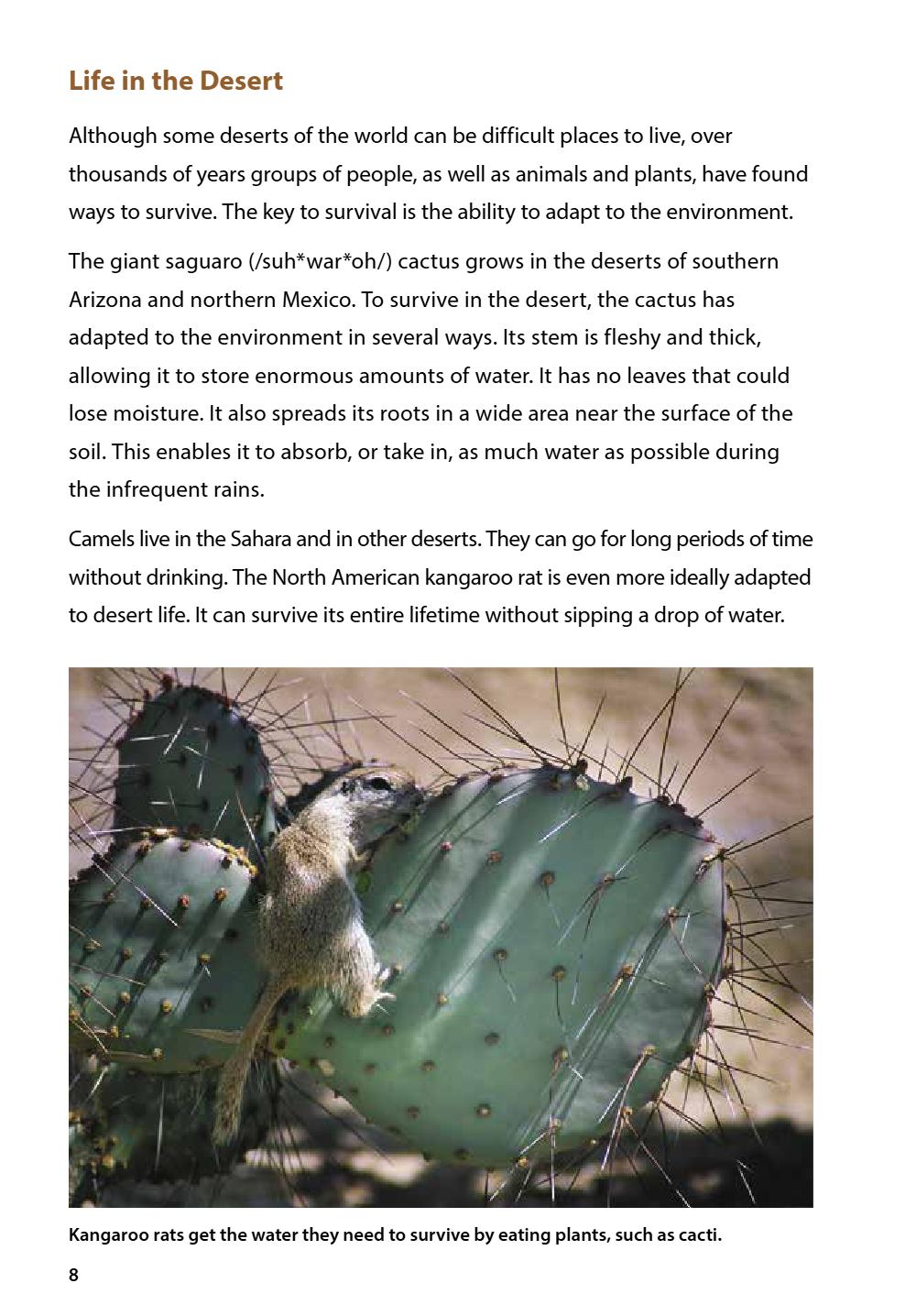
Camels live in the Sahara and in other deserts. They can go for long periods of time
without drinking. The North American kangaroo rat is even more ideally adapted
to desert life. It can survive its entire lifetime without sipping a drop of water.
Kangaroo rats get the water they need to survive by eating plants, such as cacti.
8
The giant saguaro cactus has adapted to life in the desert.
9
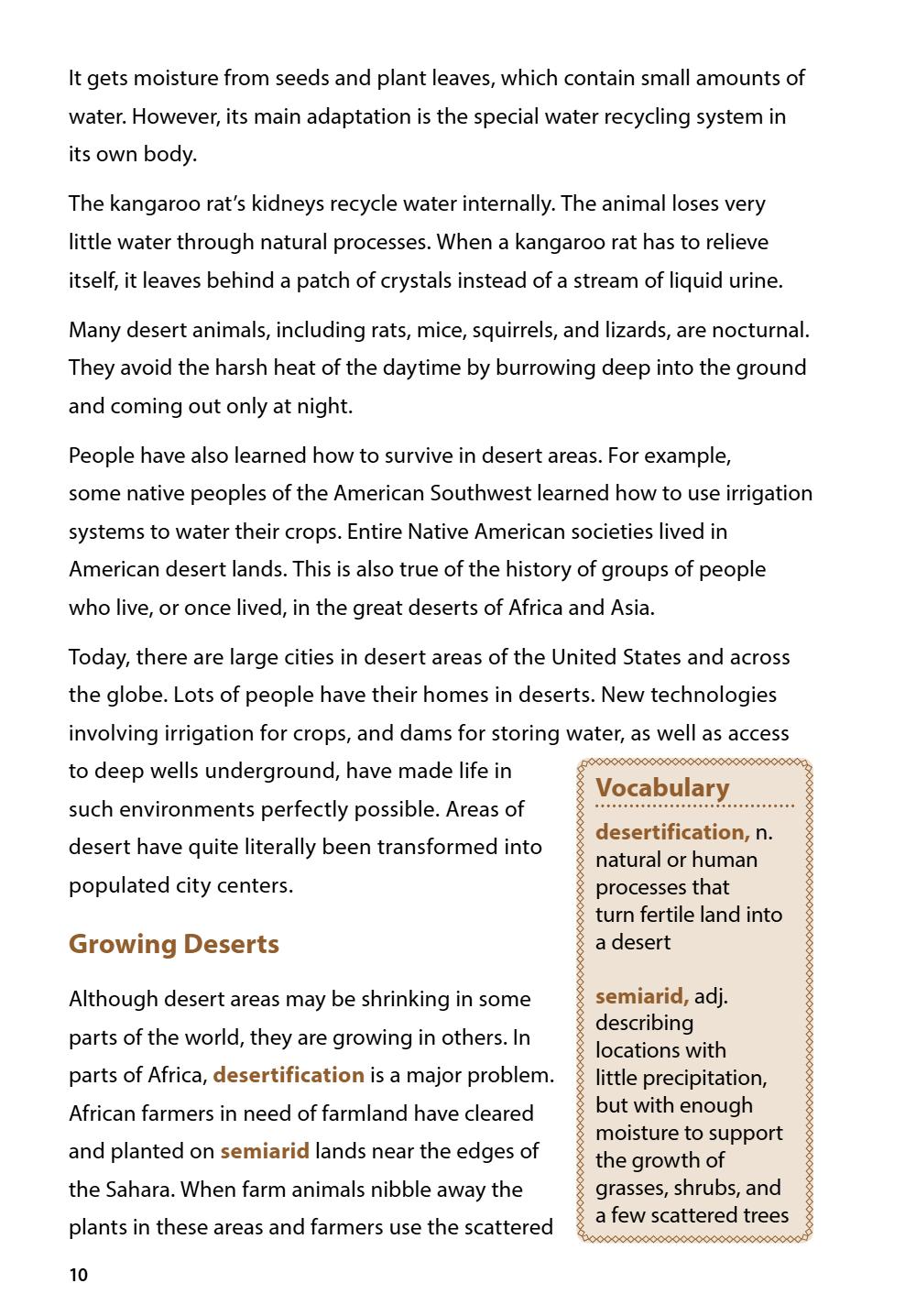
It gets moisture from seeds and plant leaves, which contain small amounts of
water. However, its main adaptation is the special water recycling system in
its own body.
The kangaroo rat’s kidneys recycle water internally. The animal loses very
little water through natural processes. When a kangaroo rat has to relieve
itself, it leaves behind a patch of crystals instead of a stream of liquid urine.
Many desert animals, including rats, mice, squirrels, and lizards, are nocturnal.
They avoid the harsh heat of the daytime by burrowing deep into the ground
and coming out only at night.
People have also learned how to survive in desert areas. For example,
some native peoples of the American Southwest learned how to use irrigation
systems to water their crops. Entire Native American societies lived in
American desert lands. This is also true of the history of groups of people
who live, or once lived, in the great deserts of Africa and Asia.
Today, there are large cities in desert areas of the United States and across
the globe. Lots of people have their homes in deserts. New technologies
involving irrigation for crops, and dams for storing water, as well as access
to deep wells underground, have made life in
such environments perfectly possible. Areas of
desert have quite literally been transformed into
populated city centers.
Growing Deserts
Although desert areas may be shrinking in some
parts of the world, they are growing in others. In
parts of Africa, desertification is a major problem.
African farmers in need of farmland have cleared
and planted on semiarid lands near the edges of
the Sahara. When farm animals nibble away the
plants in these areas and farmers use the scattered
10
Vocabulary
desertification, n.
natural or human
processes that
turn fertile land into
a desert
semiarid, adj.
describing
locations with
little precipitation,
but with enough
moisture to support
the growth of
grasses, shrubs, and
a few scattered trees
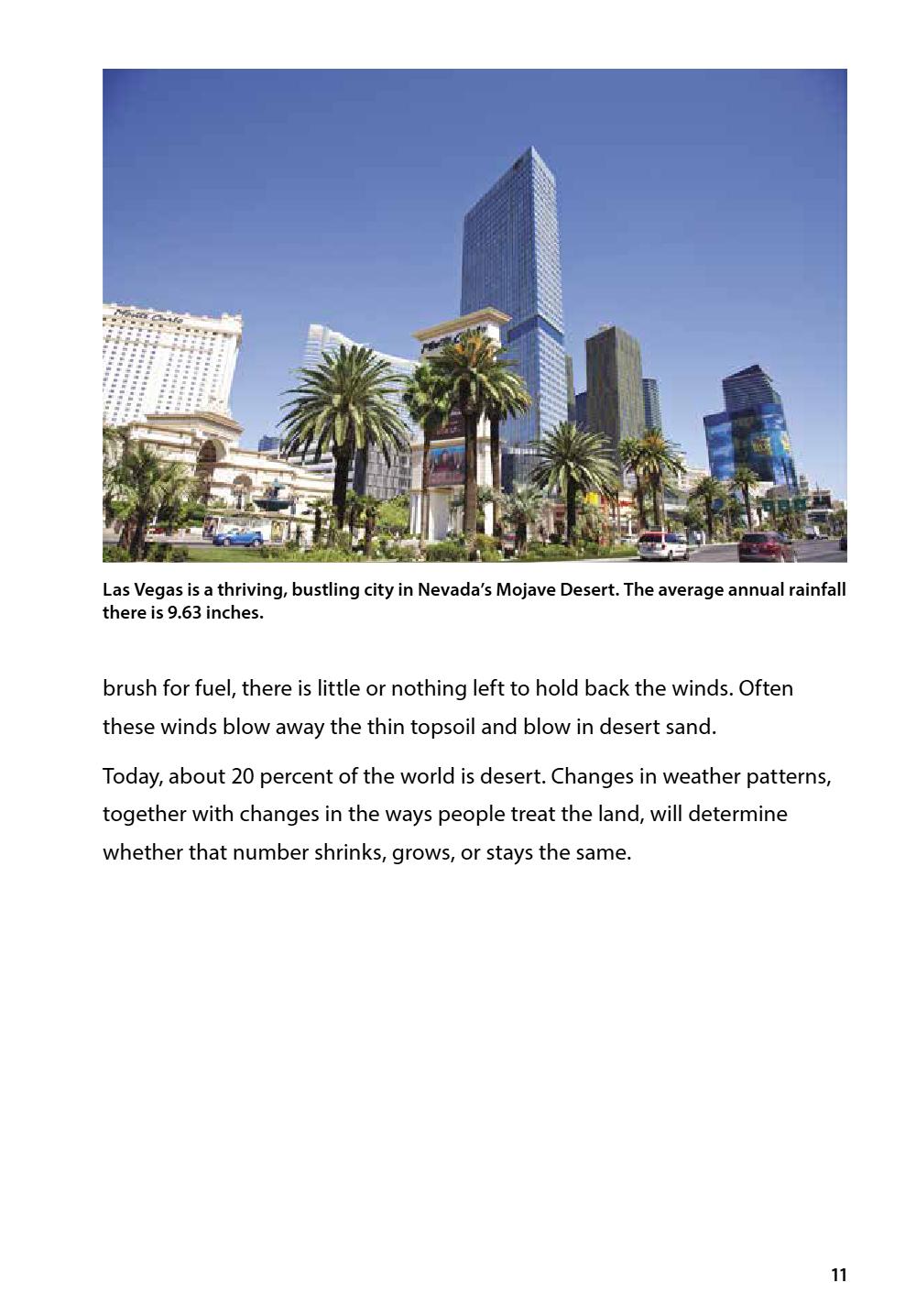
Las Vegas is a thriving, bustling city in Nevada’s Mojave Desert. The average annual rainfall
there is 9.63 inches.
brush for fuel, there is little or nothing left to hold back the winds. Often
these winds blow away the thin topsoil and blow in desert sand.
Today, about 20 percent of the world is desert. Changes in weather patterns,
together with changes in the ways people treat the land, will determine
whether that number shrinks, grows, or stays the same.
11
Talk it over
Ask these as you read or afterward. Answers for the teacher are tucked under each question.
Where are the polar deserts?
Answer
The polar deserts are in the Arctic and Antarctic region.
How do most climatologists define the word desert?
Answer
They define desert as a place where evaporation exceeds precipitation. Page 3
Why do plants and animals use only a small percentage of rainwater in the desert?
Answer
Deserts near the equator can be very hot. Deserts farther from the equator don’t get the same scorching temperatures and can get freezing cold in winter.
What feature do “hot” and “cold” deserts share?
Answer
Both “hot” and “cold” deserts experience big changes between daytime and nighttime temperatures.
How have some animals adapted to the desert?
Answer
Some animals, such as the kangaroo rat, get moisture from seeds and plant leaves or can go long periods of time without drinking water. Some animals are nocturnal and/or burrow into the ground to escape the desert heat.
How have people learned to adapt to the desert?
Answer
They have learned to use irrigation to water crops. People have also learned to use technology to transport water from other places, as well as to use dams to store water for future use.
Check for understanding
- Answer the Big Question out loud or in a sentence or two: What features determine whether an area of land is a desert?
What a good answer includes
The dryness of the land; the rate of evaporation exceeding the amount of precipitation or rainfall the area receives; a dramatic change between daytime and nighttime temperatures.
- Pick one of today’s words and use it in a sentence of your own.
Activity pages
Print these from the Teacher Guide, or have your student answer on paper.
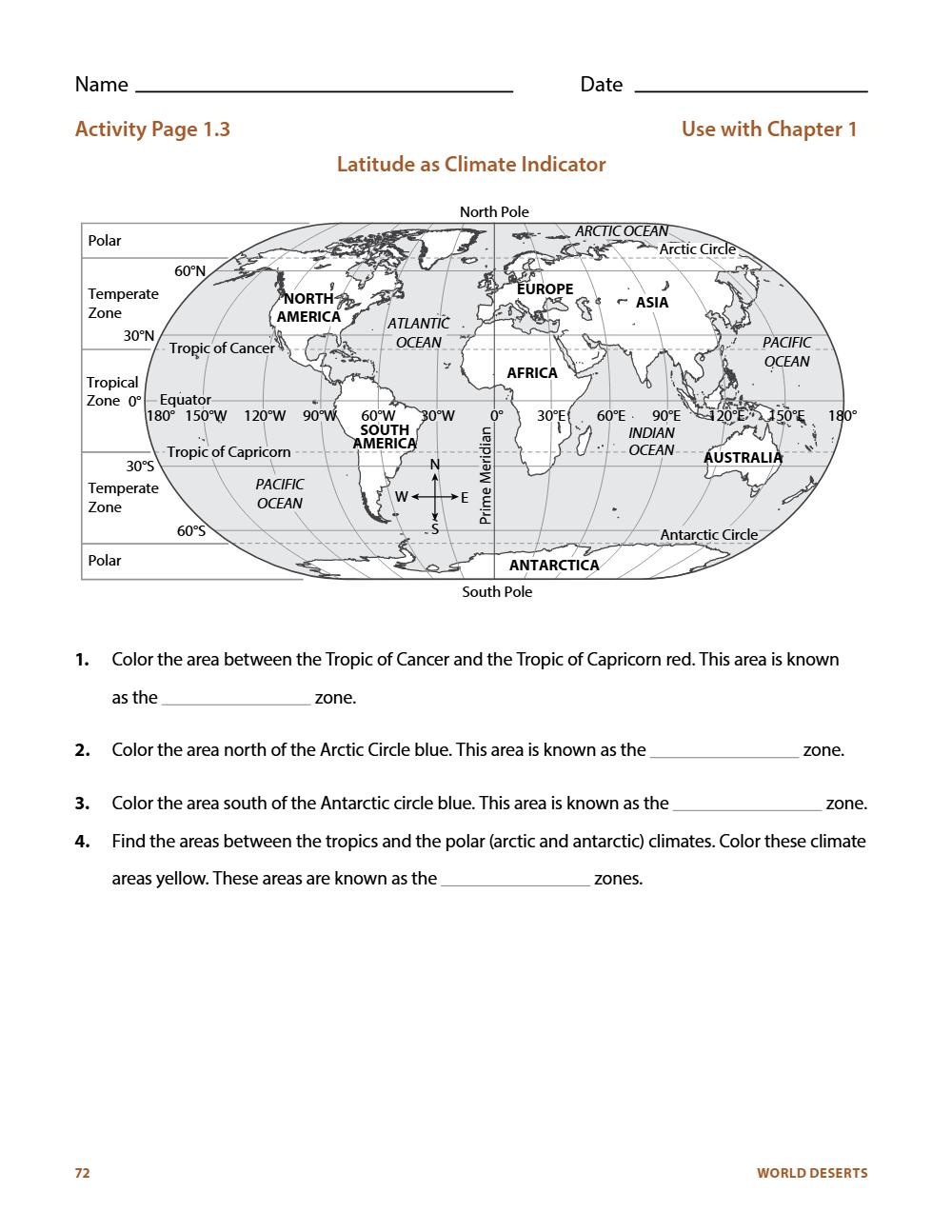
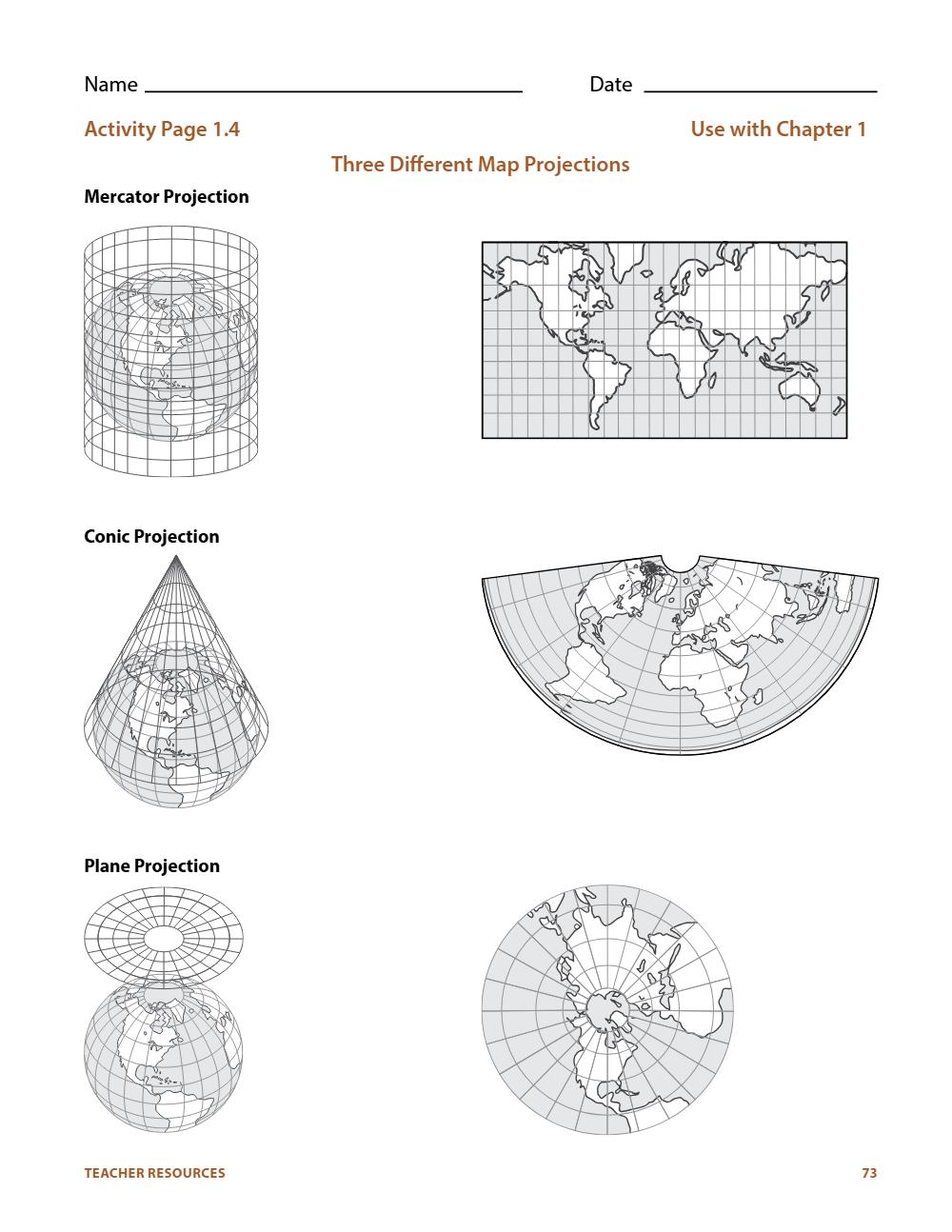
For offline study
Download these once and you can teach this unit without the internet.
This course is based on an original work of the Core Knowledge® Foundation (www.coreknowledge.org) made available through licensing under a Creative Commons Attribution-NonCommercial-ShareAlike 4.0 International License. This does not in any way imply that the Core Knowledge Foundation endorses this work. PGAMO added the lesson pages, study packs and quizzes layout, and shares them under the same license. CC BY-NC-SA 4.0 · Core Knowledge History and Geography. Free for everyone — this course may never be sold.