Grade 8 History & Geography
Study Bibles 26
Chapter 1: A Time of Great Change: Immigration, Industrialization, and Urbanization (1865–1914)
What impact did immigration, industrialization, and urbanization have on America in the late 1800s and early 1900s?
Keep this question in mind as you read. You’ll answer it at the end.Words to know
- immigration
- the act of coming to live permanently in a new countryA wave of immigration brought many people from Europe to the United States to start a new life.
- industrialization
- a shift to the widespread use of machines and factories to produce goodsIndustrialization meant people moved from farms in the country to cities to work in factories.
- urbanization
- the formation and growth of citiesThe growth of factories in cities and towns caused urbanization as people moved away from the country.
- economy
- the way a country manages its money and resources to produce, buy, and sell goods and servicesThe opening of a new factory led to a booming economy in the small town.
- discrimination
- unfair treatment of a person or group because of beliefs about that group of peopleImmigrants sometimes suffer discrimination from citizens because of their language or customs.
- malnutrition
- a state of poor health due to not having enough healthy foodTheir poor diet led to malnutrition and illness.
- synonymous
- alike in meaning, like a synonymHaving fun shouldn’t be synonymous with getting in trouble.
- political economy
- the combination or interaction of economy and governmentTo describe a country as “capitalist” or “socialist” is to describe its political economy.
- capitalism
- an economic system in which resources and businesses are privately owned and prices are not controlled by the governmentCapitalism is the primary economic system in the United States.
- public policy
- a set of government steps for how something is doneThe Affordable Care Act is public policy that provides health care to Americans.
- agrarian
- relating to farming or agricultureAn agrarian society focuses on farming as a way to make a living.
- injunction
- a court order that specifies an action a person or group must or must not takeThe judge issued an injunction against the group that had been harassing and threatening workers.
- invalidate
- to prove incorrect or illegalThe will proved that he inherited the farm and invalidated his cousin’s claim on it.
- entrepreneur
- a person who starts a businessThe entrepreneur began selling fish at the local farmers markets.
- free enterprise
- the freedom of businesses to operate without government interferenceIn a free enterprise system, the government does not require businesses to follow safety rules.
- regulate
- to control or place limits onGovernments regulate industry to ensure that certain safety and environmental measures are followed.
- populism
- a political movement in the 1890s that claimed to represent ordinary peoplePopulism appealed to some ordinary working people.
- inflation
- a rise in prices and a fall in the purchasing value of moneyBecause of inflation, the price of a loaf of bread is much higher than it was only months ago. A HISTORY OF THE UNITED STATES: MODERN TIMES—LATE 1800s TO THE 2000s
Read: Chapter 1, “A Time of Great Change: Immigration, Industrialization, and Urbanization (1865–1914)”
Read it aloud together, or let your student read on their own. Pictures and maps are part of the lesson — talk about them too.
Text version (for read-aloud apps and screen readers)
Chapter 1
A Time of Great Change:
Immigration,
Industrialization,
and Urbanization
(1865–1914)
The Big Question
What impact did immigration,
industrialization, and
urbanization have on America in
the late 1800s and early 1900s?
The Transformation
The United States saw expansive
economic growth and dynamic
social change in the decades
following the American Civil War.
In the half century from the end of
that war in 1865 to the beginning
of the First World War in 1914,
the nation was transformed by
immigration, industrialization,
and urbanization.
Vocabulary
immigration, n. the act of coming to live
permanently in a new country
industrialization, n. a shift to the
widespread use of machines and
factories to produce goods
urbanization, n. the formation and
growth of cities
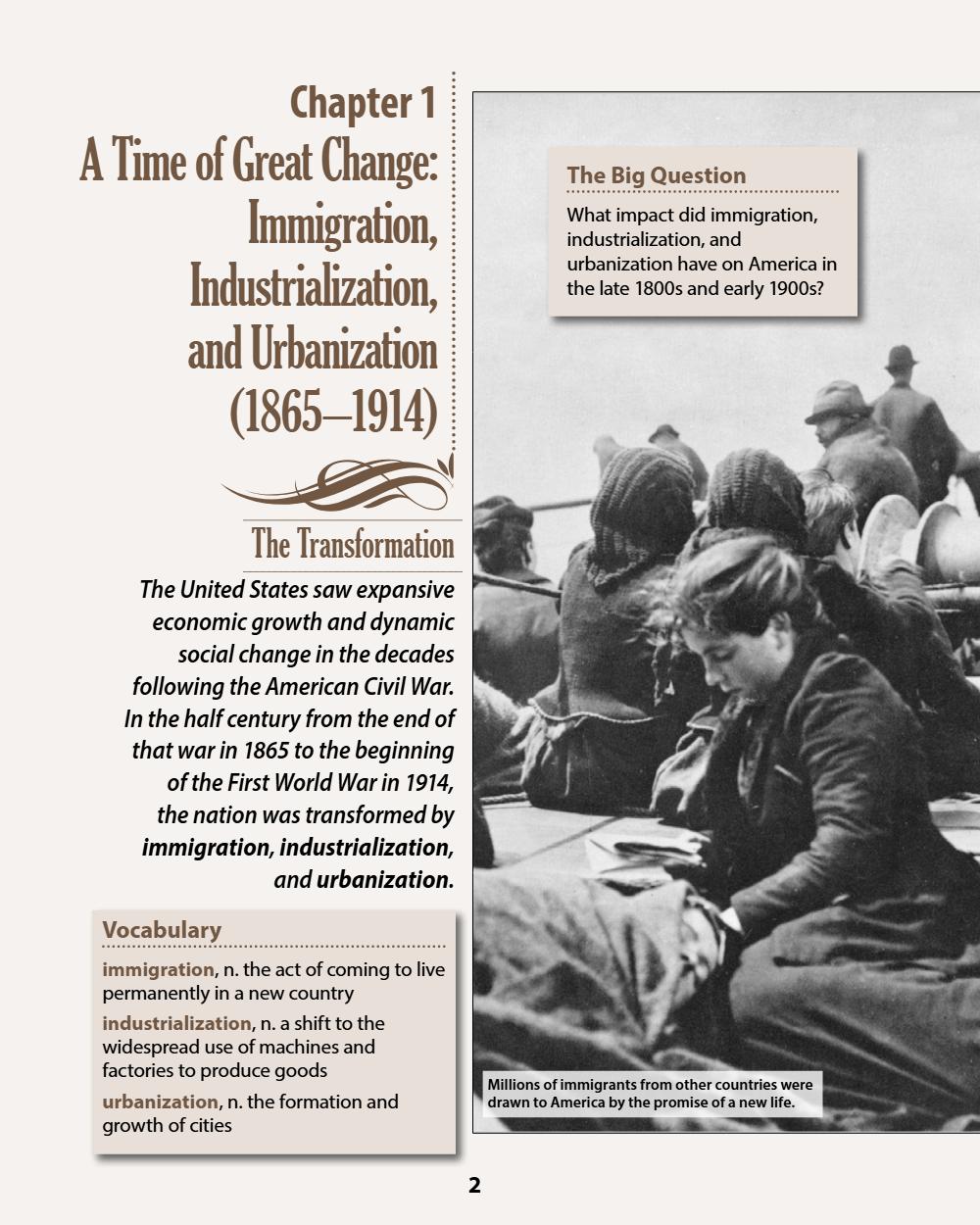
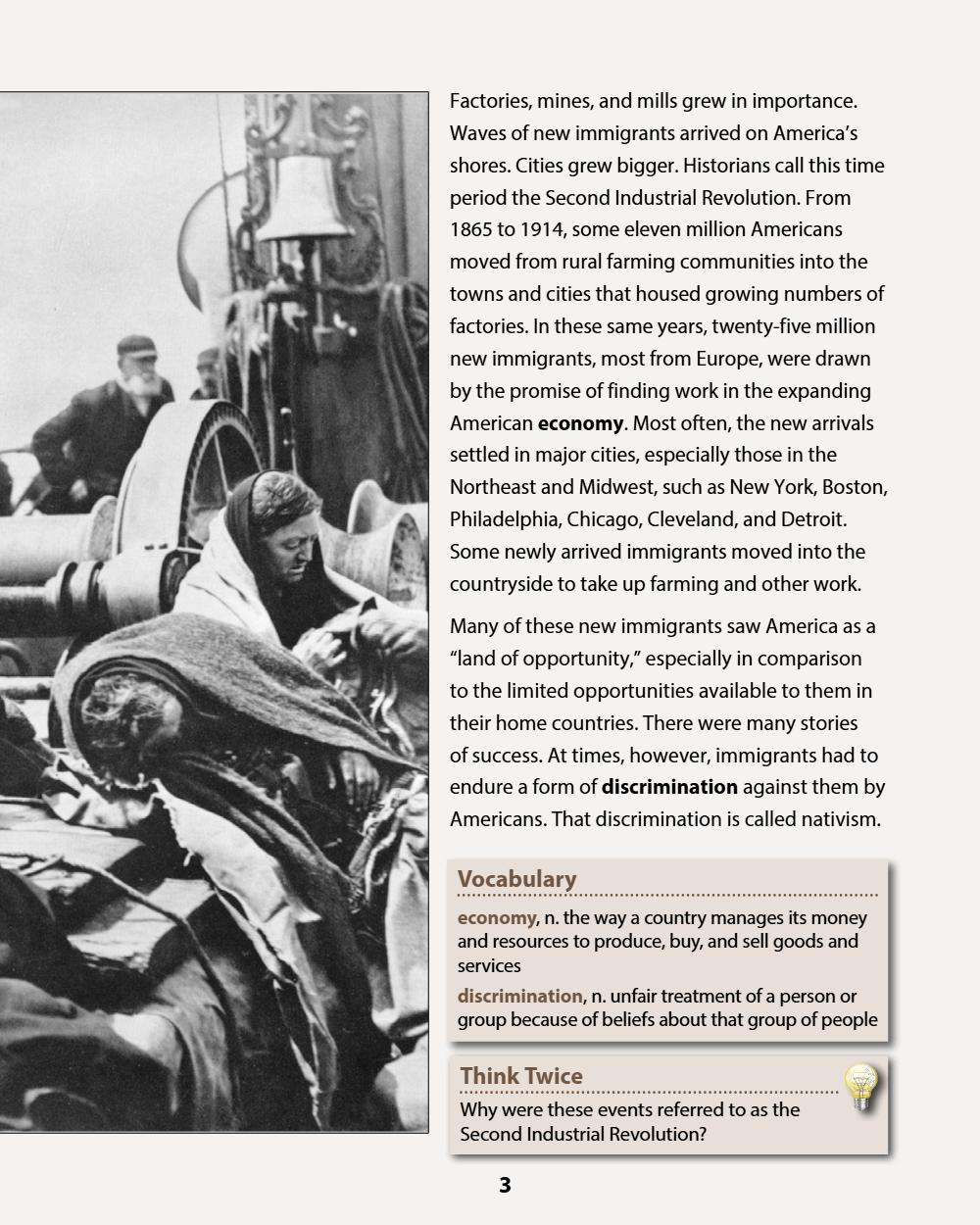
Millions of immigrants from other countries were
drawn to America by the promise of a new life.
2
Factories, mines, and mills grew in importance.
Waves of new immigrants arrived on America’s
shores. Cities grew bigger. Historians call this time
period the Second Industrial Revolution. From
1865 to 1914, some eleven million Americans
moved from rural farming communities into the
towns and cities that housed growing numbers of
factories. In these same years, twenty-five million
new immigrants, most from Europe, were drawn
by the promise of finding work in the expanding
American economy. Most often, the new arrivals
settled in major cities, especially those in the
Northeast and Midwest, such as New York, Boston,
Philadelphia, Chicago, Cleveland, and Detroit.
Some newly arrived immigrants moved into the
countryside to take up farming and other work.
Many of these new immigrants saw America as a
“land of opportunity,” especially in comparison
to the limited opportunities available to them in
their home countries. There were many stories
of success. At times, however, immigrants had to
endure a form of discrimination against them by
Americans. That discrimination is called nativism.
Vocabulary
economy, n. the way a country manages its money
and resources to produce, buy, and sell goods and
services
discrimination, n. unfair treatment of a person or
group because of beliefs about that group of people
Think Twice
Why were these events referred to as the
Second Industrial Revolution?
3
Melting Pot
its debut, first in Washington, D.C., and
Irish and German Immigration in
the 1900s
then in New York City. The play’s title
Immigrants coming to America were
In 1908, a play by the playwright Israel
Zangwill titled The Melting Pot made
popularized a metaphor about American
sometimes “pushed” to leave their home
immigration: America was a “melting
country because of poverty, religious
pot.” But, some people asked, what
persecution, or political unrest. They were
does calling the United States a melting
also “pulled” to America by the promise of
pot actually mean? Is the “melting pot”
economic opportunity, religious freedom,
one in which new immigrants’ cultures
and political democracy. In the years
are melted—absorbed—by America’s
from the mid-1800s to the early 1900s, as
traditional cultures? Or is the image of
today, there were push and pull factors
a melting pot meant to call forth ideas
in immigration. Many newly arrived
of immigrant and American cultures
immigrants found America to be a land
blending together, with each culture,
of great opportunity, even as they had
in some ways, melting into and taking
to endure hardships. Some Americans
on characteristics of the others? Some
welcomed the new arrivals, but other
scholars think that “salad bowl” or
Americans were anti-immigrant; they
“mosaic” is a more accurate metaphor.
were not happy with the arrival of so
The vegetables in the salad or the pieces
many foreigners.
of tile in a mosaic each retain their own
Think Twice
character.
What home-grown reasons drove
immigration to the United States of
America?
Think Twice
What metaphor would you use
to describe America in relation to
immigration, not only in terms of its past,
but today as well?
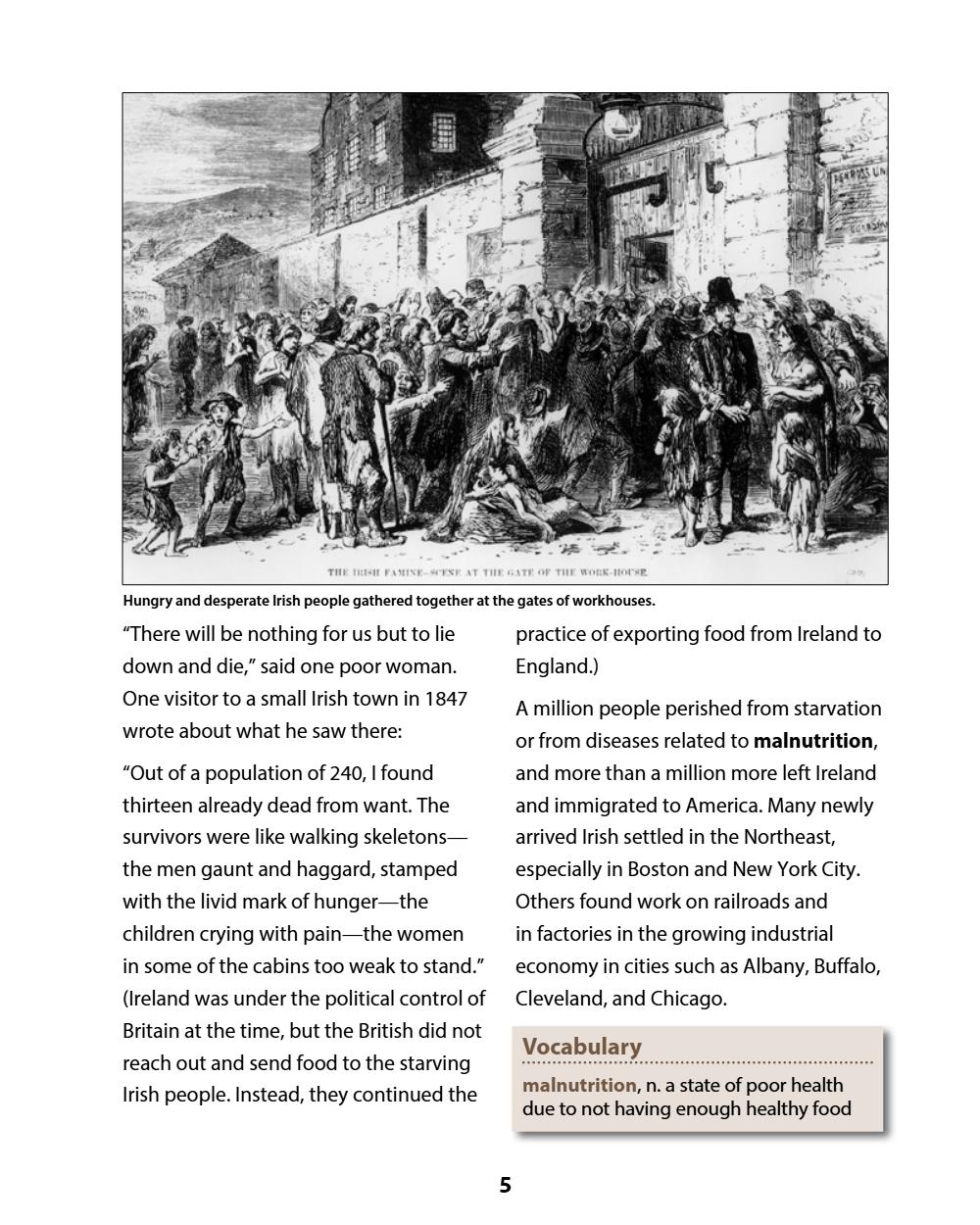
One example of being pushed to leave a
country occurred in Ireland. For several
years, beginning in 1845, disaster struck
Ireland when a plant disease known as
potato blight wiped out nearly the entire
potato crop. Starvation was everywhere.
4
Hungry and desperate Irish people gathered together at the gates of workhouses.
“There will be nothing for us but to lie
practice of exporting food from Ireland to
down and die,” said one poor woman.
England.)
One visitor to a small Irish town in 1847
A million people perished from starvation
wrote about what he saw there:
or from diseases related to malnutrition,
“Out of a population of 240, I found
and more than a million more left Ireland
thirteen already dead from want. The
and immigrated to America. Many newly
survivors were like walking skeletons—
arrived Irish settled in the Northeast,
the men gaunt and haggard, stamped
especially in Boston and New York City.
with the livid mark of hunger—the
Others found work on railroads and
children crying with pain—the women
in factories in the growing industrial
in some of the cabins too weak to stand.”
economy in cities such as Albany, Buffalo,
(Ireland was under the political control of
Cleveland, and Chicago.
Britain at the time, but the British did not
Vocabulary
reach out and send food to the starving
malnutrition, n. a state of poor health
due to not having enough healthy food
Irish people. Instead, they continued the
5
In the decade after 1845, more than
who were seeking to escape poverty
a million Germans immigrated to the
and religious persecution in Europe.
United States. Many German immigrants
(In Europe, Jewish people were often
were farmers and laborers in search
required to live in cramped areas called
of greater economic opportunity and
ghettos. Some ghettos were fenced-in
better jobs. They settled on farms across
streets in a city called a Judengasse. In
the Midwest and also in cities, including
some places, Jewish people were only
Cincinnati, Milwaukee, and St. Louis.
allowed to travel outside the ghetto into
Other Germans fled to the United States
other parts of a city at specific times or on
after the Revolutions of 1848 failed to
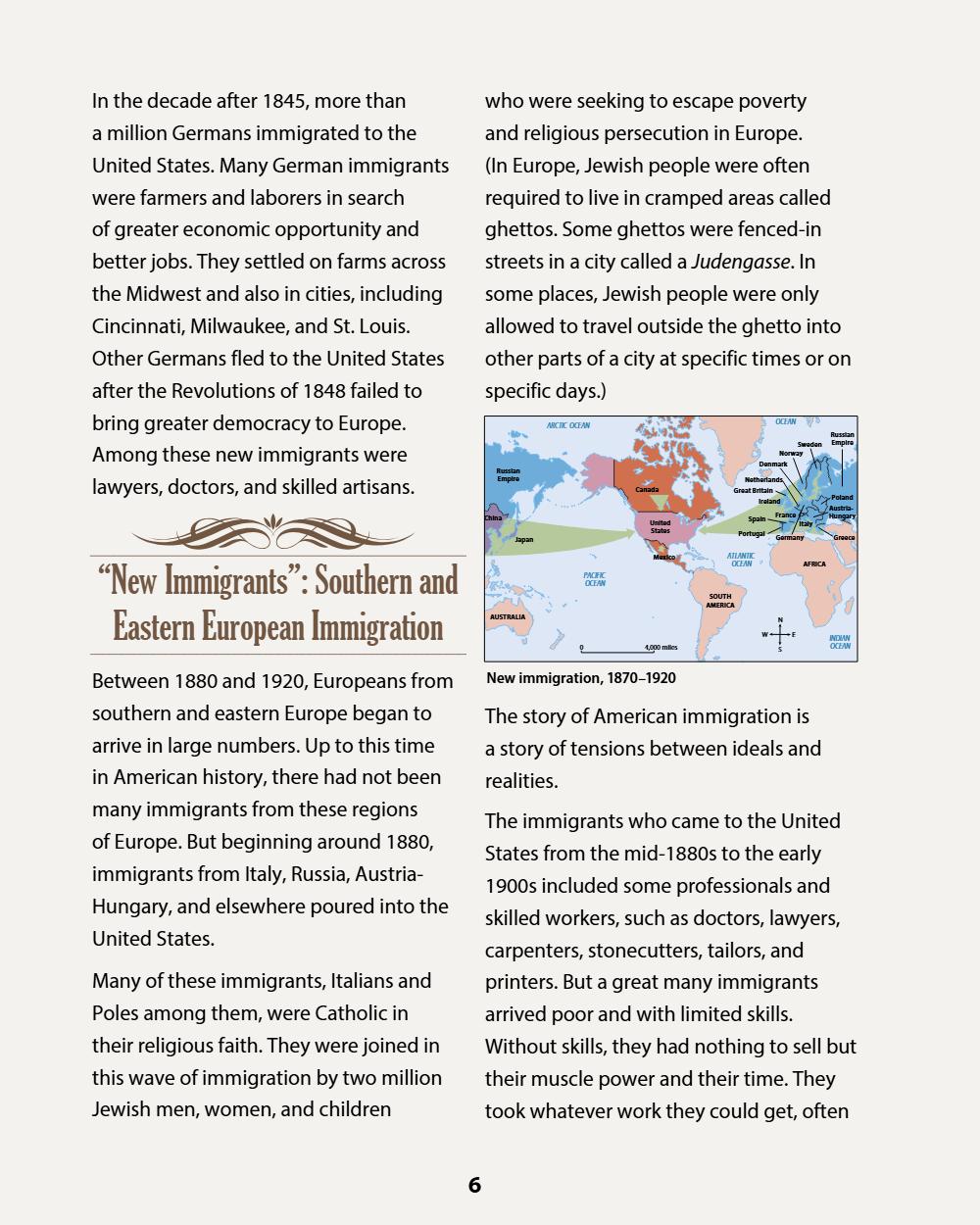
New Immigration, 1870–1920
specific days.)
bring greater democracy to Europe.
ARCTIC
OCEAN
ARCTIC OCEAN
Among these new immigrants were
Sweden
Norway
Denmark
Russian
Empire
lawyers, doctors, and skilled artisans.
Netherlands
Canada
Great Britain
Poland
Ireland
China
Spain
United
States
Japan
Mexico
“New Immigrants”: Southern and
Eastern European Immigration
Russian
Empire
Portugal
France
Italy
AustriaHungary
Germany
ATLANTIC
OCEAN
Greece
AFRICA
PACIFIC
OCEAN
SOUTH
AMERICA
AUSTRALIA
N
W
0
4,000 miles
E
S
Between 1880 and 1920, Europeans from
New immigration, 1870–1920
southern and eastern Europe began to
The story of American immigration is
arrive in large numbers. Up to this time
a story of tensions between ideals and
in American history, there had not been
realities.
many immigrants from these regions
INDIAN
OCEAN
The immigrants who came to the United
of Europe. But beginning around 1880,
States from the mid-1880s to the early
immigrants from Italy, Russia, Austria-
1900s included some professionals and
Hungary, and elsewhere poured into the
skilled workers, such as doctors, lawyers,
United States.
carpenters, stonecutters, tailors, and
Many of these immigrants, Italians and
printers. But a great many immigrants
Poles among them, were Catholic in
arrived poor and with limited skills.
their religious faith. They were joined in
Without skills, they had nothing to sell but
this wave of immigration by two million
their muscle power and their time. They
Jewish men, women, and children
took whatever work they could get, often
6
at low pay. Immigrant women found
work as maids, cooks, housekeepers, or
washer women. Immigrant men found
work sweeping streets, hauling trash,
digging ditches, or selling food from carts
as street vendors. In cities, immigrant
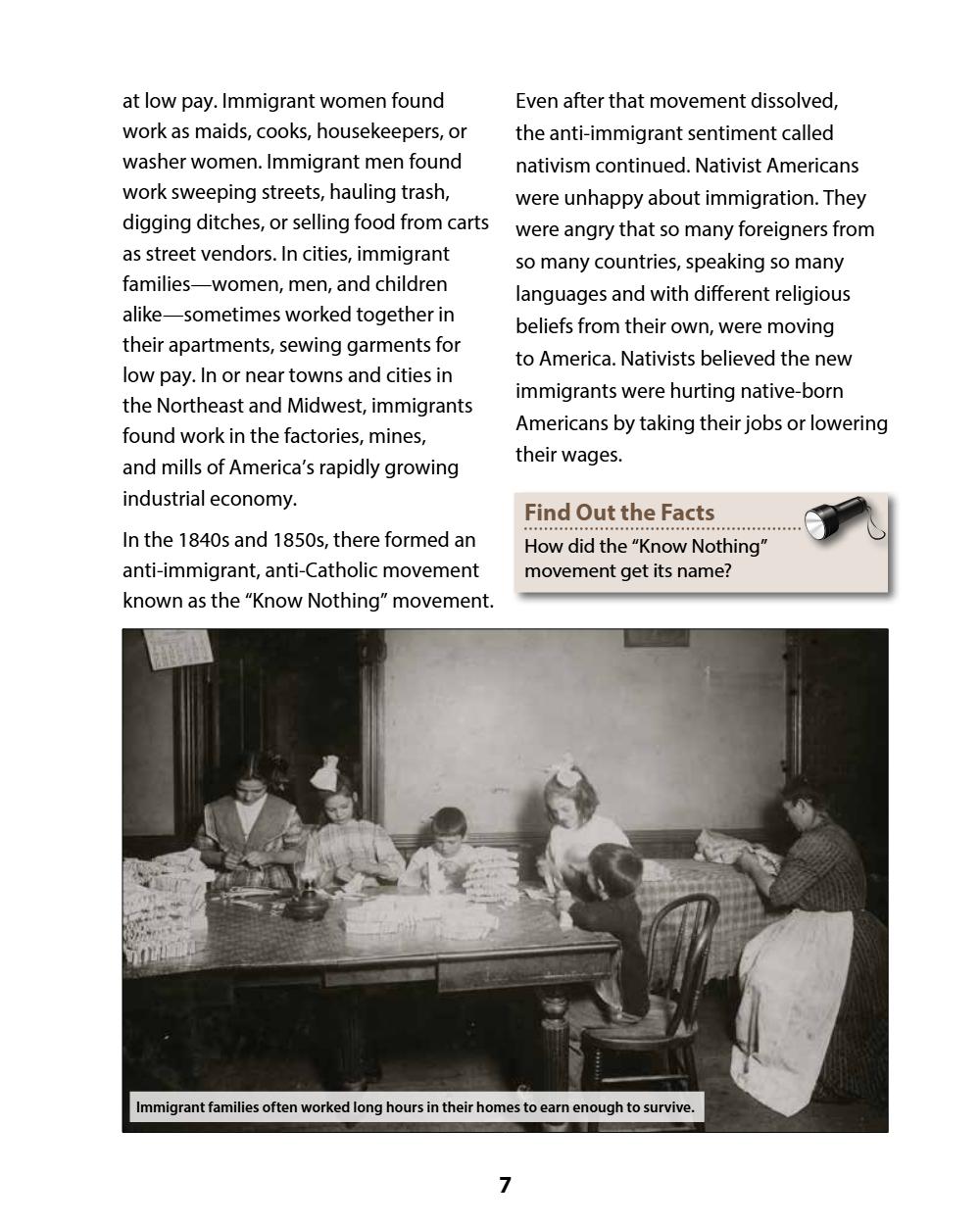
families—women, men, and children
alike—sometimes worked together in
their apartments, sewing garments for
low pay. In or near towns and cities in
the Northeast and Midwest, immigrants
found work in the factories, mines,
and mills of America’s rapidly growing
Even after that movement dissolved,
the anti-immigrant sentiment called
nativism continued. Nativist Americans
were unhappy about immigration. They
were angry that so many foreigners from
so many countries, speaking so many
languages and with different religious
beliefs from their own, were moving
to America. Nativists believed the new
immigrants were hurting native-born
Americans by taking their jobs or lowering
their wages.
industrial economy.
Find Out the Facts
In the 1840s and 1850s, there formed an
anti-immigrant, anti-Catholic movement
known as the “Know Nothing” movement.
How did the “Know Nothing”
movement get its name?
Immigrant families often worked long hours in their homes to earn enough to survive.
7
The issue of religion was also important.
were able to elect people of Irish heritage
Beginning in colonial times, most
to the city council and the mayor’s office.
Americans were Protestants in their
Soon, Boston and New York were hiring
religious faith. But many of the new
many Irish police officers, firefighters, and
arrivals—including many Irish, Italian,
civil servants.
Slavic, and German immigrants—were
Think Twice
Catholics. Catholics had different ways of
How might having political power
change an immigrant group’s experience?
practicing their Christian faith than did
Protestant Americans. Protestants were
wary of Catholics.
Religious tensions in the late 1800s
sometimes arose in public schools. At this
A Mighty Woman with a Torch
time in America, students were required
In the late 1800s, millions of immigrants
to read passages from the Bible during
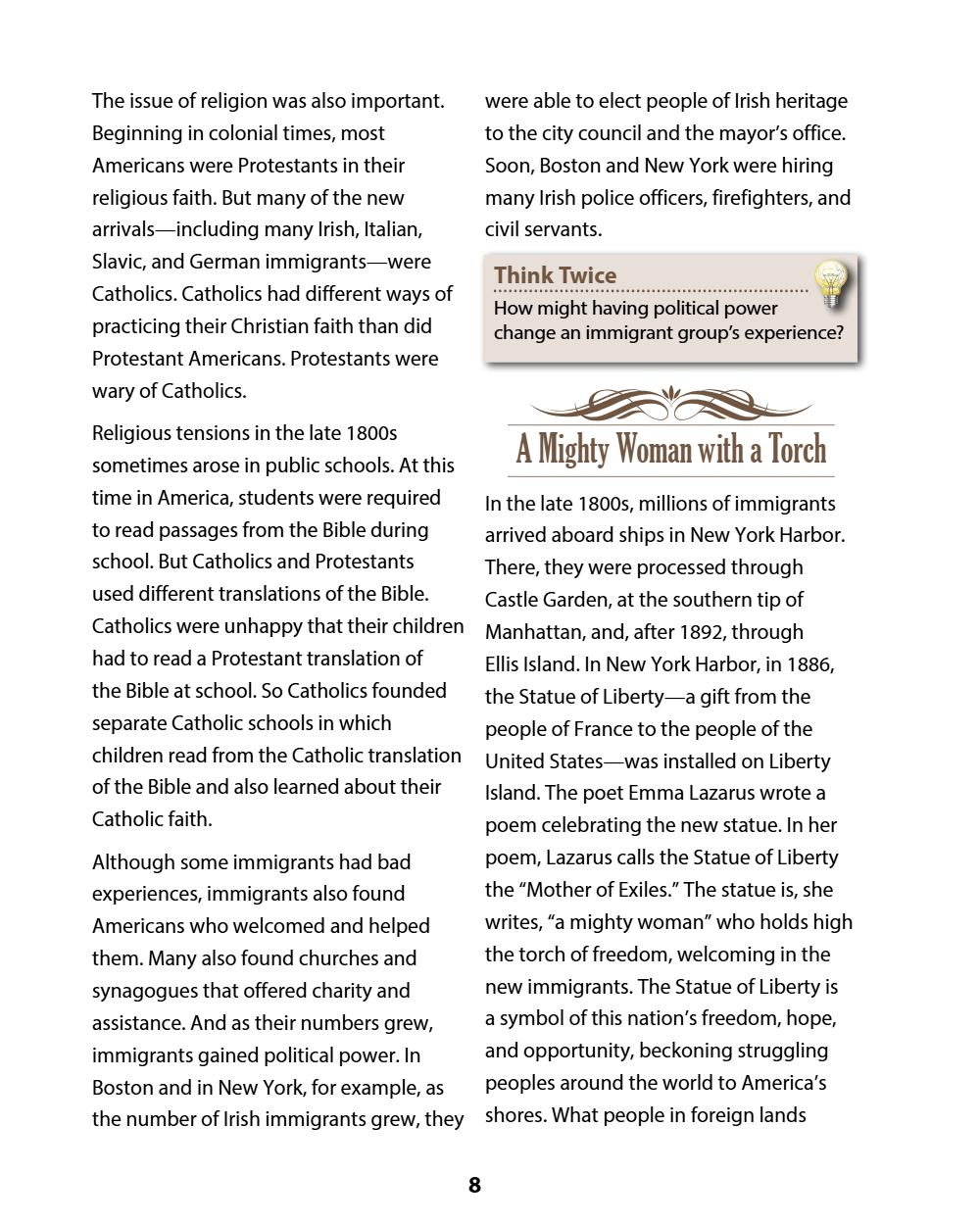
arrived aboard ships in New York Harbor.
school. But Catholics and Protestants
There, they were processed through
used different translations of the Bible.
Castle Garden, at the southern tip of
Catholics were unhappy that their children Manhattan, and, after 1892, through
had to read a Protestant translation of
Ellis Island. In New York Harbor, in 1886,
the Bible at school. So Catholics founded
the Statue of Liberty—a gift from the
separate Catholic schools in which
people of France to the people of the
children read from the Catholic translation
United States—was installed on Liberty
of the Bible and also learned about their
Island. The poet Emma Lazarus wrote a
Catholic faith.
poem celebrating the new statue. In her
Although some immigrants had bad
poem, Lazarus calls the Statue of Liberty
experiences, immigrants also found
the “Mother of Exiles.” The statue is, she
Americans who welcomed and helped
writes, “a mighty woman” who holds high
them. Many also found churches and
the torch of freedom, welcoming in the
synagogues that offered charity and
new immigrants. The Statue of Liberty is
assistance. And as their numbers grew,
a symbol of this nation’s freedom, hope,
immigrants gained political power. In
and opportunity, beckoning struggling
Boston and in New York, for example, as
peoples around the world to America’s
the number of Irish immigrants grew, they shores. What people in foreign lands
8
consider their “wretched refuse,” the
United States welcomes. The final lines of
The Chinese Exclusion Act
her poem read:
Give me your tired, your poor,
Chinese immigrants settling in the United
Your huddled masses yearning to breathe free,
States encountered their own version
The wretched refuse of your teeming shore.
of prejudice against immigrants. By
Send these, the homeless, tempest-tost to me,
1880, more than one hundred thousand
I lift my lamp beside the golden door!
Chinese people lived in the United States.
Nearly all of them lived on the West
Coast. They found work laying railway
tracks for the nation’s expanding western
railroads or working in factories and gold
fields. Chinese immigrants were different
from most native-born Americans.
They often dressed differently, the men
sometimes wore long pigtails, and they
had different religious practices than
native-born Americans. These immigrants
encountered prejudice and even violence.
In fact, prejudice against Chinese people
was so fierce that in 1882, the United
States Congress passed the Chinese
Exclusion Act, a law that banned further
Chinese immigration.
European immigrants passing the Statue of Liberty in
New York Harbor, 1892
Find Out the Facts
Find out more about the
Chinese Exclusion Act and what
it actually said.
Writers’ Corner
Imagine you are an immigrant on a
crowded ship as it sails into New York
Harbor. You catch your first glimpse of
the Statue of Liberty and also the city
of New York in the distance. Write
a descriptive paragraph about
what you see and how you feel.
9
Black Americans Move North
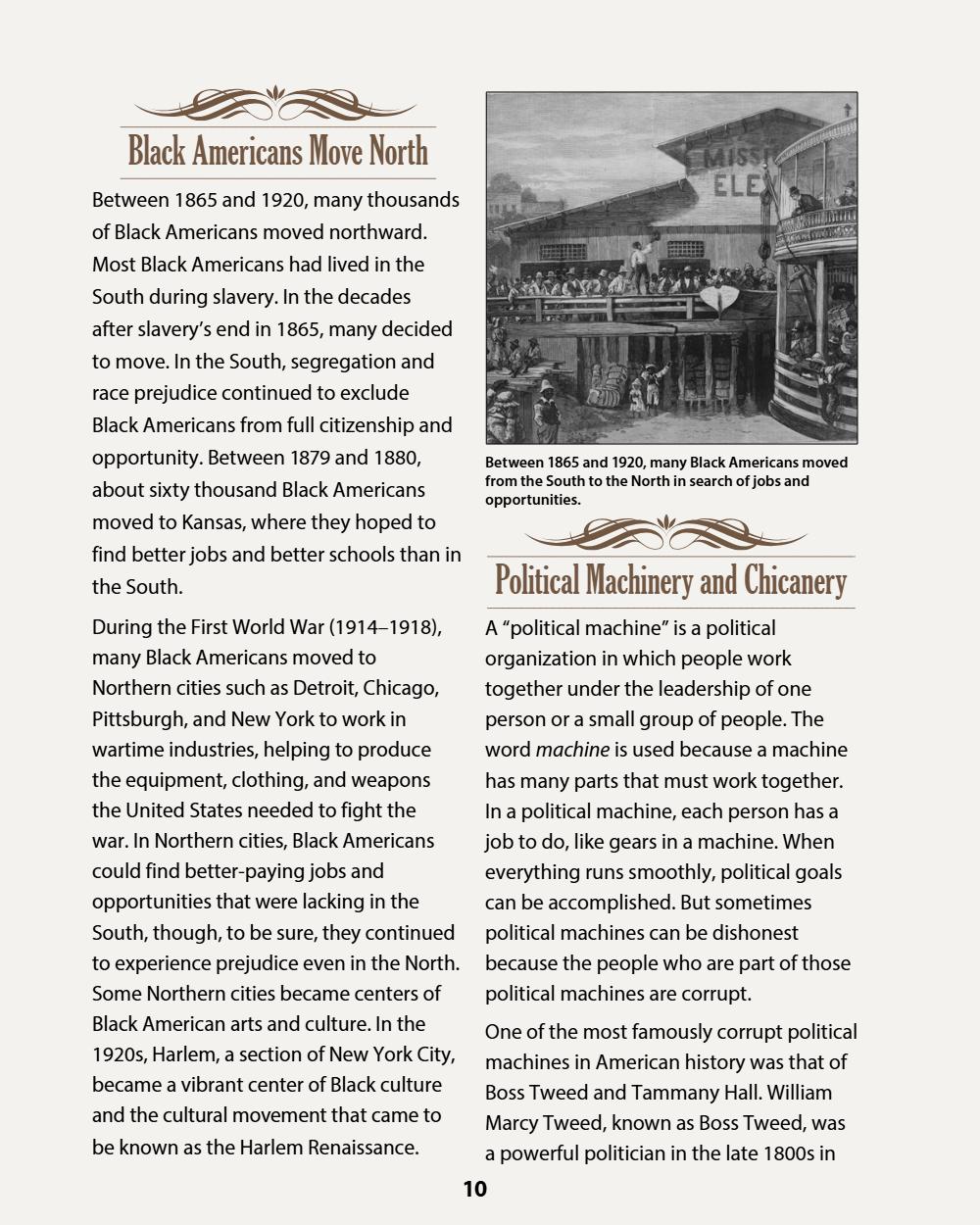
Between 1865 and 1920, many thousands
of Black Americans moved northward.
Most Black Americans had lived in the
South during slavery. In the decades
after slavery’s end in 1865, many decided
to move. In the South, segregation and
race prejudice continued to exclude
Black Americans from full citizenship and
opportunity. Between 1879 and 1880,
about sixty thousand Black Americans
Between 1865 and 1920, many Black Americans moved
from the South to the North in search of jobs and
opportunities.
moved to Kansas, where they hoped to
find better jobs and better schools than in
Political Machinery and Chicanery
the South.
During the First World War (1914–1918),
many Black Americans moved to
Northern cities such as Detroit, Chicago,
Pittsburgh, and New York to work in
wartime industries, helping to produce
the equipment, clothing, and weapons
the United States needed to fight the
war. In Northern cities, Black Americans
could find better-paying jobs and
opportunities that were lacking in the
South, though, to be sure, they continued
to experience prejudice even in the North.
Some Northern cities became centers of
Black American arts and culture. In the
1920s, Harlem, a section of New York City,
became a vibrant center of Black culture
and the cultural movement that came to
be known as the Harlem Renaissance.
A “political machine” is a political
organization in which people work
together under the leadership of one
person or a small group of people. The
word machine is used because a machine
has many parts that must work together.
In a political machine, each person has a
job to do, like gears in a machine. When
everything runs smoothly, political goals
can be accomplished. But sometimes
political machines can be dishonest
because the people who are part of those
political machines are corrupt.
One of the most famously corrupt political
machines in American history was that of
Boss Tweed and Tammany Hall. William
Marcy Tweed, known as Boss Tweed, was
a powerful politician in the late 1800s in
10
New York City, and he was one of the
leaders of the Tammany Hall political
machine. Boss Tweed and his men stole
millions of dollars from New York City’s
government, and they bribed people to
help them do it. They used all sorts of
tricks and lies. But finally, Boss Tweed
and the men who worked with him were
caught. Tweed was put in jail. He died in
the Ludlow Street Jail in New York City in
1878, at the age of fifty-five.
Americans worked in non-agricultural
Political machines can also work to
of economy and government “political
achieve positive things. Some historians
economy,” and it was America’s political
even point to ways in which Boss Tweed
economy that made it the wealthiest
and Tammany Hall helped the poor
country in the world—as it still is today.
and aided business
development. But
whatever good Boss
Tweed’s ring may have
done, his name remains
synonymous with
political corruption.
jobs than in agricultural ones. By the
1910s, American industry was producing a
third of the world’s manufactured goods.
That last sentence is something to think
about. The United States had become the
richest country in the world! American
commercial society, in combination with
the country’s representative democracy,
had given rise to astonishing economic
growth. Scholars call the combination
How exactly did this
Vocabulary
synonymous
(/sih*na*nuh*muss/), adj. alike in
meaning, like a synonym
political economy, n. the
combination or interaction of
economy and government
and mills grew rapidly. By 1880, more
The increasing number
of factories gave rise to
a vast expansion in the
amount and variety of
goods produced.
Think Twice
Rapid Growth: The Second
Industrial Revolution
Before the Civil War, most Americans
were farmers. In the early 1800s, there
were some factories, mostly cloth-making
factories in New England. However, after
1865, the number of factories, mines,
happen?
Do you think such rapid growth could
have happened without millions of
immigrants working in America?
Machines did all sorts of work. Some
machines spun thread and wove cloth.
Sewing machines stitched pieces of cloth
into shirts, pants, and dresses. Other
machines made pins, needles, and nails.
11
Machines were used to make typewriters
one person undertaking each step in
for homes and offices and mechanical
the process. As machine production
harvesters to help farmers in their fields.
output increased, labor costs per unit fell.
The telephone was invented in 1876 and
Industrialization made possible an ever-
the automobile in 1886. Soon, factories
increasing abundance of goods at lower
were producing phones and motor
prices.
vehicles of all sorts. Furthermore, in 1882,
the first electricity-generating power
station was built by Thomas Edison in
lower Manhattan. Within several years,
with Nikola Tesla’s alternating-current
power plants, electricity and electric
motors were replacing steam-powered
factories.
Innovation, engineering, and ingenuity
were transforming the production of
all sorts of things. Machines increased
output and lowered labor costs for each
unit of production. Where once it took
an individual worker a day to make one
pair of shoes, machines and assemblyline production streamlined the process.
In the newly emergent machine-assisted
production process, a worker might sit
for hours at a leather-stitching machine
stitching leather soles to “uppers.”
Another worker would focus on putting
holes and grommets where the shoes
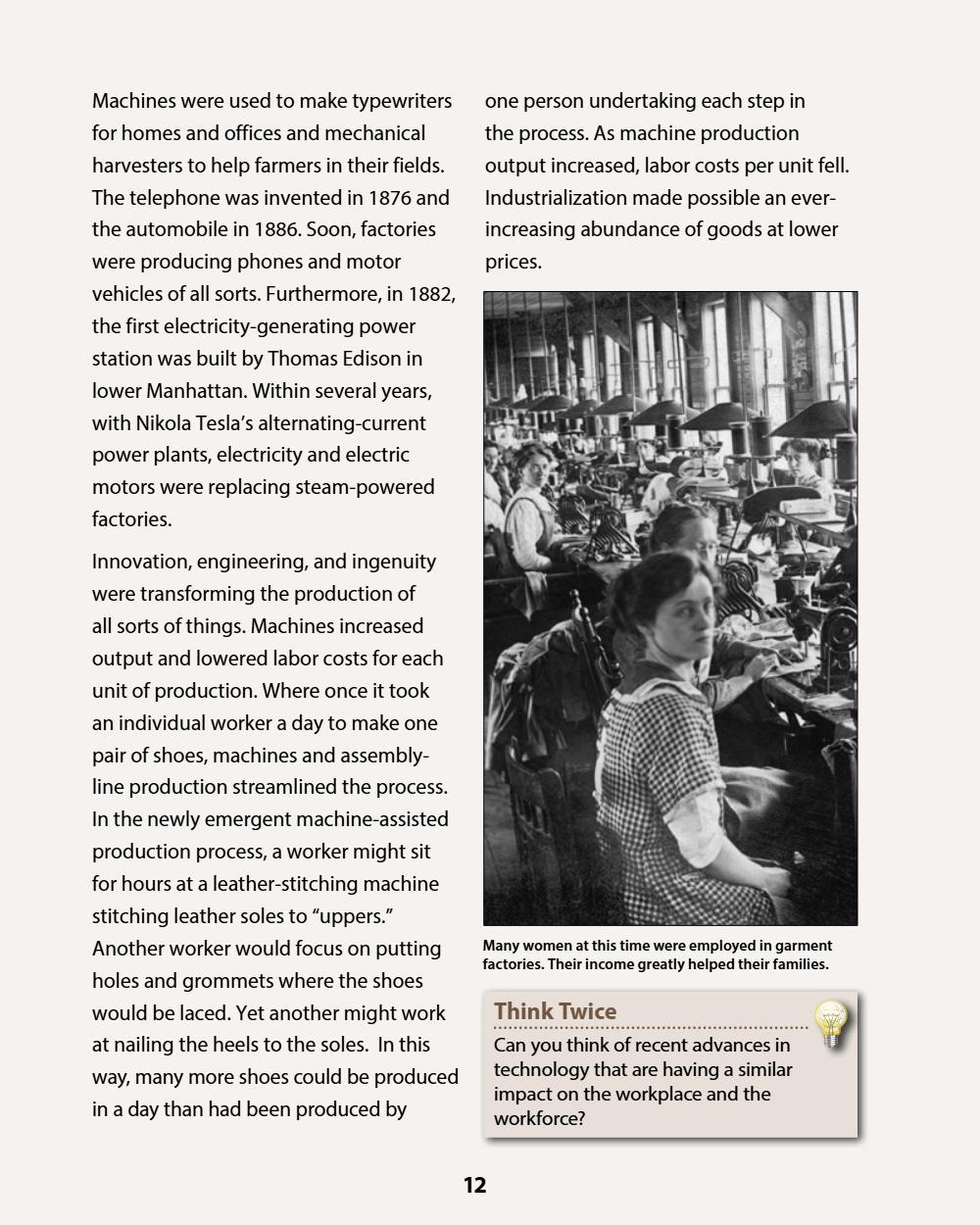
Many women at this time were employed in garment
factories. Their income greatly helped their families.
would be laced. Yet another might work
Think Twice
at nailing the heels to the soles. In this
Can you think of recent advances in
technology that are having a similar
impact on the workplace and the
workforce?
way, many more shoes could be produced
in a day than had been produced by
12
Gilded Age
In 1873, Mark Twain coauthored a novel
titled The Gilded Age: A Tale of Today.
Historians like the term “Gilded Age,”
and use it to refer to the time period
from 1870 to 1890 (some historians
would say 1877 to 1895). When you
“gild” something, you cover something
ordinary, such as wood or plaster, with a
very thin layer of gold. By calling these
years the Gilded Age, historians are
suggesting that while a few Americans
lived bright lives of riches and gold, there
were many who experienced poverty
and suffering. The famous historian
Eric Foner points out that by 1890, the
richest one percent of Americans owned
more wealth than the other ninety-nine
percent.
Find Out the Facts
Who was Mark Twain, and
what is he most known for?
The Economy: Commercial Society
The rise of the industrial economy points
Each of these terms stresses a slightly
different aspect of the American
economic system. Adam Smith’s Wealth of
Nations (1776) outlines how the economy
in much of the world, including the United
States, works. In his book, Smith describes
how commercial society functions (he
never uses the word capitalism—that
word became more common in the late
1800s). He writes about how an economy
based on self-interest can lead individuals
to see that it is to each person’s benefit
to cooperate with others. Each of us,
Smith says, wants good economic lives
for ourselves and those we love. We are
motivated by our own wish to make
money and use that money to pay for, or
buy, the things we need and want. We
need food and a place to live, and we
come to recognize that if we cooperate
with others, we can all benefit. That’s
because in buying the things we need
from others, we allow them to meet
their own needs. Smith’s description
of commercial society explains how,
through ingenuity, innovation, and hard
work in a largely unregulated economic
market, a nation—and the people in
directly to how the American economy
Vocabulary
works. The American economy is referred
capitalism, n. an economic system in
which resources and businesses are
privately owned and prices are not
controlled by the government
to by different terms: a market economy,
a competitive market economy, a free
market economy, commercial society,
and capitalism.
13
an advantage to sell its goods. Employers
who wanted their business to succeed
pushed their workers to work long hours.
Factory managers enforced strict work
hours, sped up the pace of work, and kept
the wages of their workers low so that the
products cost less to produce. Then these
products could be priced competitively
against the products from other factories.
it—can achieve astonishing economic
successes. (Some people criticize the
commercial society Smith describes. Some
thinkers, the socialist Karl Marx among
them, have offered alternative approaches
to structuring a nation’s economy and
society. Of course, theory is one thing, and
practice is another.)
Think Twice
What do you think the author means
by “theory is one thing, and practice is
another”?
Factory Conditions
Mass production by machines made goods
less expensive and more readily available
than ever before. In the days before the
rise of the Industrial Revolution, artisans
handcrafted each item—shoes, clothes,
nails, and the like—from beginning to end.
But the new machines of the Industrial
Revolution often divided the process
into many small, repetitive tasks. So an
individual worker was assigned to do only
a single task over and over. These new
machines and methods greatly increased
the output of goods. But work in a factory
could be repetitive and exhausting.
What’s more, factory owners were often in
competition with each other. If one factory
produced a product that was made in
many other factories, that factory needed
A sweatshop is a factory or a workshop,
especially in the clothes-making industry,
in which workers are employed at very
low wages for long hours. Sweatshops
in the 1890s and 1900s were sometimes
located in crowded apartments—the
very apartments in which families lived.
In 1893, one observer, Helen Moore,
wrote about the “long panorama of heartrending sights” she observed among the
immigrant poor working in sweatshops
on Manhattan’s Lower East Side. She saw
there Irish, Italians, Germans, Poles, and
Russian Jews. “Every window,” she wrote,
“opens into a room crowded with . . . dullfaced men and women sewing upon heavy
woolen coats and trousers. They pant for
air, the perspiration that drops from their
foreheads is like life-blood, but they toil on
steadily, wearily.” Outside, on the street,
there was “fermenting [rotting] garbage in
the gutter.” Life for these immigrants was
especially hard—though often, their lives
back in Europe had been even harder.
14
Child Labor
In the late 1800s and early 1900s, more
than two million children were sent to
work in factories, mines, and mills in the
United States. Earlier, most Americans
made their living by farming, and many
children worked alongside their parents.
Although farmwork was hard and farming
chores had to be carried out in all kinds
of weather, children saw daylight,
worked outside, and could experience
the passing seasons. A child working in
a textile factory might work from sunup
to sundown, standing by a noisy loom,
helping make cloth for shirts and dresses.
A child’s job might be to fix a thread that
had broken as the machine was in motion
or to collect the fabric and put it into bins.
In underground coal mines, men used
pickaxes to break coal and rock from the
walls of the mine. Child workers picked
small bits of coal from among the rocks,
or they carried bags of coal and dumped
them into coal cars.
In coal mines, the air was often thick with
coal dust, and breathing in the coal dust
meant that workers’ lungs would become
congested with it. They would spit out
black gobs trying to clear their lungs, but
it was little use. The coal dust caused an
illness called black lung, which often led
to cancer. Conditions in factories and
mines were different and more dangerous
than working out-of-doors on farms or
inside a home.
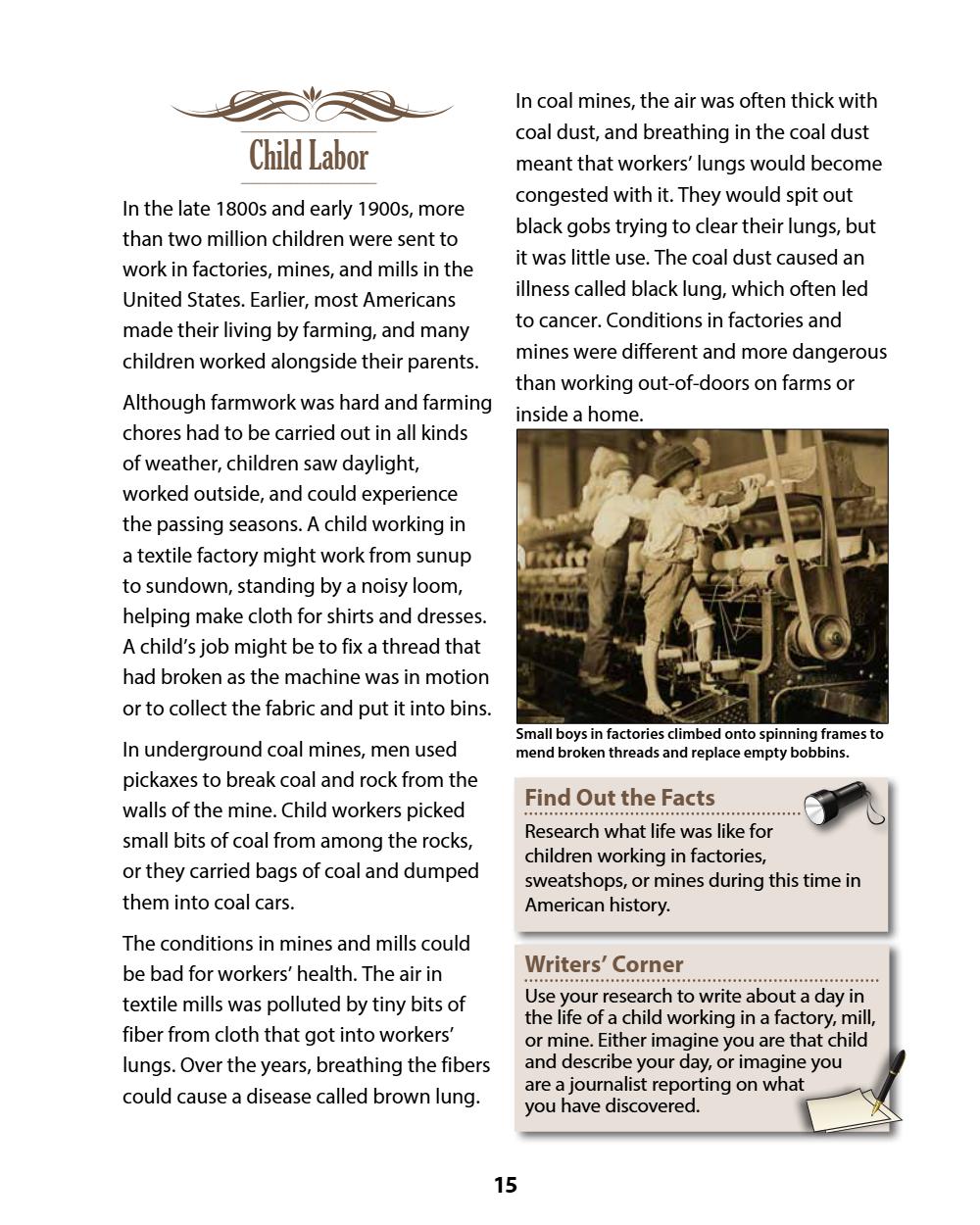
Small boys in factories climbed onto spinning frames to
mend broken threads and replace empty bobbins.
Find Out the Facts
Research what life was like for
children working in factories,
sweatshops, or mines during this time in
American history.
The conditions in mines and mills could
be bad for workers’ health. The air in
textile mills was polluted by tiny bits of
fiber from cloth that got into workers’
lungs. Over the years, breathing the fibers
could cause a disease called brown lung.
Writers’ Corner
Use your research to write about a day in
the life of a child working in a factory, mill,
or mine. Either imagine you are that child
and describe your day, or imagine you
are a journalist reporting on what
you have discovered.
15
In this time of industrial change,
Americans were trying to figure out
what rules, laws, and public policies
their government should make. Most
laws and public policies addressed
issues in an agrarian America, not in an
industrial country. One of the big battles
in American politics in the period from
1865 to 1914, and one that remains a
political issue to this day, was this: When
One of the political disagreements that
should the government make laws,
go to school, and to pursue their dreams.
rules, or policies about a workplace?
One issue people considered was if
there should be a maximum number of
hours a person can work in a day. If so,
how many hours should we the people,
through our elected representatives, say
should be the maximum—twelve, ten,
eight? In addition, people thought about
working conditions. Should the state and
federal government make laws (which,
remember, are rules we agree to follow
as citizens) to regulate cleanliness or the
sorts of safety equipment there should be
in a workplace?
people had into the early 1900s was
whether or not the federal government or
state governments should be allowed to
make laws regulating child labor. Today,
of course, children may not, according
to the law, work in industry. Instead,
children are required by law to attend
school. Today, we believe that children
should have the opportunity to learn, to
But imagine if you had to go to work for
twelve hours a day in a mine
or factory!
In 1916, Congress passed a law to
restrict child labor. The law was called
the Keating-Owen Child Labor Act. The
American people had their representatives
pass a law to try to stop child labor. But
just two years later, in 1918, in a legal
case called Hammer v. Dagenhart, the U.S.
Supreme Court struck down the KeatingOwen Child Labor Act as unconstitutional.
That meant that it remained legal to put
children to work in factories. Several
Vocabulary
years later, the Supreme Court changed
public policy, n. a set of
government steps for how
something is done
agrarian (/uh*grehr*ee*uhn/), adj.
relating to farming or agriculture
its mind. The high court upheld the Fair
Labor Standards Act of 1938, which makes
child labor illegal.
Not all nine Supreme Court justices in the
1918 case thought that child labor was
okay. One Supreme Court justice, a man
16
named Oliver Wendell Holmes, disagreed
Think Twice
with his colleagues. In a dissenting
Do you think unskilled workers
deserve the same rights and legal
protections as skilled workers?
opinion in Hammer, Holmes wisely
wrote, “If there is any matter upon which
civilized countries have agreed . . . it is the
evil of . . . child labor.”
The Importance of Unions
When workers join together to protect
their interests, they form what is called
a union. There are different kinds of
unions. Skilled workers’ unions are
But the same was not true for skilled
workers. In the late 1800s and early
1900s, skilled workers such as carpenters,
bricklayers, steam pipe fitters, and
electricians were in demand. Unlike
unskilled workers, skilled workers formed
unions and found that they could bargain
with employers for higher wages, shorter
hours of work, and better working
conditions.
their employers for better pay or safer
In 1886, a group of trade unions came
together to form the American Federation
of Labor. For many years, their president
was Samuel Gompers. The AFL and
Gompers promoted what they called
“pure and simple trade unionism.” Their
goal was to improve the lives of trade
union members by bargaining directly
with employers or, when collective
bargaining failed, by striking. In the late
1800s and early 1900s, Samuel Gompers
saw that the courts and governors almost
always ruled in favor of business. The
courts repeatedly agreed to injunctions
against workers for striking. And the
conditions. Unskilled workers in the late
Vocabulary
1800s were largely unsuccessful when
injunction, n. a court order that specifies
an action a person or group must or must
not take
called trade unions. Unskilled workers’
unions are often called labor unions. And
today, there are unions—sometimes
called associations or organizations—for
doctors, nurses, teachers, firefighters,
police officers, and many other jobs.
A worker in the late 1800s who stood
at a machine all day doing the same
task, or a laborer laying railroad tracks
or digging ditches, had few protections.
That person’s job could easily be taken by
someone else. Those deemed unskilled
workers had little ability to bargain with
they tried to form unions.
17
courts rarely ruled against employers for
The AFL worked to protect skilled
mistreating or underpaying workers.
workers’ jobs, pay, benefits, and working
Gompers learned his trade union tactics
conditions. But it did little to aid the
organizing efforts of semiskilled or
by experience. He had grown up poor in
unskilled workers, including tens of
London, England, and immigrated to the
United States in his youth. In New York, he
thousands of women and child laborers.
became a cigar roller, and he joined the
New York cigar workers’ union. Gompers
Strikes and Retaliation
watched as that union sought help from
the government to end “tenement-
Labor strife in the period from 1865 to
1914 was at times intense. There were
hundreds of strikes each year across
America. And labor actions—strikes or
lockouts—sometimes turned violent as
workers made demands and employers
pushed back.
house production” of cigars. The New
York state legislature twice passed laws
making tenement-house production
illegal. But then New York State’s
courts twice invalidated those laws. In
response, Gompers and his union, as
Vocabulary
invalidate, v. to prove
incorrect or illegal
Gompers wrote,
“harassed the
manufacturers
by strikes and
agitation.” Through these actions, the
skilled workers achieved “what [they] had
failed to achieve through legislation.”
Early on, the AFL was not open to the idea
of allowing women or Black Americans to
join their trade unions. In the 1890s, Sam
Gompers seemed open to including other
races. He said to the white members of the
AFL, “As working men we are not justified
in refusing them [Black Americans] the
right of the opportunity to organize.” But
ten years later, he abandoned this view.
18
One incident occurred at Chicago’s
Haymarket Square on May 4, 1886, when a
peaceful rally in support of union workers
and the eight-hour day turned suddenly
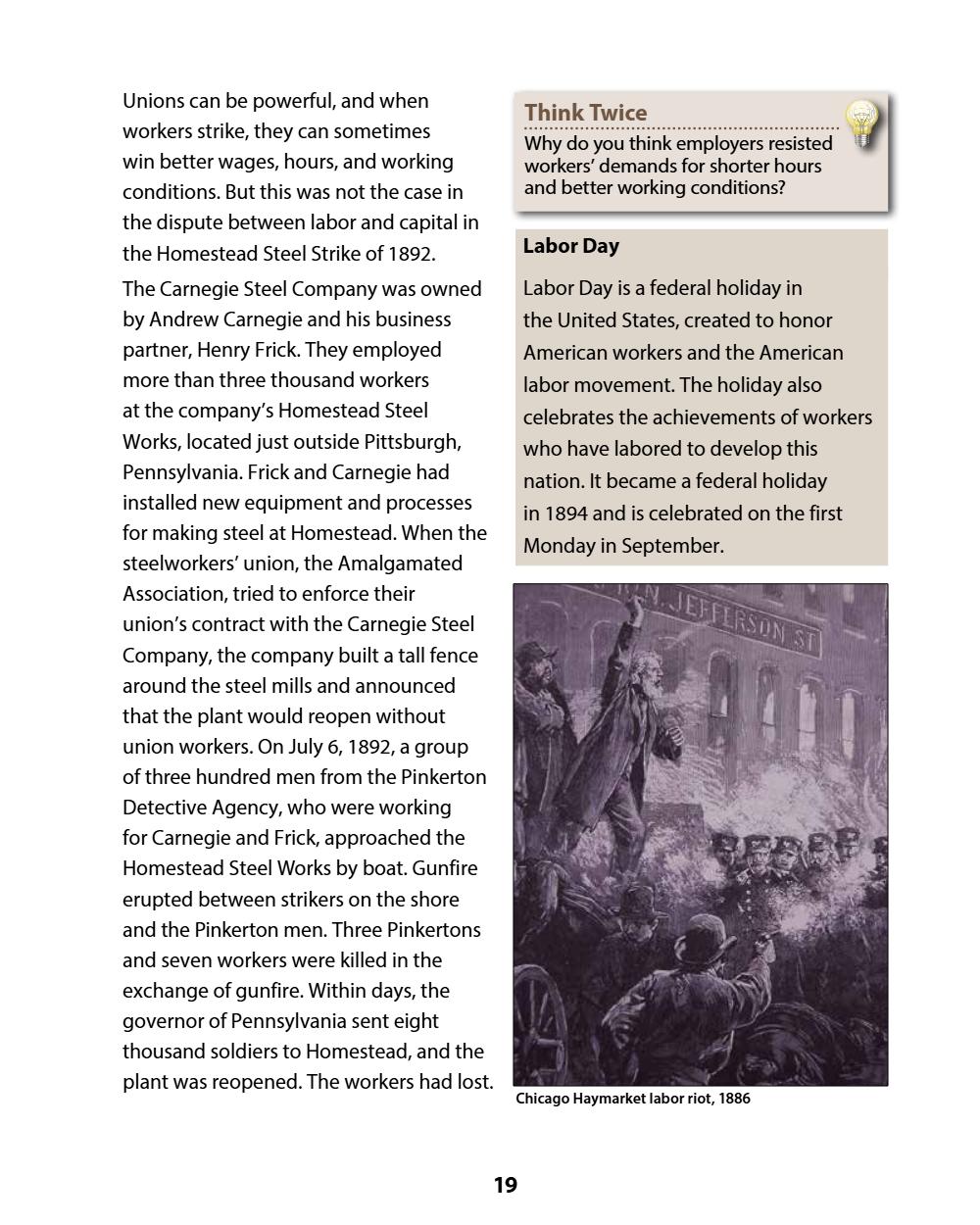
violent. Someone in the crowd threw a
bomb at the police. A police officer was
killed by the bomb. In the confusion
that followed, police opened fire, and a
number of police officers and civilians
were killed. In the aftermath, eight
people were convicted of conspiracy.
Four of them were hanged, though the
bomb thrower was never identified. The
Haymarket incident attracted international
attention. Employers used it as an
example of how the labor movement was
full of foreigners, anarchists, and radicals.
Unions can be powerful, and when
workers strike, they can sometimes
win better wages, hours, and working
conditions. But this was not the case in
the dispute between labor and capital in
the Homestead Steel Strike of 1892.
Think Twice
Why do you think employers resisted
workers’ demands for shorter hours
and better working conditions?
Labor Day
The Carnegie Steel Company was owned
by Andrew Carnegie and his business
partner, Henry Frick. They employed
more than three thousand workers
at the company’s Homestead Steel
Works, located just outside Pittsburgh,
Pennsylvania. Frick and Carnegie had
installed new equipment and processes
for making steel at Homestead. When the
steelworkers’ union, the Amalgamated
Association, tried to enforce their
union’s contract with the Carnegie Steel
Company, the company built a tall fence
around the steel mills and announced
that the plant would reopen without
union workers. On July 6, 1892, a group
of three hundred men from the Pinkerton
Detective Agency, who were working
for Carnegie and Frick, approached the
Homestead Steel Works by boat. Gunfire
erupted between strikers on the shore
and the Pinkerton men. Three Pinkertons
and seven workers were killed in the
exchange of gunfire. Within days, the
governor of Pennsylvania sent eight
thousand soldiers to Homestead, and the
plant was reopened. The workers had lost.
Labor Day is a federal holiday in
the United States, created to honor
American workers and the American
labor movement. The holiday also
celebrates the achievements of workers
who have labored to develop this
nation. It became a federal holiday
in 1894 and is celebrated on the first
Monday in September.
Chicago Haymarket labor riot, 1886
19
Captains of Industry or Robber Barons?
The influence of America’s wealthiest
entrepreneurs and business leaders
increased in the late 1800s and early
1900s. Andrew Carnegie, John D.
Rockefeller, and
Vocabulary
J. P. Morgan were
entrepreneur, n. a
three of the richest
person who starts a
and most successful
business
entrepreneurs in
history. Carnegie made his money in
steel, Rockefeller made his money in oil,
and Morgan made his in banking and
investing. In 1901, J. P. Morgan even
bought Andrew Carnegie’s steel company
for $480 million! Some Americans saw
these men and business leaders like
them as “captains of industry”—that is,
they saw the good that these men were
doing by leading important businesses.
Their corporations employed thousands
of workers, and each of those workers
earned money they might otherwise not
have had. But other Americans criticized
the men as “robber barons,” describing
them as rich men who made their millions
off the labor of those they employed.
Carnegie in particular was a great
philanthropist. A philanthropist is
someone who uses their money to help
others. And Carnegie did this in a big
way. In 1889, he wrote an article called
“The Gospel of Wealth” in which he
said that wealthy people should make
use of their wealth to improve society.
Wealthy people, Carnegie said, should
be philanthropists. During his lifetime,
Andrew Carnegie gave away much of his
wealth; he donated millions of dollars to
charities, foundations, and universities,
and he paid for the building of hundreds
of public libraries across America.
Think Twice
What do you think? Were the men
described here captains of industry or
robber barons?
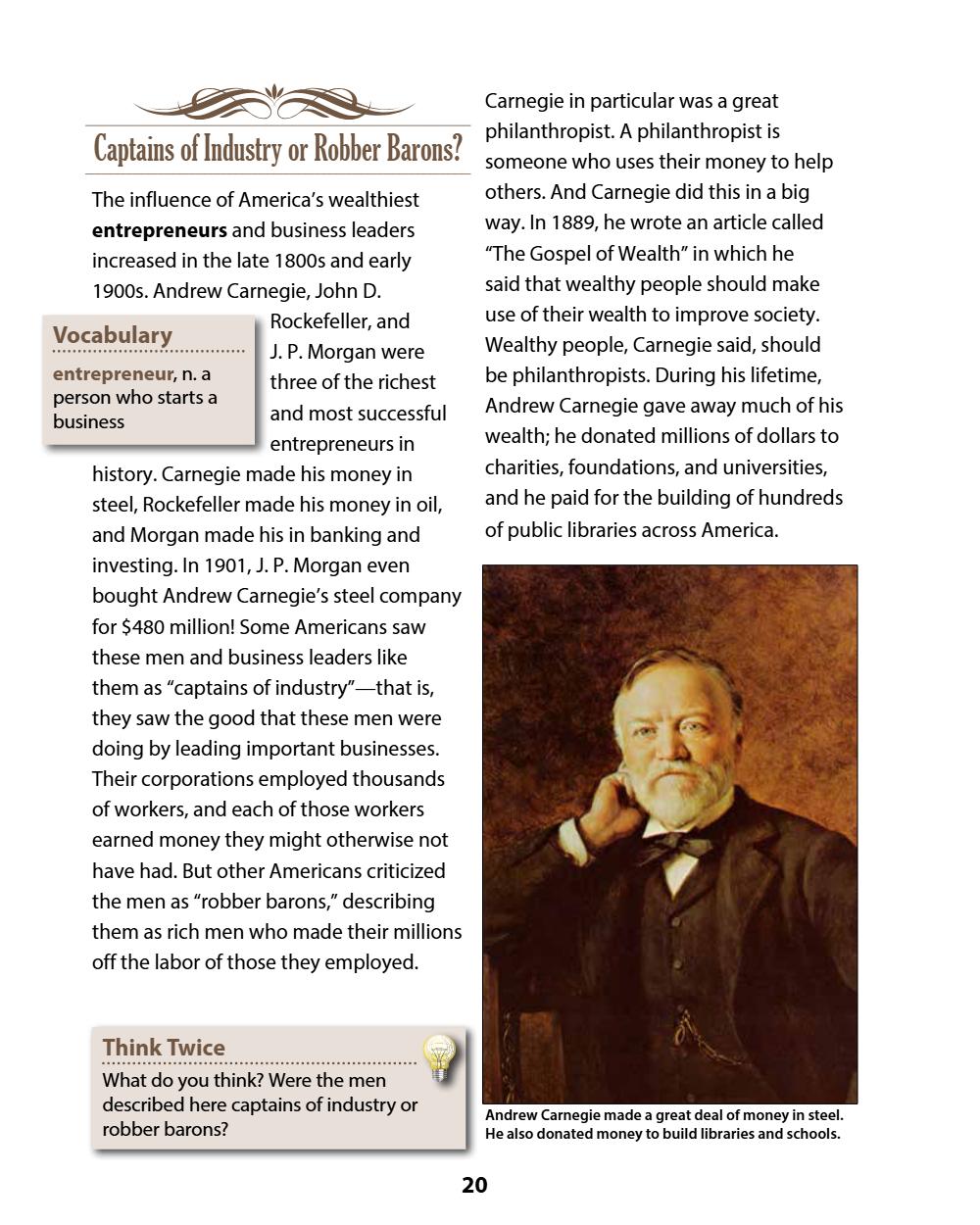
Andrew Carnegie made a great deal of money in steel.
He also donated money to build libraries and schools.
20
people to help run their business, just as
Andrew Carnegie hired people to work in
“Free Enterprise” vs.
Government Regulation
the steel company he owned. The idea of
free enterprise is that individuals should
be able to decide what goods or services
From colonial times to today, the United
their business will offer to consumers.
States economy has largely functioned
They are in charge. And if everyone is
under the system of commercial society
allowed the freedom to pursue a plan for
or “free enterprise.” For more than a
making money through a business, and
century, the United States has been, the
if that business can be run without too
richest country in the world.
much government regulation, then that
Vocabulary
free enterprise should, in theory, lead to
free enterprise, n. the freedom
of businesses to operate without
government interference
a growing economy in which Americans
benefit economically.
One of the biggest issues for Americans
is the question of how much citizens
want the government to make laws,
rules, and policies to regulate private
businesses. This question is really
Vocabulary
regulate, v. to
control or place
limits on
important. After all, the
government belongs
to its citizens—it is, as
Abraham Lincoln said, a
government of, by, and
for the American people. When should
people reach for the government and ask
their representatives to make laws that
have to do with private enterprise?
In the United States, if someone has
a good idea, they can start their own
business. It’s their business. They can hire
21
But in the late 1800s, the American people
spoke up. Congress—which is the voice of
the American people—created the Interstate
Commerce Commission (ICC) in 1887.
By making the law that created the ICC,
Congress said that Americans can use the
government to regulate private businesses.
At first, the goal was to address unfair
practices that some people accused the
railroads of (such as charging clients different
amounts of money for shipping goods). In
1890, Congress passed the Sherman Antitrust Act (named after Senator John Sherman
of Ohio), which made monopolies illegal.
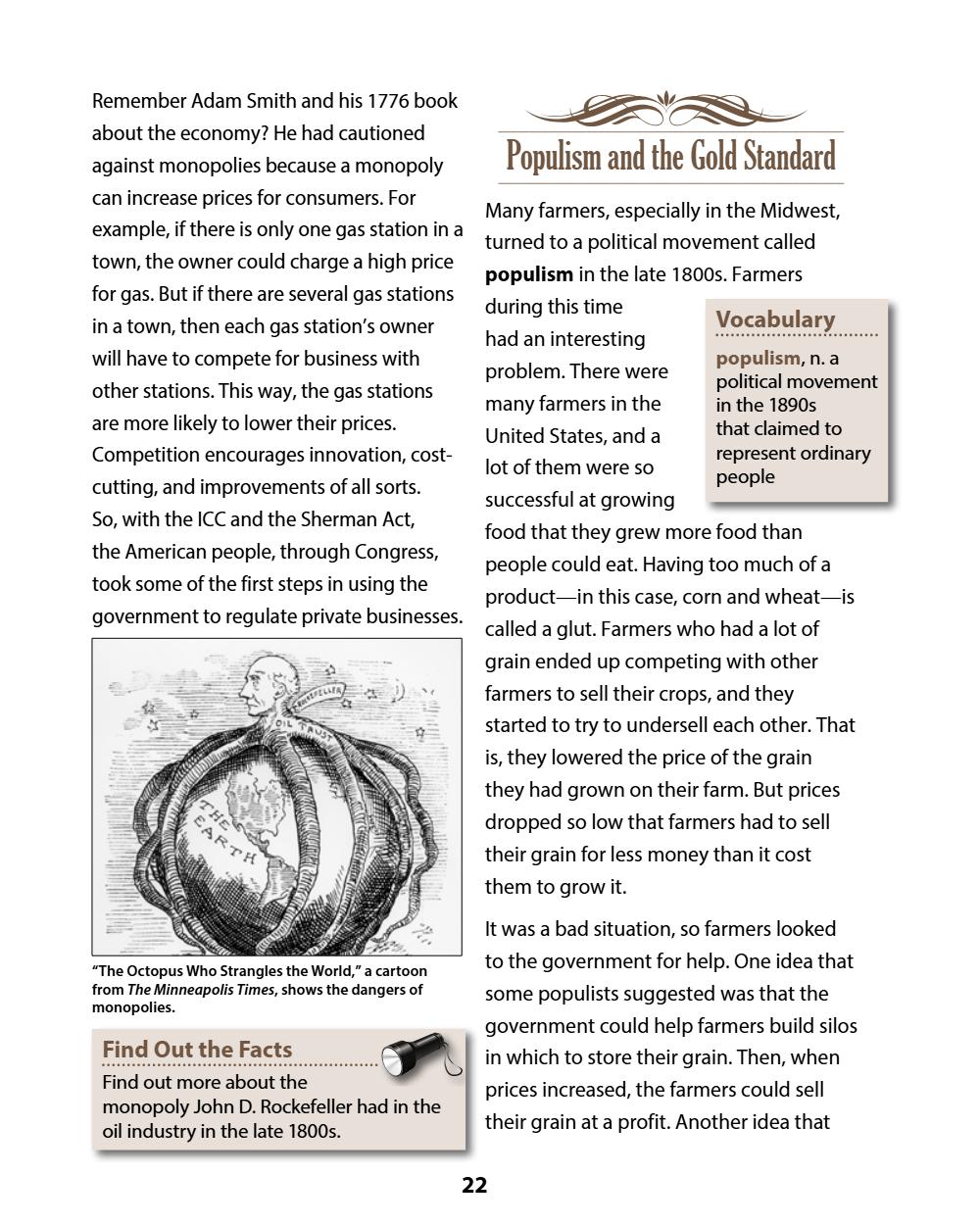
A monopoly is when a corporation owns all,
or almost all, of an industry. For example,
by the early 1890s, John Rockefeller owned
about ninety percent of the oil refineries in
the United States—he had a monopoly in
the oil industry.
Remember Adam Smith and his 1776 book
about the economy? He had cautioned
Populism and the Gold Standard
against monopolies because a monopoly
can increase prices for consumers. For
example, if there is only one gas station in a
town, the owner could charge a high price
Many farmers, especially in the Midwest,
turned to a political movement called
populism in the late 1800s. Farmers
for gas. But if there are several gas stations
during this time
in a town, then each gas station’s owner
had an interesting
will have to compete for business with
problem. There were
other stations. This way, the gas stations
many farmers in the
are more likely to lower their prices.
United States, and a
Competition encourages innovation, cost-
lot of them were so
cutting, and improvements of all sorts.
successful at growing
So, with the ICC and the Sherman Act,
Vocabulary
populism, n. a
political movement
in the 1890s
that claimed to
represent ordinary
people
food that they grew more food than
the American people, through Congress,
people could eat. Having too much of a
took some of the first steps in using the
government to regulate private businesses.
product—in this case, corn and wheat—is
called a glut. Farmers who had a lot of
grain ended up competing with other
farmers to sell their crops, and they
started to try to undersell each other. That
is, they lowered the price of the grain
they had grown on their farm. But prices
dropped so low that farmers had to sell
their grain for less money than it cost
them to grow it.
It was a bad situation, so farmers looked
“The Octopus Who Strangles the World,” a cartoon
from The Minneapolis Times, shows the dangers of
monopolies.
Find Out the Facts
Find out more about the
monopoly John D. Rockefeller had in the
oil industry in the late 1800s.
to the government for help. One idea that
some populists suggested was that the
government could help farmers build silos
in which to store their grain. Then, when
prices increased, the farmers could sell
their grain at a profit. Another idea that
22
was very popular among populists, both
people who only wanted to use gold and
farmers and some working people, was
who opposed using silver were wrong.
that the government could use its power
He concluded his speech with the words,
to create inflation. The populists wanted
“You shall not press down upon the brow
the government to cause inflation by
of labor this crown of thorns; you shall not
adding more money into the economy.
Vocabulary
inflation, n. a rise
in prices and a fall
in the purchasing
value of money
At the time, the
federal government
used gold as a basis
for money. But the
populists suggested
that the government
should allow silver to be used as money,
too. They said that if silver were added to
the money supply, there would be more
money, which would cause the inflation
crucify mankind upon a cross of gold.”
And as he said this, he threw his arms
wide as he stood before the hundreds of
people gathered in the convention hall.
Having finished his speech, he walked
slowly back to his seat. There was dead
silence in the hall. Bryan wondered to
himself if the people had liked his speech.
But then, after a few seconds, there was
thunderous applause. People in the
they were looking for. Many of the farmers audience went wild. They cheered and
who were populists had borrowed money threw their hats in the air; they hugged
from banks, and they reasoned that if they one another in great joy. Bryan’s speech
had been a great success. But while his
could pay the banks back with inflated
dollars, then they would come out ahead.
speech was a success, his plan did not
A man named William Jennings Bryan
succeed. By 1900, President William
In 1896, he gave a famous speech at
directly to gold.
thought the populists had a good idea. He McKinley had put the nation on the gold
standard, a system that links money
supported adding silver to the economy.
the Democratic Party Convention. His
speech is called the “Cross of Gold.” In
Think Twice
it, he declared that the United States
Who or what do you think Bryan was
referring to when he used the words
“crown of thorns”?
government should allow silver as well
as gold to be used. At the very end of
his speech, he did a thing that drew
people’s attention. He said that the
23
Talk it over
Ask these as you read or afterward. Answers for the teacher are tucked under each question.
What is the name of the period of change caused by industrialization, immigration, and urbanization after the Civil War?
Answer
This period of change is called the Second Industrial Revolution.
What drew immigrants to the United States between 1865 and 1920?
Answer
The promise of finding work in the expanding American economy drew immigrants to the United States.
What was the metaphor of the melting pot meant to convey?
Answer
The metaphor was meant to convey that people from many places became part of the same group—Americans.
What difference would the metaphor of a salad or mosaic make?
Answer
The metaphor of a salad or mosaic suggests that people can keep their cultures and traditions and still be American.
What “pushed” Irish people to leave Ireland for the United States beginning in 1845?
Answer
The potato blight and resulting lack of food pushed them to immigrate to the United States. 144
In which cities did most Irish immigrants settle in the United States?
Answer
Most Irish immigrants settled in Boston, New York, Albany, Buffalo, Cleveland, and Chicago.
Why did more than a million Germans immigrate to the United States between 1845 and 1855?
Answer
Some were farmers and laborers in search of better jobs and better economic opportunities. Later, doctors, lawyers, and artisans fled the aftermath of the Revolutions of 1848.
From which countries in southern and eastern Europe did immigrants come to the United States between 1880 and 1920?
Answer
Immigrants came from Italy, Russia, Austria-Hungary, and elsewhere.
Why did Jewish people immigrate to the United States?
Answer
Jewish people immigrated to escape poverty and religious persecution.
What types of jobs did most immigrants take?
Answer
Most immigrants took unskilled jobs for low pay, working as maids, cooks, housekeepers, or washer women; sweeping streets; digging ditches; selling food; sewing garments; or working in factories, mines, or mills.
What does the Statue of Liberty’s torch symbolize?
Answer
The Statue of Liberty’s torch symbolizes freedom.
Where in the United States did nearly all Chinese immigrants live?
Answer
Nearly all Chinese immigrants lived on the West Coast.
Why did the United States Congress pass the Chinese Exclusion Act to ban further Chinese immigration?
Answer
The act was passed because of prejudice against Chinese people.
Why did Black Americans move north after slavery ended?
Answer
They hoped to find better jobs and better schools than in the South.
What opportunities did Black Americans find in Northern cities during the First World War?
Answer
They found work in wartime industries.
What examples of chicanery did you find?
Answer
The theft of millions of dollars, bribery, tricks, and lies are all examples of chicanery. 146
What positive things did Boss Tweed and Tammany Hall do?
Answer
They helped poor people and aided business development.
How many of the world’s manufactured goods was the United States producing by the 1910s?
Answer
By the 1910s, the United States was producing one-third of the world’s manufactured goods.
How did machines change manufacturing?
Answer
Machines increased output and lowered labor costs for each unit of production, and they streamlined the process and made it faster.
What does it mean to gild something?
Answer
To gild something is to put a thin layer of gold over something ordinary.
What did Adam Smith believe is to each person’s benefit?
Answer
Adam Smith believed that cooperation is to each person’s benefit.
How did Adam Smith believe we could help others meet their own needs?
Answer
Adam Smith believed that by buying the things we need from others, we help them meet their own needs.
What was factory work like?
Answer
Factory work could be repetitive, mind-numbing, and exhausting.
What is a sweatshop?
Answer
A sweatshop is a factory or workshop in which people work long hours for very low wages.
What were the differences between farm work and factory work for children?
Answer
On farms, children had a chance to be outside, and they worked with their family. In factories, children were inside in often hazardous conditions for long hours. The working conditions in factories and mines could cause lifelong health problems.
How did child labor change in 1938?
Answer
In 1938, a federal law was passed to make child labor illegal.
How do labor unions help workers?
Answer
Unions can bargain with employers and get higher wages, shorter working hours, and better working conditions for their members.
What happened at Chicago’s Haymarket Square on May 4, 1886?
Answer
A strike grew violent when someone in the crowd threw a bomb at the police. People were killed, and eight people were convicted of conspiracy.
Why did the Homestead Steel Strike backfire?
Answer
The Homestead Steel Strike backfired because the Carnegie Steel Company hired Pinkertons to keep the workers out, several people died, and the governor supported the company over the workers.
What is Labor Day?
Answer
Labor Day is a federal holiday celebrated on the first Monday in September that honors American workers and the American labor movement.
What is a “captain of industry”?
Answer
A “captain of industry” is someone who does good by leading an important business and employing thousands of workers.
What is a “robber baron”?
Answer
A “robber baron” is a rich person who makes millions off the labor of their employees.
What was the goal of the Interstate Commerce Commission?
Answer
The goal of the ICC was to address unfair practices, such as charging clients different amounts of money for shipping goods.
What is a monopoly?
Answer
A monopoly is when a corporation owns all or almost all of an industry.
What big problem were farmers facing?
Answer
Because of falling prices, farmers had to sell their crops for less than it cost to grow them.
Check for understanding
- Answer the Big Question out loud or in a sentence or two: What impact did immigration, industrialization, and urbanization have on America in the late 1800s and early 1900s?
What a good answer includes
Immigration and industrialization caused urbanization as the factories provided jobs that brought immigrants and people from the country into the cities to work. Immigrants fled poor living conditions in their home countries to start again in the United States. Black Americans moved north to work in factories, too. After the railroads were built, the Chinese Exclusion Act kept new immigrants from coming from China. The country changed as the cities grew and rural areas became emptier. Factory workers, who could be children, worked long days at repetitive tasks. In time, laws prevented children from working as a way to protect them. Unions were formed to protect workers and guarantee better pay and working conditions. At first, only skilled workers had unions, but then unions organized for unskilled workers, too. Sometimes strikes were unsuccessful against really big companies, especially if the companies had the support of the government. The late 1800s and early 1900s were called the Gilded Age because the richest 1 percent lived so very well, but there was great poverty. America’s wealthiest entrepreneurs made
- Pick one of today’s words and use it in a sentence of your own.
For offline study
Download these once and you can teach this unit without the internet.
This course is based on an original work of the Core Knowledge® Foundation (www.coreknowledge.org) made available through licensing under a Creative Commons Attribution-NonCommercial-ShareAlike 4.0 International License. This does not in any way imply that the Core Knowledge Foundation endorses this work. PGAMO added the lesson pages, study packs and quizzes layout, and shares them under the same license. CC BY-NC-SA 4.0 · Core Knowledge History and Geography. Free for everyone — this course may never be sold.