Grade 7 History & Geography
Study Bibles 26
Chapter 1: Early Americans and the First Europeans
What were some of the similarities and differences between the early indigenous or Native American groups of the Americas?
Keep this question in mind as you read. You’ll answer it at the end.Words to know
- primary source
- a firsthand account of a historical eventA letter written by George Washington to his wife during the Revolutionary War is a primary source.
- pestilent
- infectious or sicklyHer infected knee was covered with pus and had a pestilent smell.
- smallpox
- a serious disease that spreads from person to person and causes a fever and rashQueen Elizabeth I of England survived smallpox, but for the rest of her life, her face was scarred from the terrible rash.
- climate pattern
- the type of weather that occurs regularly in a placeHot, humid summers are part of the climate pattern for the southeastern region of the United States.
- geographic region
- a large area whose geographic characteristics, such as climate and physical features, set it apart from other placesThe Northeast is a geographic region known for cold, snowy winters.
- cultural artifact
- an object that reflects the life, beliefs, and society of a group of peopleThe National Museum of the American Indian contains thousands of indigenous cultural artifacts.
- judicial
- having to do with courts of law or decisions of right and wrongJudges and courts are part of the judicial system in the United States.
- commerce
- the buying and selling of goods and services; tradeThe market was the center of commerce for the whole town; you could buy shoes or fruit or even pots and pans there.
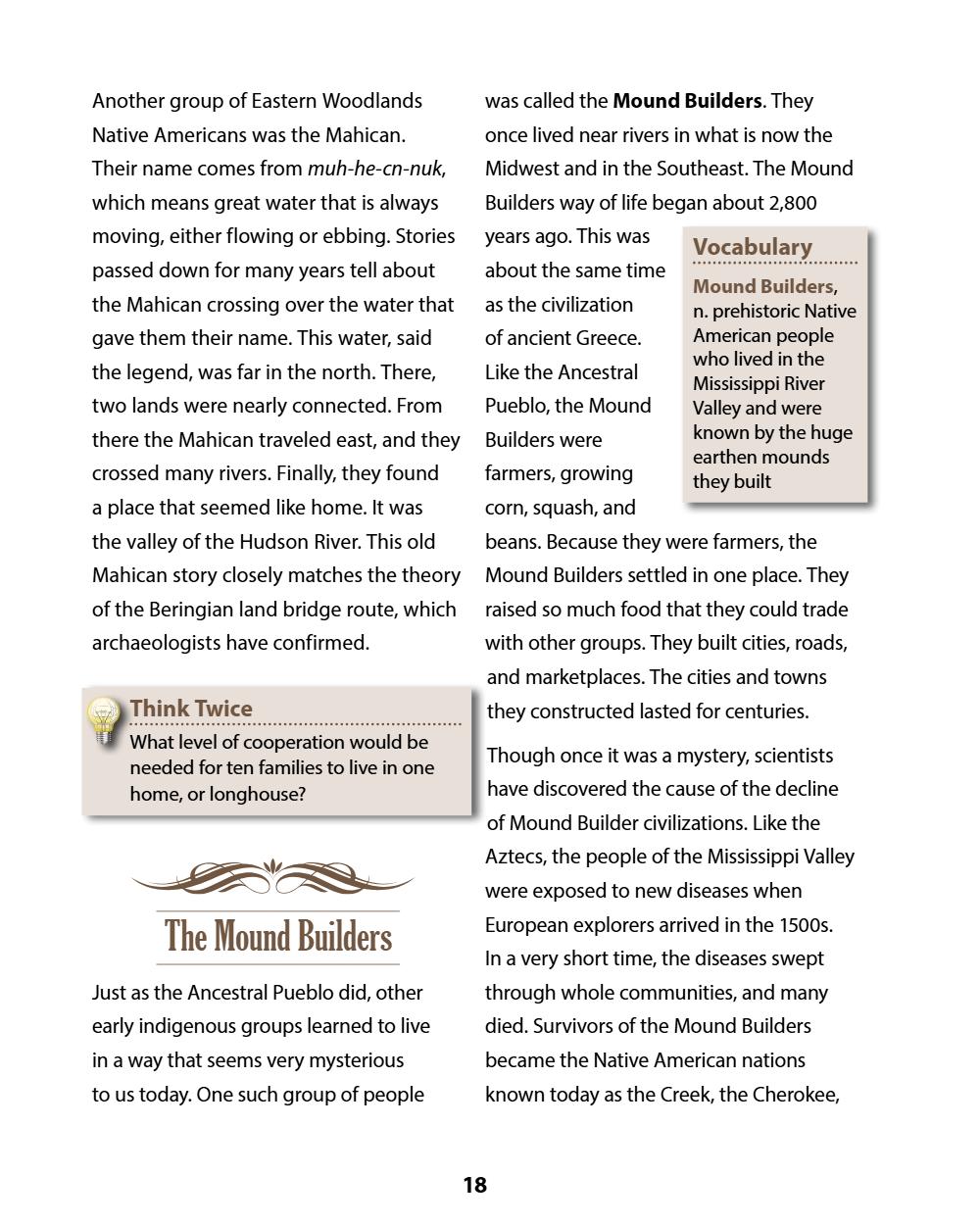
- Mound Builders
- prehistoric Native American people who lived in the Mississippi River valley and were known by the huge earthen mounds they builtThe Mound Builders were expert farmers who lived in North America long before European explorers arrived.
- monotheism
- the religious belief in one godChristians, Jews, and Muslims practice monotheism.
- polytheism
- the religious belief in many godsMany Native American societies practice polytheism and believe that the natural world contains many spirits to worship or honor.
- shaman
- a religious leader who performs healing rites and ritualsThe shaman of the village traveled to those who were ill to heal them.
Read: Chapter 1, “Early Americans and the First Europeans”
Read it aloud together, or let your student read on their own. Pictures and maps are part of the lesson — talk about them too.
Text version (for read-aloud apps and screen readers)
Chapter 1
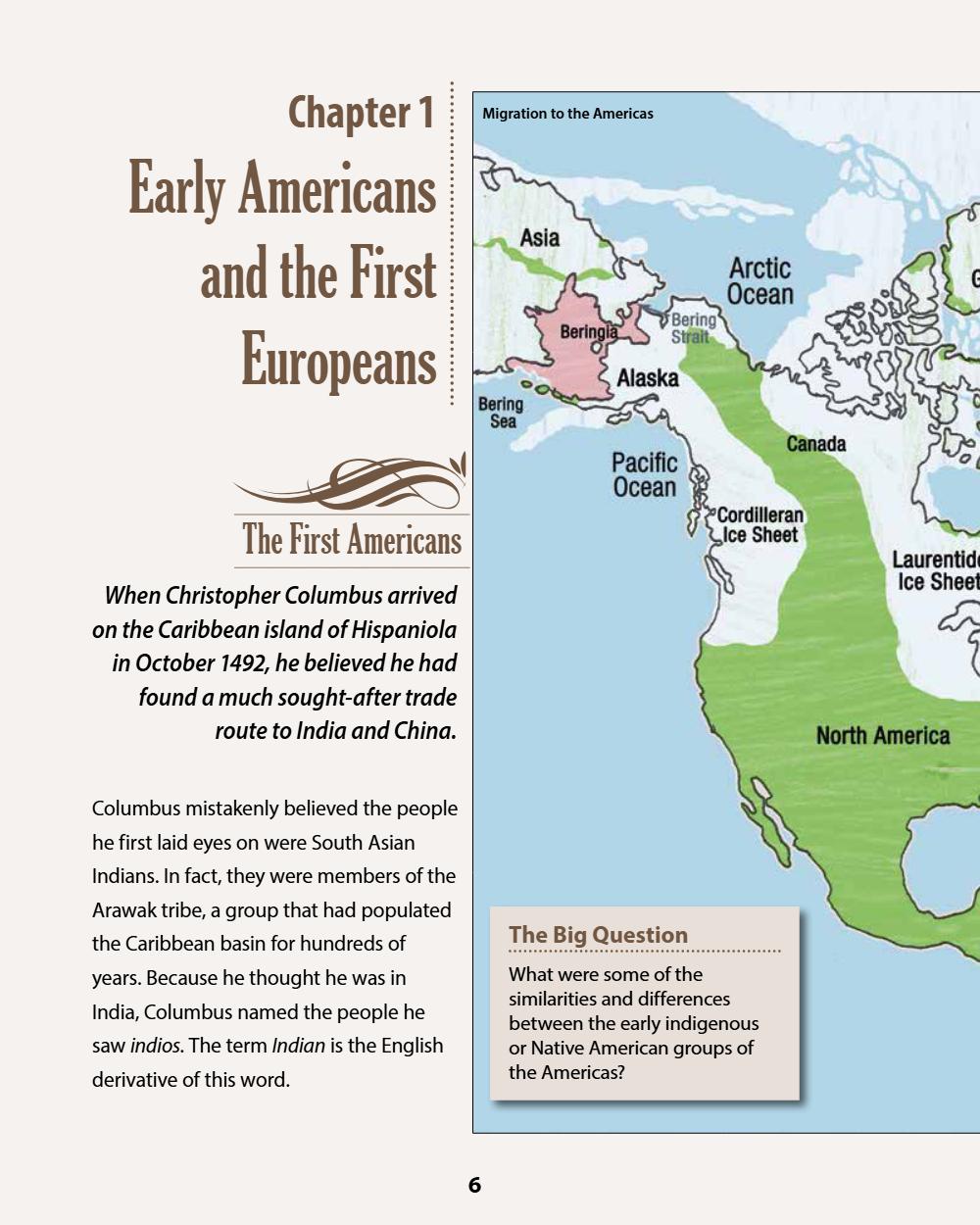
Migration to the Americas
Early Americans
and the First
Europeans
The First Americans
When Christopher Columbus arrived
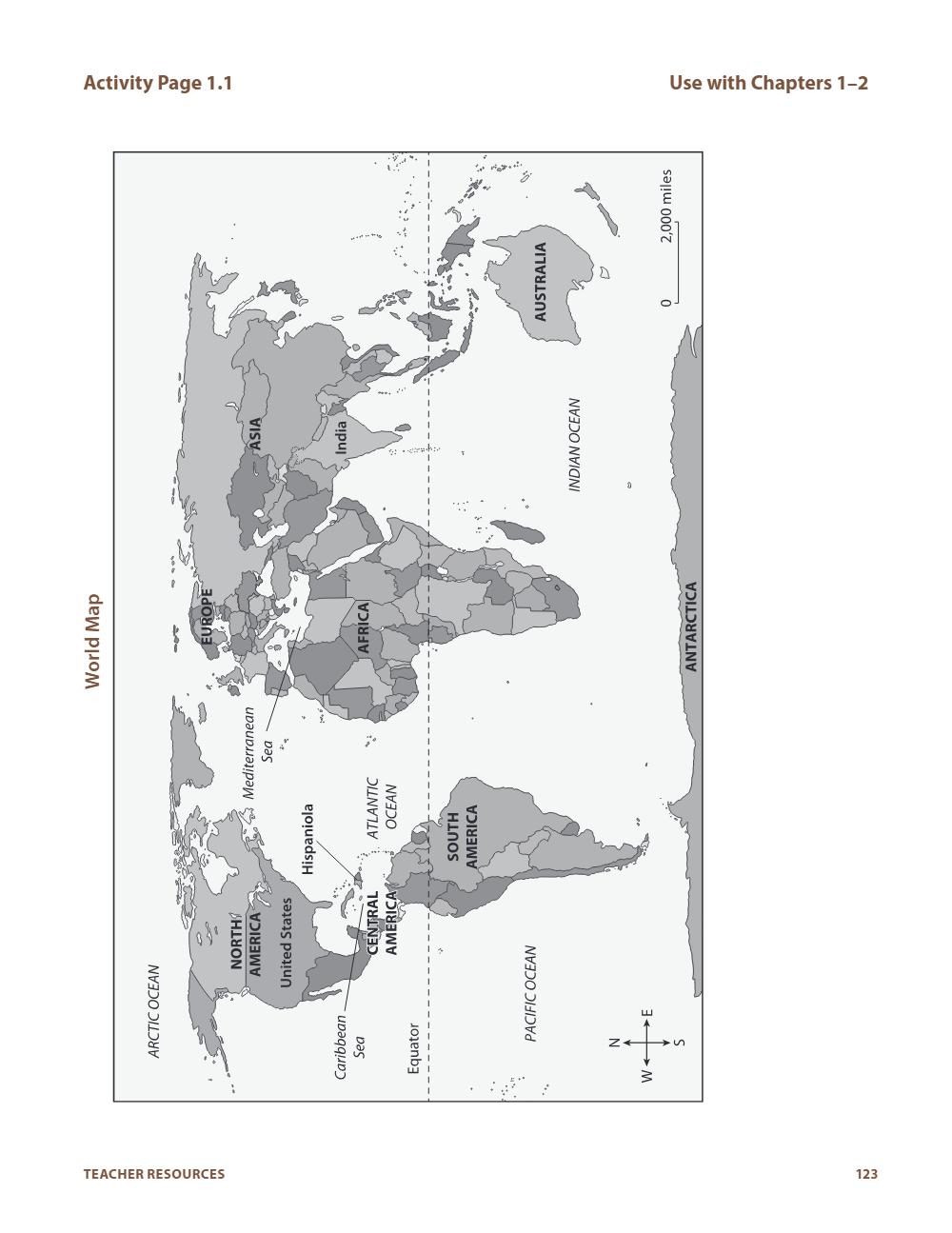
on the Caribbean island of Hispaniola
in October 1492, he believed he had
found a much sought-after trade
route to India and China.
Columbus mistakenly believed the people
he first laid eyes on were South Asian
Indians. In fact, they were members of the
Arawak tribe, a group that had populated
The Big Question
the Caribbean basin for hundreds of
What were some of the
similarities and differences
between the early indigenous
or Native American groups of
the Americas?
years. Because he thought he was in
India, Columbus named the people he
saw indios. The term Indian is the English
derivative of this word.
6
How People Came to America
Indigenous Society Before
European Contact
The long-held explanation of how
America’s indigenous peoples came
As many as eighty to one hundred million
to settle this part of the world is the
people lived in the Western Hemisphere
Beringian land bridge theory. This theory
by the time Italian explorer Christopher
proposes that Stone Age migrants
Columbus arrived. They occupied lands
from central Asia crossed a frozen land
throughout the North and South American
bridge from the Eastern Hemisphere.
continents. Their lands extended north
The land bridge had been formed by
to the Arctic—now Alaska and northern
the geological patterns of the era. It
Canada—south to the Andes Mountains
was located in the area now known as
of South America, and to all points in
the Bering Strait. This narrow body of
between. Big game hunting may have
water separates North America from
brought some to the land, but climate
Asia and borders Alaska on the west.
patterns and the locations they settled
Many centuries ago, this area was a land
in distinguished each group further. The
Inuit, in what is now Alaska, were seal
formation that people could cross on
hunters. Mound-building farmers lived
foot. It is believed that early migrants
in the Mississippi Valley. And Peru and
came here following the big game
Ecuador were home to highly structured
they hunted for food. In time, over the
agricultural societies. As populations grew,
course of hundreds of years, groups of
societies became more complex. We will
people with different languages and
now take a closer look at the different
different ways of life populated what is
indigenous groups that lived in South,
now North, Central, and South America.
Central, and North America.
More recently, scholars have proposed
that people first arrived in various ways,
Think Twice
including walking across frozen water,
Why might it be difficult to truly
understand how people originally
migrated to the Americas?
and by boat along the Pacific Coast.
7
Indigenous People of Central and South America
Three of the most highly established
The Inca were extraordinarily skilled in
and organized indigenous groups of
warfare compared to any group of their
the Western Hemisphere were the Inca,
time. However, the Inca’s skills were no
the Maya, and the Aztec. The Inca lived
match for Spanish explorers who invaded
in what is now the country of Peru, as
their territory in the 1500s. Known as
well as in other areas along the western
conquistadors, these warrior-explorers
coast of South America. They built one
used force against indigenous groups.
of the most extensive empires the world
The warriors assaulted Inca homelands in
had ever known. In fact, many of their
search of gold and silver.
roads, walls, and irrigation works are still
One of these conquistadors was Francisco
in use today. The masonry, metalwork,
Pizzaro. Intrigued by the stories of
and weaving performed by expert Inca
the wealth of the Inca empire, Pizzaro
artisans rivaled anything that could be
was determined to seize some of this
found in Europe at the time.
wealth for himself. So he set out on an
Find Out the Facts
expedition. Pizzaro lured the last of
Research the skills practiced by
Inca, Maya, and Aztec artisans.
invitation to dinner. When Atahualpa
the Inca emperors, Atahualpa, with an
arrived, he received no fine meal. Instead,
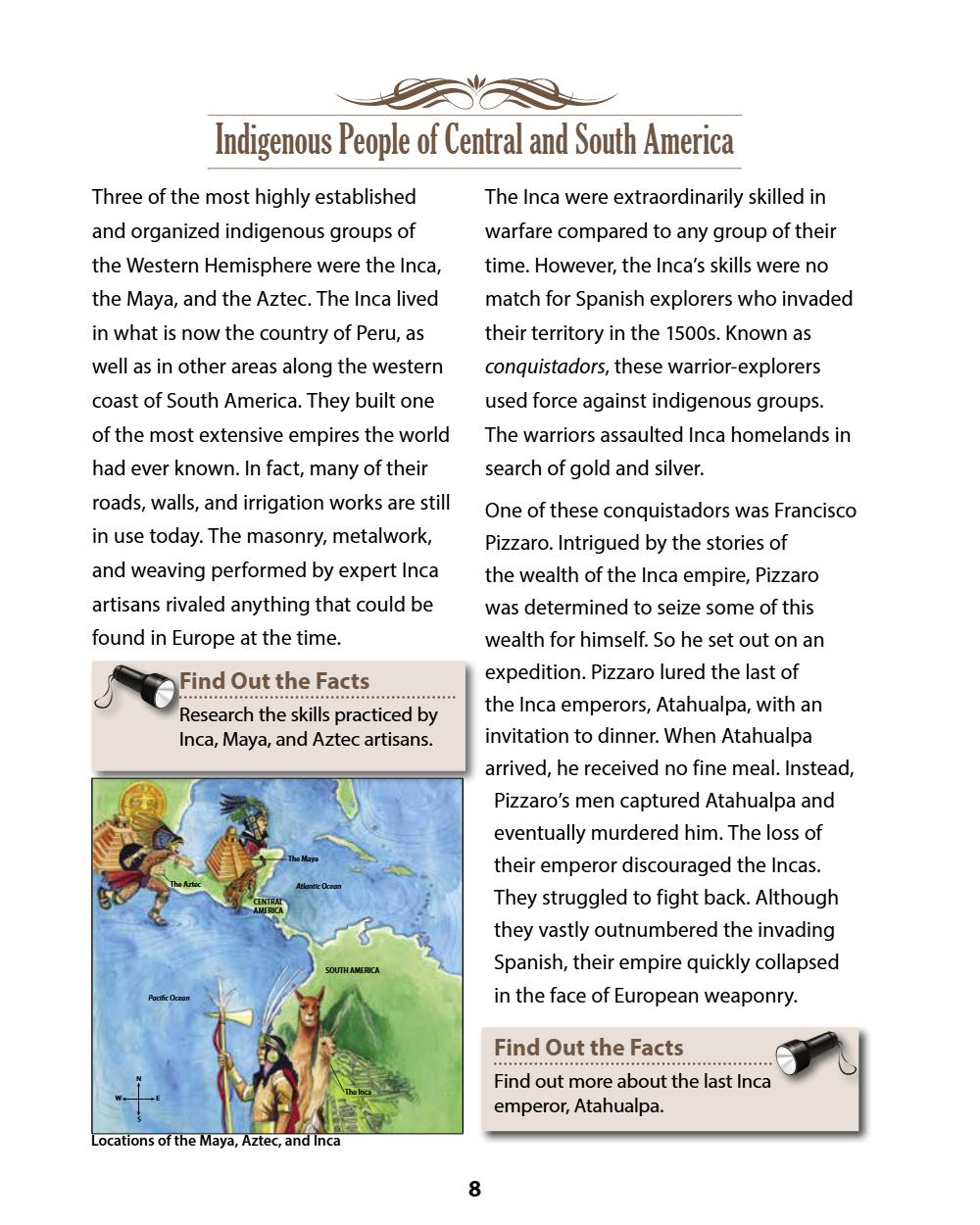
NORTH AMERICA
Pizzaro’s men captured Atahualpa and
eventually murdered him. The loss of
their emperor discouraged the Incas.
The Maya
The Aztec
Atlantic Ocean
They struggled to fight back. Although
CENTRAL
AMERICA
they vastly outnumbered the invading
Spanish, their empire quickly collapsed
SOUTH AMERICA
in the face of European weaponry.
Pacific Ocean
Find Out the Facts
Find out more about the last Inca
emperor, Atahualpa.
N
W
E
The Inca
S
Locations of the Maya, Aztec, and Inca
8
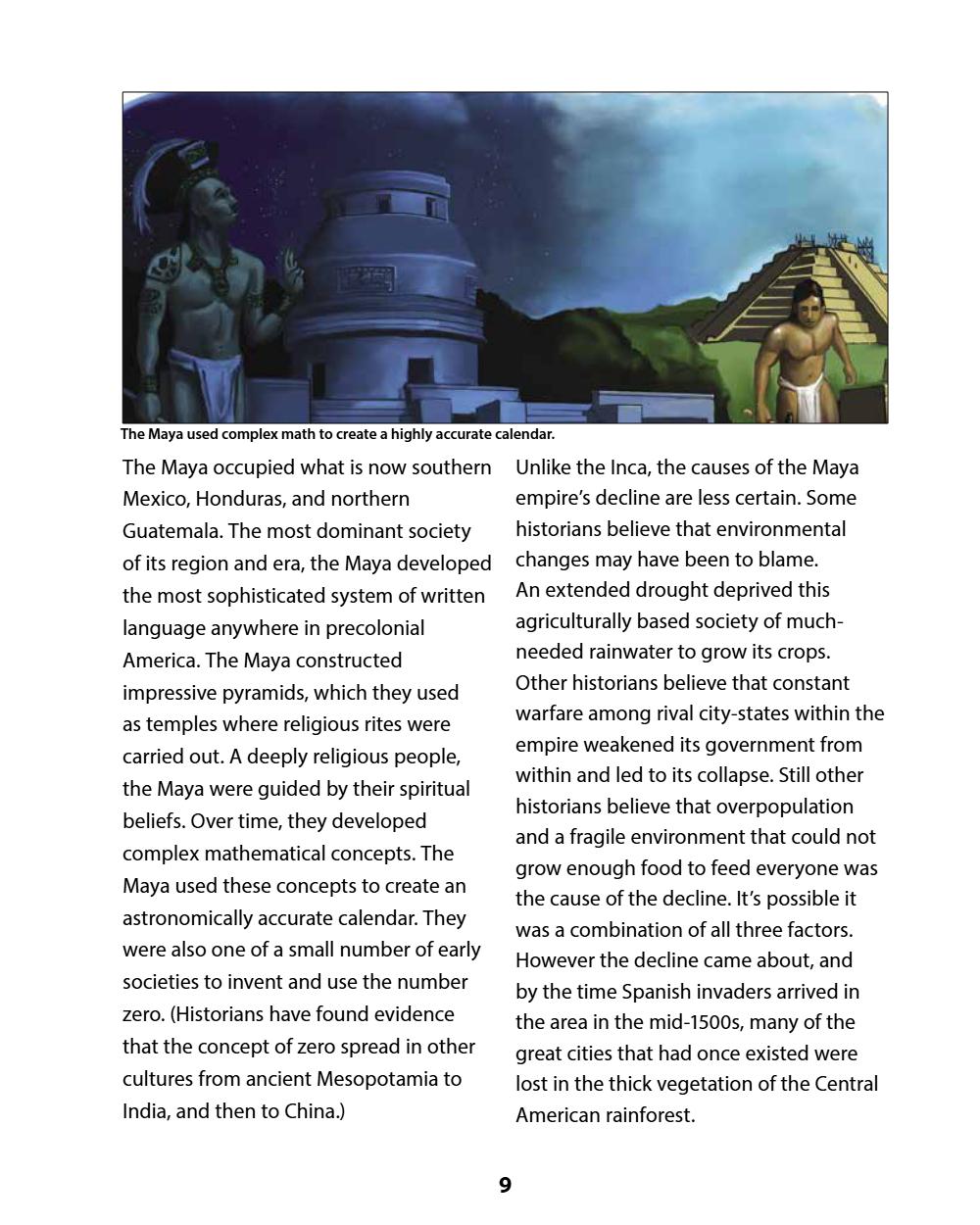
The Maya used complex math to create a highly accurate calendar.
Unlike the Inca, the causes of the Maya
empire’s decline are less certain. Some
historians believe that environmental
changes may have been to blame.
An extended drought deprived this
agriculturally based society of muchneeded rainwater to grow its crops.
Other historians believe that constant
warfare among rival city-states within the
empire weakened its government from
within and led to its collapse. Still other
historians believe that overpopulation
and a fragile environment that could not
grow enough food to feed everyone was
the cause of the decline. It’s possible it
was a combination of all three factors.
However the decline came about, and
by the time Spanish invaders arrived in
the area in the mid-1500s, many of the
great cities that had once existed were
lost in the thick vegetation of the Central
American rainforest.
The Maya occupied what is now southern
Mexico, Honduras, and northern
Guatemala. The most dominant society
of its region and era, the Maya developed
the most sophisticated system of written
language anywhere in precolonial
America. The Maya constructed
impressive pyramids, which they used
as temples where religious rites were
carried out. A deeply religious people,
the Maya were guided by their spiritual
beliefs. Over time, they developed
complex mathematical concepts. The
Maya used these concepts to create an
astronomically accurate calendar. They
were also one of a small number of early
societies to invent and use the number
zero. (Historians have found evidence
that the concept of zero spread in other
cultures from ancient Mesopotamia to
India, and then to China.)
9
The Aztec lived to the north of the Maya
empire. Their grand capital city was called
Tenochtitlán. The Aztec controlled a vast
expanse of what is now north-central
Mexico. The Aztec engaged in agriculture
as their primary economic activity. They
also developed trading relationships with
groups such as the Ancestral Pueblo and
the Hopis of the American Southwest. By
the time of Spanish conquest in the mid1500s, the Aztec empire included five
hundred smaller tribal communities with
an estimated population between seven
and eight million people.
One of the most notable features of Aztec
culture was its use of human sacrifice
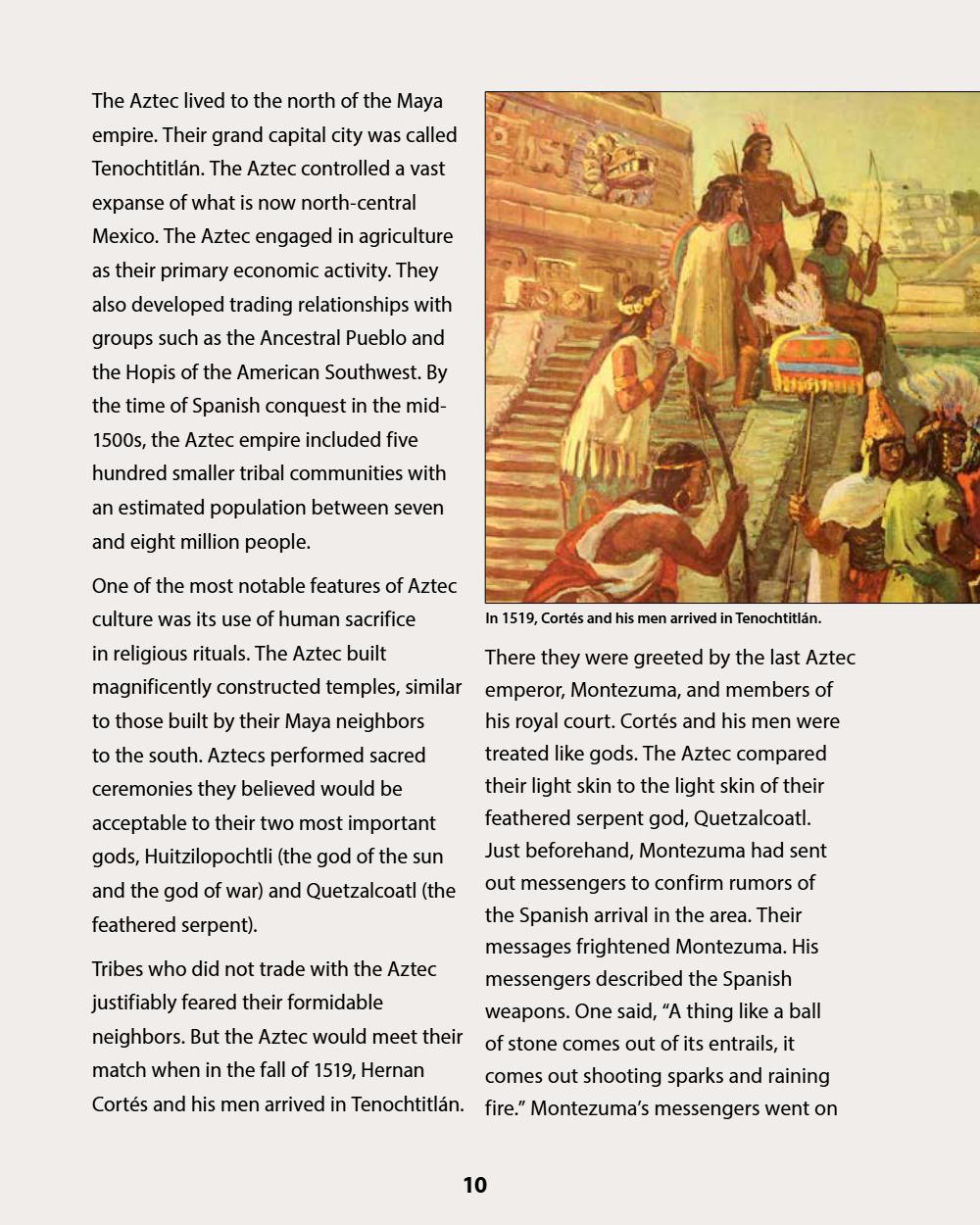
In 1519, Cortés and his men arrived in Tenochtitlán.
in religious rituals. The Aztec built
There they were greeted by the last Aztec
magnificently constructed temples, similar
emperor, Montezuma, and members of
to those built by their Maya neighbors
his royal court. Cortés and his men were
to the south. Aztecs performed sacred
treated like gods. The Aztec compared
ceremonies they believed would be
their light skin to the light skin of their
acceptable to their two most important
feathered serpent god, Quetzalcoatl.
gods, Huitzilopochtli (the god of the sun
Just beforehand, Montezuma had sent
and the god of war) and Quetzalcoatl (the
out messengers to confirm rumors of
feathered serpent).
the Spanish arrival in the area. Their
Tribes who did not trade with the Aztec
messengers described the Spanish
messages frightened Montezuma. His
justifiably feared their formidable
neighbors. But the Aztec would meet their
match when in the fall of 1519, Hernan
weapons. One said, “A thing like a ball
of stone comes out of its entrails, it
comes out shooting sparks and raining
Cortés and his men arrived in Tenochtitlán. fire.” Montezuma’s messengers went on
10
defeated by the firepower of the Spanish.
Montezuma himself died at their hands.
Think Twice
What do you think Montezuma’s
messengers were describing?
Perhaps even more deadly than Cortés’s
armed invasions into Aztec territory were
European diseases such as smallpox,
measles, and mumps. Although these
diseases were common in Europe,
indigenous people lacked immunity or
resistance to them. One Catholic priest
observed the effect these diseases had
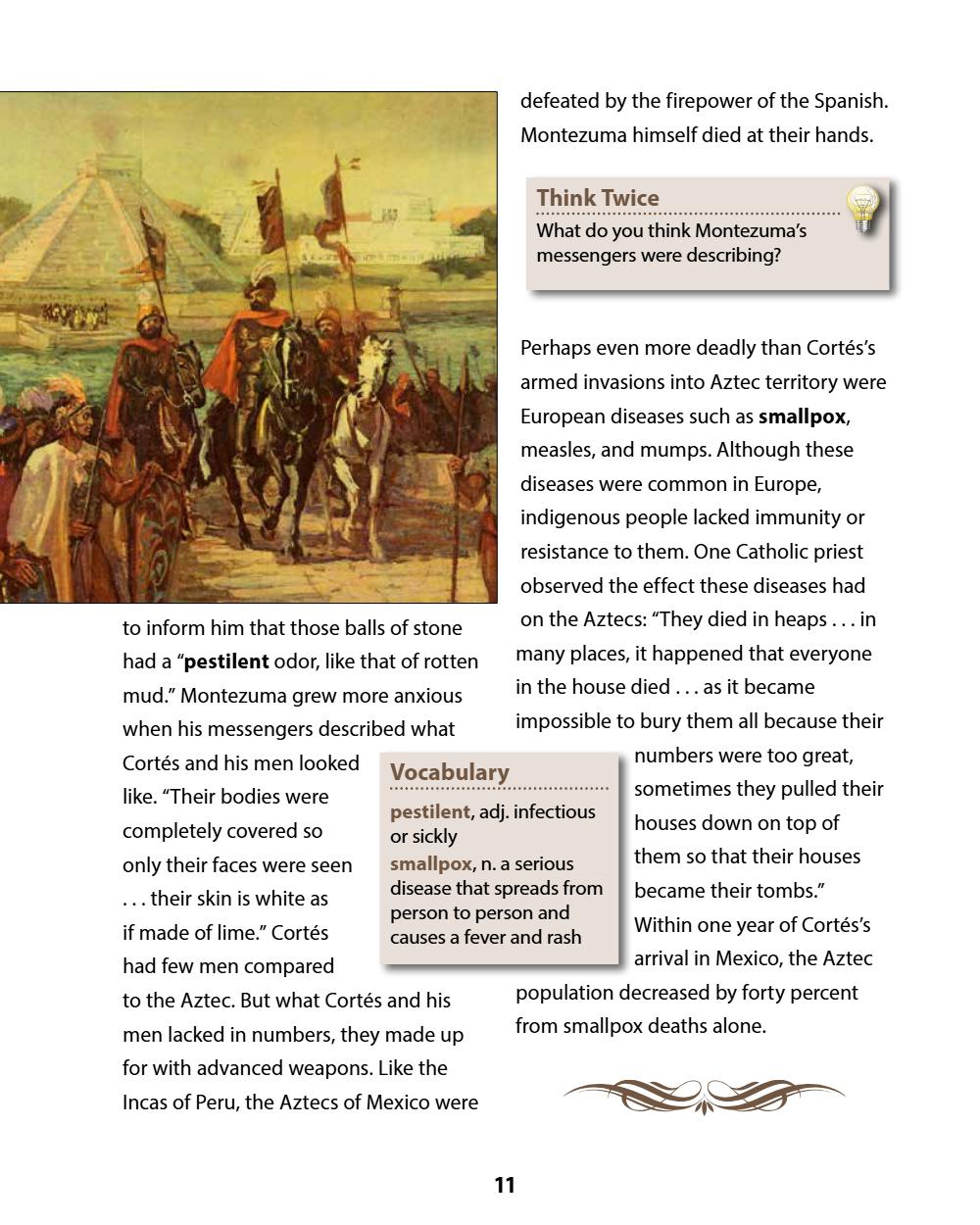
to inform him that those balls of stone
on the Aztecs: “They died in heaps . . . in
had a “pestilent odor, like that of rotten
many places, it happened that everyone
mud.” Montezuma grew more anxious
in the house died . . . as it became
when his messengers described what
impossible to bury them all because their
Cortés and his men looked
like. “Their bodies were
completely covered so
only their faces were seen
. . . their skin is white as
if made of lime.” Cortés
numbers were too great,
Vocabulary
pestilent, adj. infectious
or sickly
smallpox, n. a serious
disease that spreads from
person to person and
causes a fever and rash
had few men compared
sometimes they pulled their
houses down on top of
them so that their houses
became their tombs.”
Within one year of Cortés’s
arrival in Mexico, the Aztec
to the Aztec. But what Cortés and his
population decreased by forty percent
men lacked in numbers, they made up
from smallpox deaths alone.
for with advanced weapons. Like the
Incas of Peru, the Aztecs of Mexico were
11
The American Southwest
The American Southwest has unique
geographic features, with mesas, canyons,
and plateaus that stretch for miles. It has a
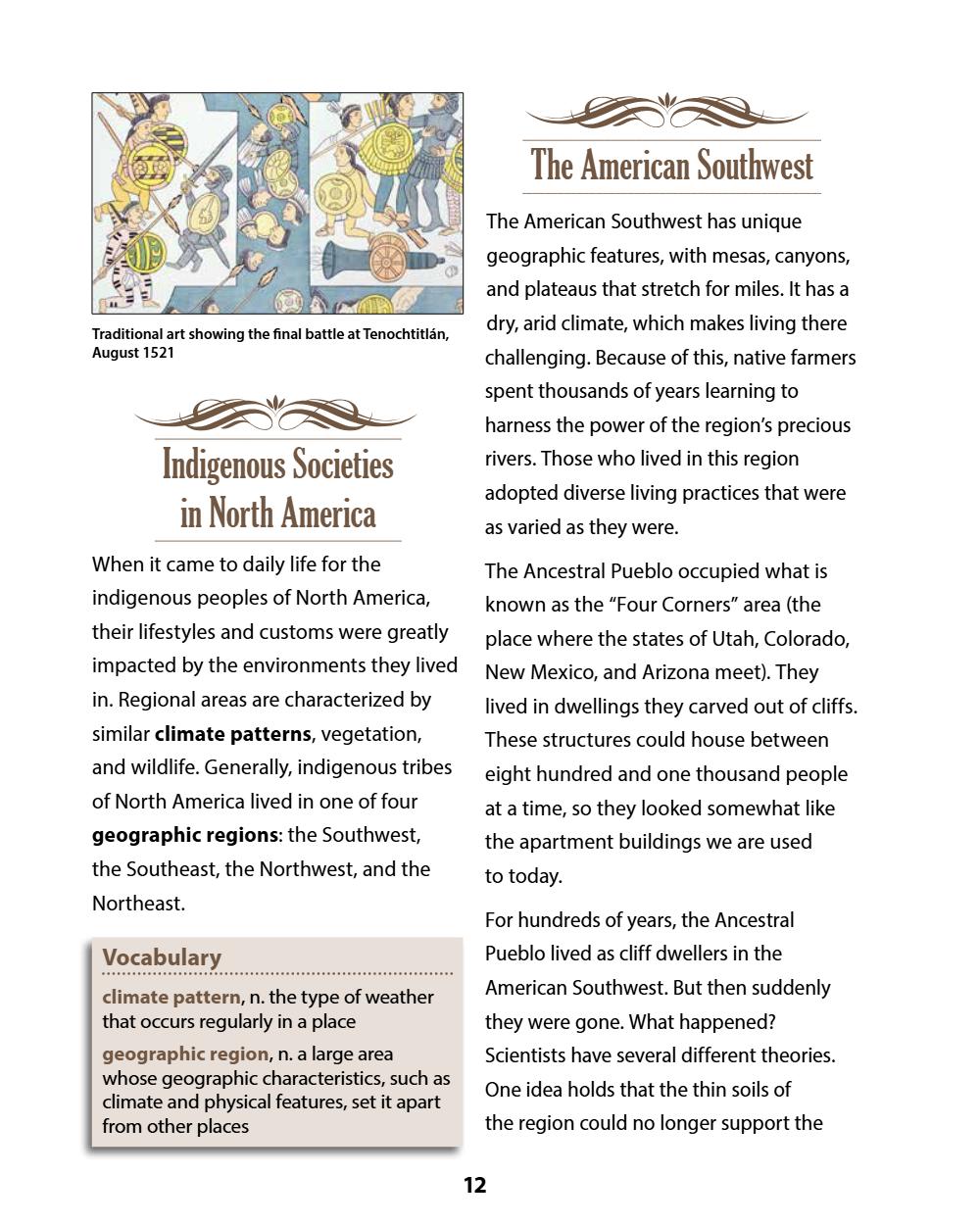
Traditional art showing the final battle at Tenochtitlán,
August 1521
dry, arid climate, which makes living there
challenging. Because of this, native farmers
spent thousands of years learning to
harness the power of the region’s precious
Indigenous Societies
in North America
rivers. Those who lived in this region
adopted diverse living practices that were
as varied as they were.
When it came to daily life for the
The Ancestral Pueblo occupied what is
indigenous peoples of North America,
known as the “Four Corners” area (the
their lifestyles and customs were greatly
place where the states of Utah, Colorado,
impacted by the environments they lived
New Mexico, and Arizona meet). They
in. Regional areas are characterized by
lived in dwellings they carved out of cliffs.
similar climate patterns, vegetation,
These structures could house between
and wildlife. Generally, indigenous tribes
eight hundred and one thousand people
of North America lived in one of four
at a time, so they looked somewhat like
geographic regions: the Southwest,
the apartment buildings we are used
the Southeast, the Northwest, and the
to today.
Northeast.
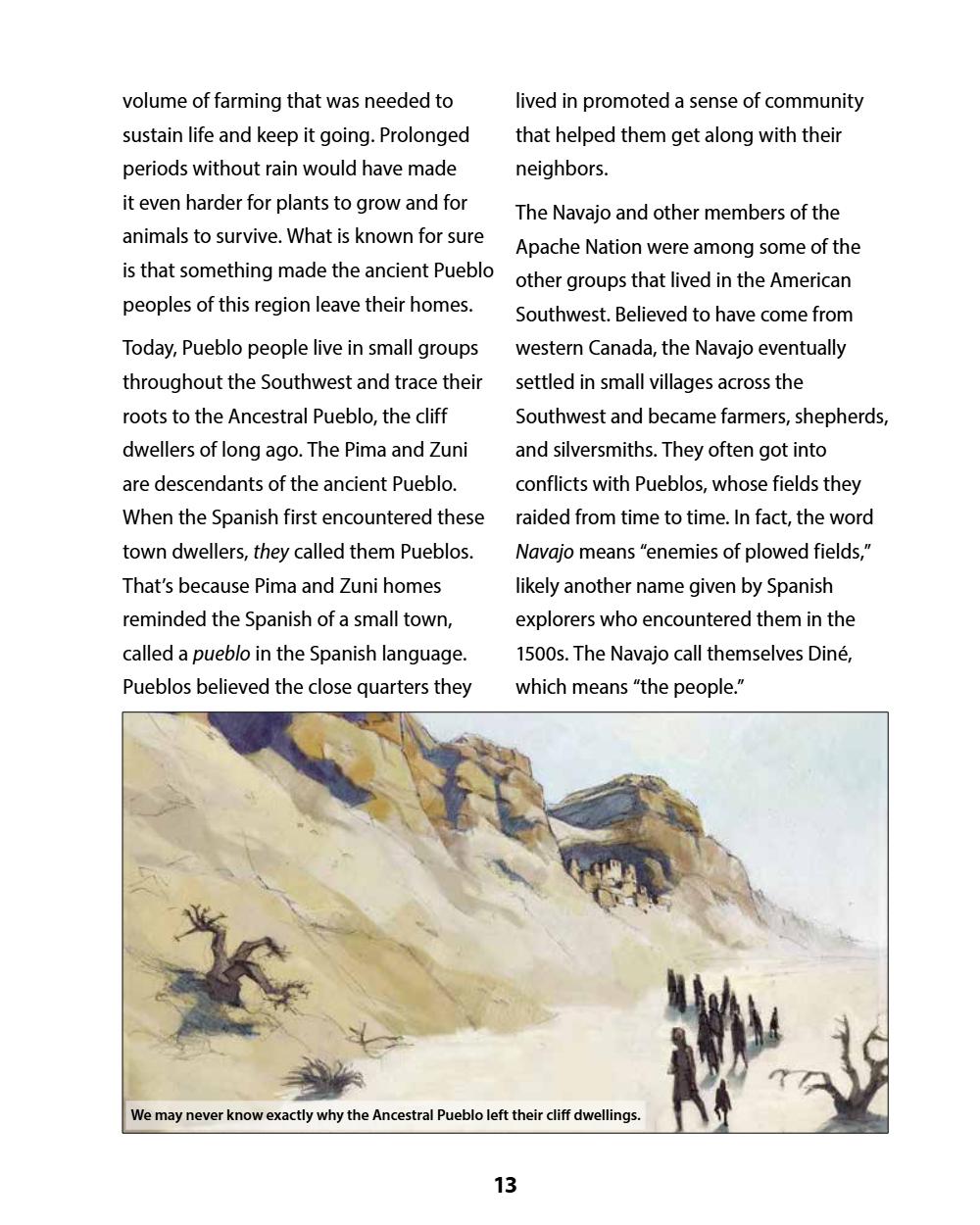
For hundreds of years, the Ancestral
Vocabulary
Pueblo lived as cliff dwellers in the
climate pattern, n. the type of weather
that occurs regularly in a place
American Southwest. But then suddenly
geographic region, n. a large area
whose geographic characteristics, such as
climate and physical features, set it apart
from other places
Scientists have several different theories.
they were gone. What happened?
One idea holds that the thin soils of
the region could no longer support the
12
volume of farming that was needed to
lived in promoted a sense of community
sustain life and keep it going. Prolonged
that helped them get along with their
periods without rain would have made
neighbors.
it even harder for plants to grow and for
The Navajo and other members of the
animals to survive. What is known for sure
is that something made the ancient Pueblo
peoples of this region leave their homes.
Apache Nation were among some of the
other groups that lived in the American
Southwest. Believed to have come from
Today, Pueblo people live in small groups
western Canada, the Navajo eventually
throughout the Southwest and trace their
settled in small villages across the
roots to the Ancestral Pueblo, the cliff
Southwest and became farmers, shepherds,
dwellers of long ago. The Pima and Zuni
and silversmiths. They often got into
are descendants of the ancient Pueblo.
conflicts with Pueblos, whose fields they
When the Spanish first encountered these
raided from time to time. In fact, the word
town dwellers, they called them Pueblos.
Navajo means “enemies of plowed fields,”
That’s because Pima and Zuni homes
likely another name given by Spanish
reminded the Spanish of a small town,
explorers who encountered them in the
called a pueblo in the Spanish language.
1500s. The Navajo call themselves Diné,
Pueblos believed the close quarters they
which means “the people.”
We may never know exactly why the Ancestral Pueblo left their cliff dwellings.
13
native language, the name Inuit means
“the people,” and this is the name they
used when referring to themselves. Just
as with other indigenous groups who
lived in other regions, the Inuit had to
learn to adapt to living in their extreme
environment. The Inuit had no access to
typical building materials such as wood or
sun-dried mud bricks. So the Inuit learned
how to make warm housing from snow
and ice in the winter (igloos) and from
stretched animal skins, driftwood, and
whalebone in the summer. Because they
lived in the very cold climate of the Arctic,
they needed warm, thick clothing, which
they made from seal, otter, and caribou
skin. They lined the coats they made from
these animal skins with the furs of polar
bears, rabbits, and foxes. One way in
which the Inuit secured food was through
ice fishing. Inuit fishermen bored holes in
the ice and caught fish in the icy waters
below. Upon catching the fish, they would
allow it to freeze in the icy air. When they
were ready to cook it, the fish tasted just
as fresh as the day that it was frozen. The
Inuit process of freezing their fish would
inspire future generations to preserve and
The American Northwest
Indigenous groups who lived in the
American Northwest lived in areas that
make up the modern states of Alaska,
Washington, Oregon, and northern
California. The people in this region
farmed. They also took advantage of their
natural surroundings to provide them
with food and the makings for shelter and
cultural artifacts. This meant that they
turned to the region’s abundant lakes,
rivers, and streams for fish and other
aquatic animals to
Vocabulary
eat. They used the
heavily forested
cultural artifact, n. an
object that reflects the
areas to construct
life, beliefs, and society
shelter, boats,
of a group of people
and religious
artifacts. Perhaps the two best known
tribes in this region were the Haida and
the Inuit. The Haida were known for the
totem poles they created. Totem poles are
wooden carvings that are decorated with
brightly colored likenesses of animals and
human figures. Totem poles were symbols
of a family’s power and rank. The more
elaborate the carvings were, the more
powerful the family.
prepare their food in much the same way.
Writers’ Corner
The Inuit were and are indigenous people
who occupied the Arctic regions of
Canada and the United States. In their own
14
Write a paragraph on the various
challenges faced by indigenous
people living in either a very dry
environment or a frozen one.
The Iroquois Confederacy, initially made
up of the Five Nations, lived on lands
The American Northeast
in what is now New York, Vermont,
The American Northeast expands from
representative leaders whose job
the north, bordering Canada, to east
was to discuss and ultimately vote on
of the Mississippi River, to the Atlantic
solutions to problems. But for a decision
Coast. The indigenous people of the
to pass, there had to be a unanimous
American Northeast had the best climate
vote. This judicial style of government
to achieve success in farming. They did
provided the ability to settle conflicts
not have to substantially improve their
between neighbors and to regulate
environments to farm successfully. The
commerce. Most of the nations who
people of this region are also known by
joined the confederacy, also known as
the general name, Eastern Woodlands
the Haudenosaunee Confederacy, lived in
Indians. One characteristic of these
what is now New York State. The nations
people is that they lived under complex
were the Mohawk, the Onondaga, the
systems of government. Their complex
Seneca, the Oneida, and the Cayuga.
and Connecticut. Each nation selected
government easily shatters stereotypes
that claim Native Americans were less
Vocabulary
organized and less sophisticated than
judicial, adj. having to do with
courts of law or decisions of right
and wrong
Europeans. One group with a particularly
sophisticated government was the
commerce, n. the buying and
selling of goods and services;
trade
Iroquois. Although they did not have a
written language, the Iroquois were a
remarkable group in terms of the form
of government they established. Their
Historical evidence suggests that the
approach to making laws and keeping
Iroquois and some of their neighbors,
the peace was so impressive that later,
such as the Narraganset, the Powhatan,
American colonists such as Benjamin
the Algonquin, the Delaware, and the
Franklin would look to the Iroquois for
inspiration when designing a government
for a brand-new nation.
Cree, functioned in democratic societies
where women were vital members of the
15
decision-making process. All adults—
men and women—had a voice in making
The Eastern Woodlands
decisions. The women were very skilled
farmers and produced much of the food
for the community.
The strength of the Haudenosaunee
Confederacy earned praise from
many Europeans and colonists. Some
confederacy ceremonies became famous
throughout North America. For example,
the confederacy’s council meetings,
where Haudenosaunee leaders discussed
common problems, were called to order
by the smoking of a pipe. The saying
“smoking the peace pipe” comes from
this tradition. Like “burying the hatchet,”
“smoking the peace pipe” has become
part of our everyday language. It means
By the time Columbus landed in the
Caribbean isles in 1492, many different
indigenous peoples were living in the
Eastern Woodlands of North America.
The Eastern Woodlands stretched from
Lake Superior to the Atlantic Coast. The
landscape of the Eastern Woodlands
was mostly forest. Most people lived
in clearings within forested areas near
creeks, rivers, lakes, or ponds. The forest
provided plenty of wood and forest
materials for building and for fuel, many
large and small animals and birds to
hunt, an almost year-round supply of fish,
sitting down and calmly talking over a
and plenty of roots, berries, and nuts to
problem to reach a fair solution.
collect. Besides all of the food that was
available just outside the door, the land
Think Twice
What natural advantage or
advantages did the indigenous
people of the Northeast have over
those people living in the American
Southwest?
could be cleared in order to plant crops.
The soil was rich, even though in some
areas the growing season was short.
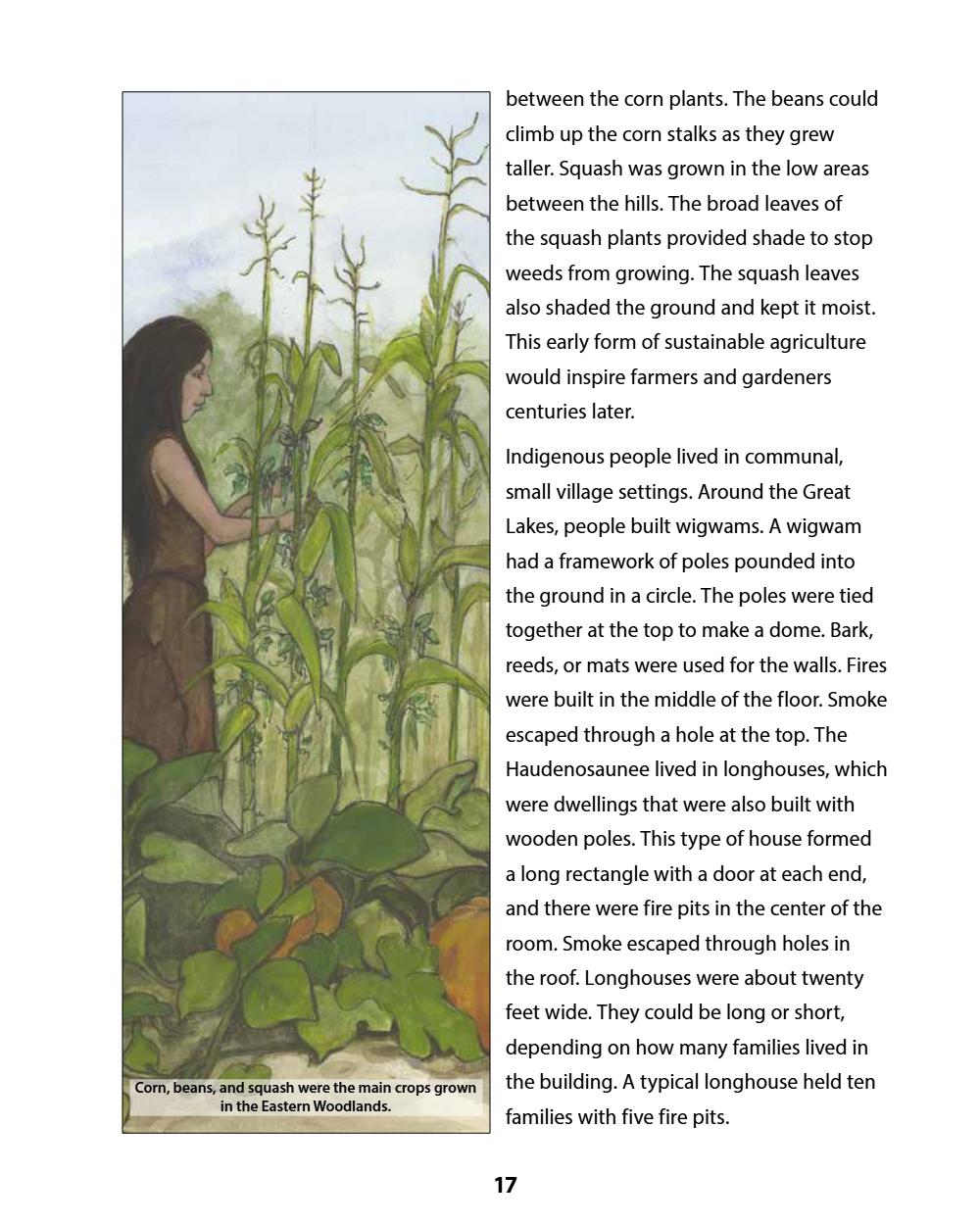
Corn, beans, and squash were the main
crops. The Haudenosaunee called these
main crops “the three sisters.” All three
crops were planted together.
Corn seeds were planted in rows of little
hills, one step apart. Beans were planted
16
between the corn plants. The beans could
climb up the corn stalks as they grew
taller. Squash was grown in the low areas
between the hills. The broad leaves of
the squash plants provided shade to stop
weeds from growing. The squash leaves
also shaded the ground and kept it moist.
This early form of sustainable agriculture
would inspire farmers and gardeners
centuries later.
Indigenous people lived in communal,
small village settings. Around the Great
Lakes, people built wigwams. A wigwam
had a framework of poles pounded into
the ground in a circle. The poles were tied
together at the top to make a dome. Bark,
reeds, or mats were used for the walls. Fires
were built in the middle of the floor. Smoke
escaped through a hole at the top. The
Haudenosaunee lived in longhouses, which
were dwellings that were also built with
wooden poles. This type of house formed
a long rectangle with a door at each end,
and there were fire pits in the center of the
room. Smoke escaped through holes in
the roof. Longhouses were about twenty
feet wide. They could be long or short,
depending on how many families lived in
Corn, beans, and squash were the main crops grown
in the Eastern Woodlands.
the building. A typical longhouse held ten
families with five fire pits.
17
Another group of Eastern Woodlands
was called the Mound Builders. They
Native Americans was the Mahican.
once lived near rivers in what is now the
Their name comes from muh-he-cn-nuk,
Midwest and in the Southeast. The Mound
which means great water that is always
Builders way of life began about 2,800
moving, either flowing or ebbing. Stories
years ago. This was
passed down for many years tell about
about the same time
the Mahican crossing over the water that
as the civilization
gave them their name. This water, said
of ancient Greece.
the legend, was far in the north. There,
Like the Ancestral
two lands were nearly connected. From
Pueblo, the Mound
there the Mahican traveled east, and they
Builders were
crossed many rivers. Finally, they found
farmers, growing
a place that seemed like home. It was
corn, squash, and
the valley of the Hudson River. This old
beans. Because they were farmers, the
Mahican story closely matches the theory
Mound Builders settled in one place. They
of the Beringian land bridge route, which
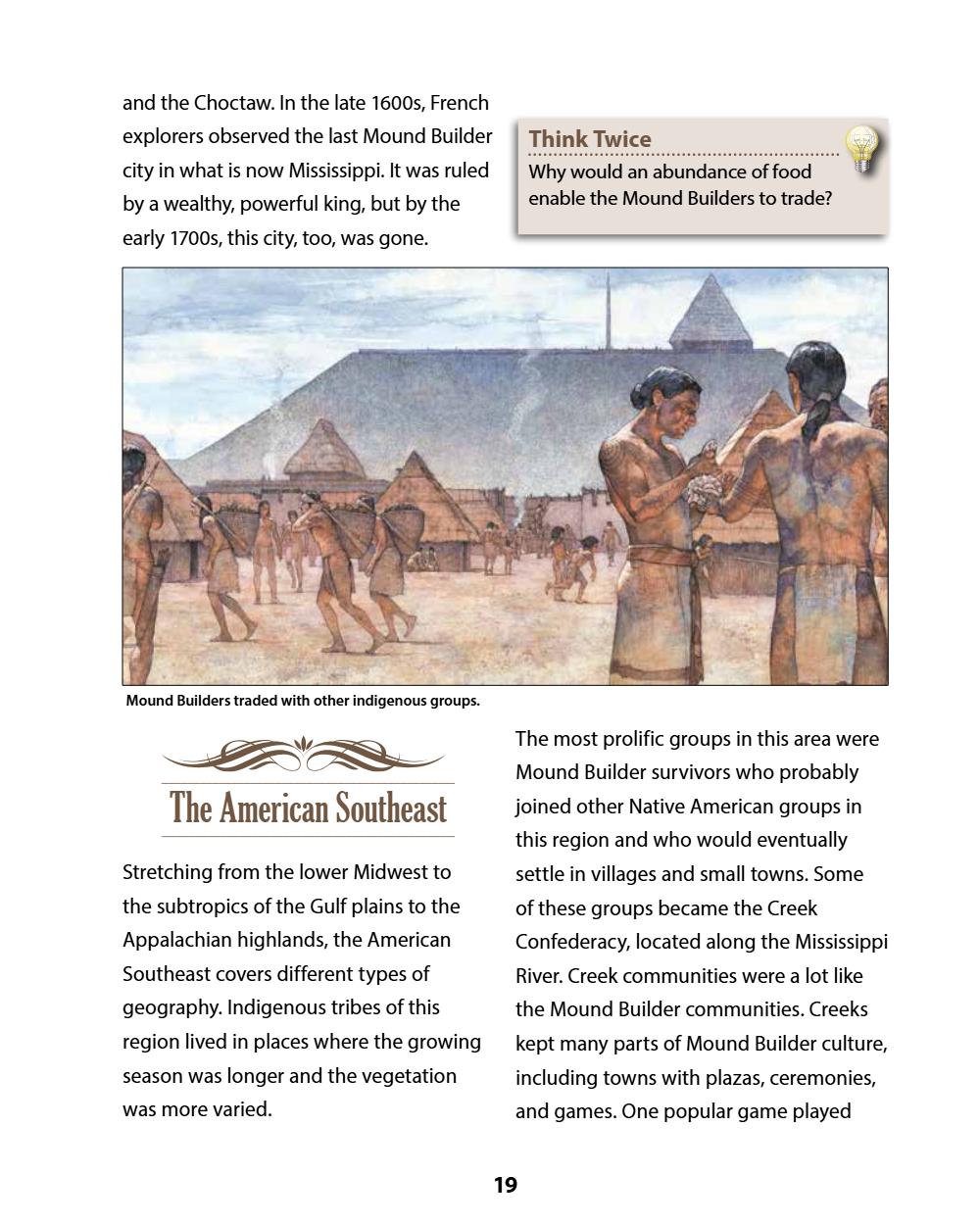
raised so much food that they could trade
archaeologists have confirmed.
with other groups. They built cities, roads,
Vocabulary
Mound Builders,
n. prehistoric Native
American people
who lived in the
Mississippi River
Valley and were
known by the huge
earthen mounds
they built
and marketplaces. The cities and towns
Think Twice
What level of cooperation would be
needed for ten families to live in one
home, or longhouse?
they constructed lasted for centuries.
Though once it was a mystery, scientists
have discovered the cause of the decline
of Mound Builder civilizations. Like the
Aztecs, the people of the Mississippi Valley
were exposed to new diseases when
The Mound Builders
European explorers arrived in the 1500s.
In a very short time, the diseases swept
Just as the Ancestral Pueblo did, other
through whole communities, and many
early indigenous groups learned to live
died. Survivors of the Mound Builders
in a way that seems very mysterious
became the Native American nations
to us today. One such group of people
known today as the Creek, the Cherokee,
18
and the Choctaw. In the late 1600s, French
explorers observed the last Mound Builder
Think Twice
city in what is now Mississippi. It was ruled
Why would an abundance of food
enable the Mound Builders to trade?
by a wealthy, powerful king, but by the
early 1700s, this city, too, was gone.
Mound Builders traded with other indigenous groups.
The most prolific groups in this area were
The American Southeast
Mound Builder survivors who probably
joined other Native American groups in
this region and who would eventually
Stretching from the lower Midwest to
settle in villages and small towns. Some
the subtropics of the Gulf plains to the
of these groups became the Creek
Appalachian highlands, the American
Confederacy, located along the Mississippi
Southeast covers different types of
River. Creek communities were a lot like
geography. Indigenous tribes of this
the Mound Builder communities. Creeks
region lived in places where the growing
kept many parts of Mound Builder culture,
season was longer and the vegetation
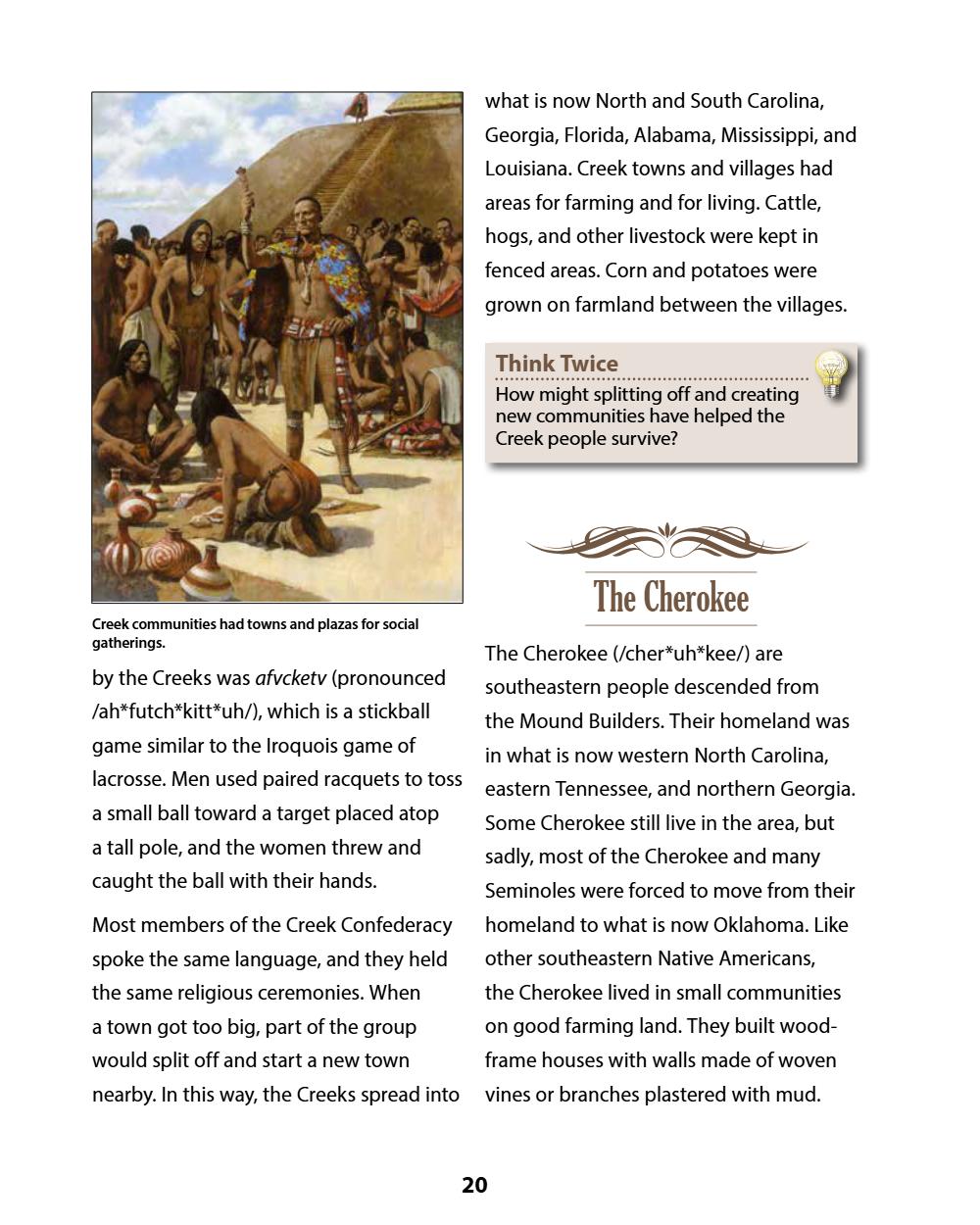
including towns with plazas, ceremonies,
was more varied.
and games. One popular game played
19
what is now North and South Carolina,
Georgia, Florida, Alabama, Mississippi, and
Louisiana. Creek towns and villages had
areas for farming and for living. Cattle,
hogs, and other livestock were kept in
fenced areas. Corn and potatoes were
grown on farmland between the villages.
Think Twice
How might splitting off and creating
new communities have helped the
Creek people survive?
The Cherokee
Creek communities had towns and plazas for social
gatherings.
The Cherokee (/cher*uh*kee/) are
by the Creeks was afvcketv (pronounced
southeastern people descended from
/ah*futch*kitt*uh/), which is a stickball
the Mound Builders. Their homeland was
game similar to the Iroquois game of
lacrosse. Men used paired racquets to toss
a small ball toward a target placed atop
a tall pole, and the women threw and
caught the ball with their hands.
in what is now western North Carolina,
eastern Tennessee, and northern Georgia.
Some Cherokee still live in the area, but
sadly, most of the Cherokee and many
Seminoles were forced to move from their
Most members of the Creek Confederacy
homeland to what is now Oklahoma. Like
spoke the same language, and they held
other southeastern Native Americans,
the same religious ceremonies. When
the Cherokee lived in small communities
a town got too big, part of the group
on good farming land. They built wood-
would split off and start a new town
frame houses with walls made of woven
nearby. In this way, the Creeks spread into
vines or branches plastered with mud.
20
Sequoyah
The Seminoles
The written language of the Cherokee
Members of the Seminole
was created by a man named Sequoyah
(/seh*muh*nole/) Nation are also
(/sih*kwoi*uh/). He was born in the
descended from the Mound Builders.
1770s in Tennessee. Sequoyah became
Today, many Seminoles live in Florida and
interested in books and letters, which he
Oklahoma. Every Seminole is a member
had seen written in English. He invented a
of one of eight clans, or family groups,
set of symbols for the Cherokee language.
named Bear, Deer, Wind, Bigtown, Bird,
This allowed the Cherokee language to
Snake, Otter, and Panther. The Panther
be written and read. Sequoyah taught
clan is the largest. The Seminoles believe
many Cherokee people to write the new
in nature spirits, including animal spirits.
language. In fact, it is still used today.
The spirits guide them in terms of how
to live. Seminole children belong to their
mothers’ clans.
Each village had a central building,
control over the people. The people had
or council house, for celebrations,
a say in how they were ruled. Like other
ceremonies, and meetings. This council
North American indigenous groups,
house had seven sides, each representing
the Cherokee told many legends. These
one of the Cherokee clans. The clans were
legends explained how their world had
Bird, Paint, Deer, Wolf, Blue, Long Hair,
come into being and how people should
and Wild Potato. Each group of Cherokee
live. In the late 1700s and early 1800s,
had two chiefs: one chief ruled during
the Cherokee became the only Native
peacetime, the other during war. The
American people in the United States
chiefs helped guide the people and make
who kept written records in their
decisions, but they did not have complete own language.
21
Shared Cultural Traits and Sources of Conflict
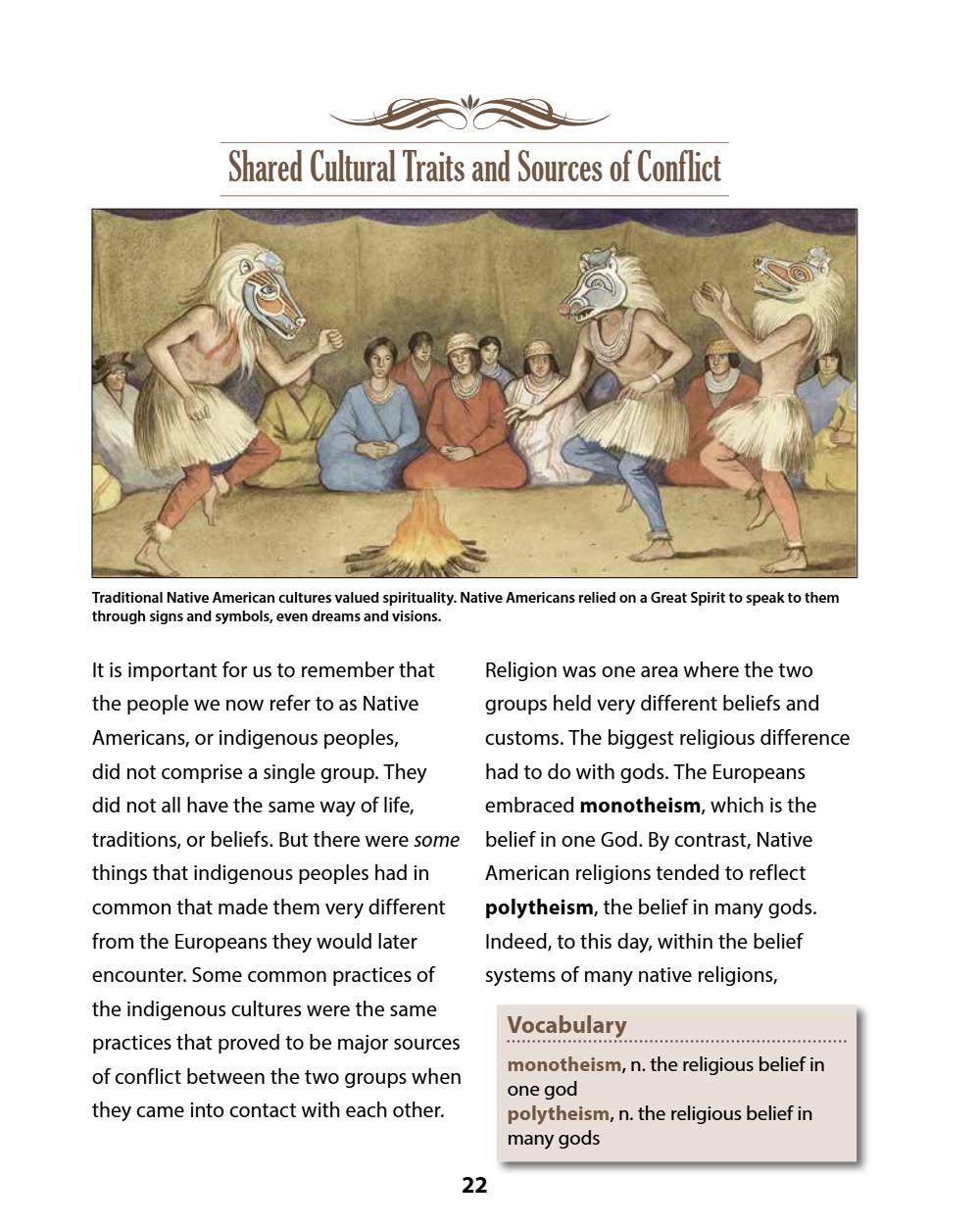
Traditional Native American cultures valued spirituality. Native Americans relied on a Great Spirit to speak to them
through signs and symbols, even dreams and visions.
It is important for us to remember that
Religion was one area where the two
the people we now refer to as Native
groups held very different beliefs and
Americans, or indigenous peoples,
customs. The biggest religious difference
did not comprise a single group. They
had to do with gods. The Europeans
did not all have the same way of life,
embraced monotheism, which is the
traditions, or beliefs. But there were some
belief in one God. By contrast, Native
things that indigenous peoples had in
American religions tended to reflect
common that made them very different
polytheism, the belief in many gods.
from the Europeans they would later
Indeed, to this day, within the belief
encounter. Some common practices of
systems of many native religions,
the indigenous cultures were the same
Vocabulary
practices that proved to be major sources
monotheism, n. the religious belief in
one god
polytheism, n. the religious belief in
many gods
of conflict between the two groups when
they came into contact with each other.
22
everything in the natural world
possesses a spirit and is therefore
entitled to some form of worship or
adoration.
Europeans’ beliefs sprang from
Christianity, the Christian Bible and the
catechism, and the clergy, or religious
leaders, who taught them. Indigenous
societies, instead, almost always relied
on traditions and values that were
passed down orally from the elders to
everyone else.
Indigenous groups also received
inspiration from people known as
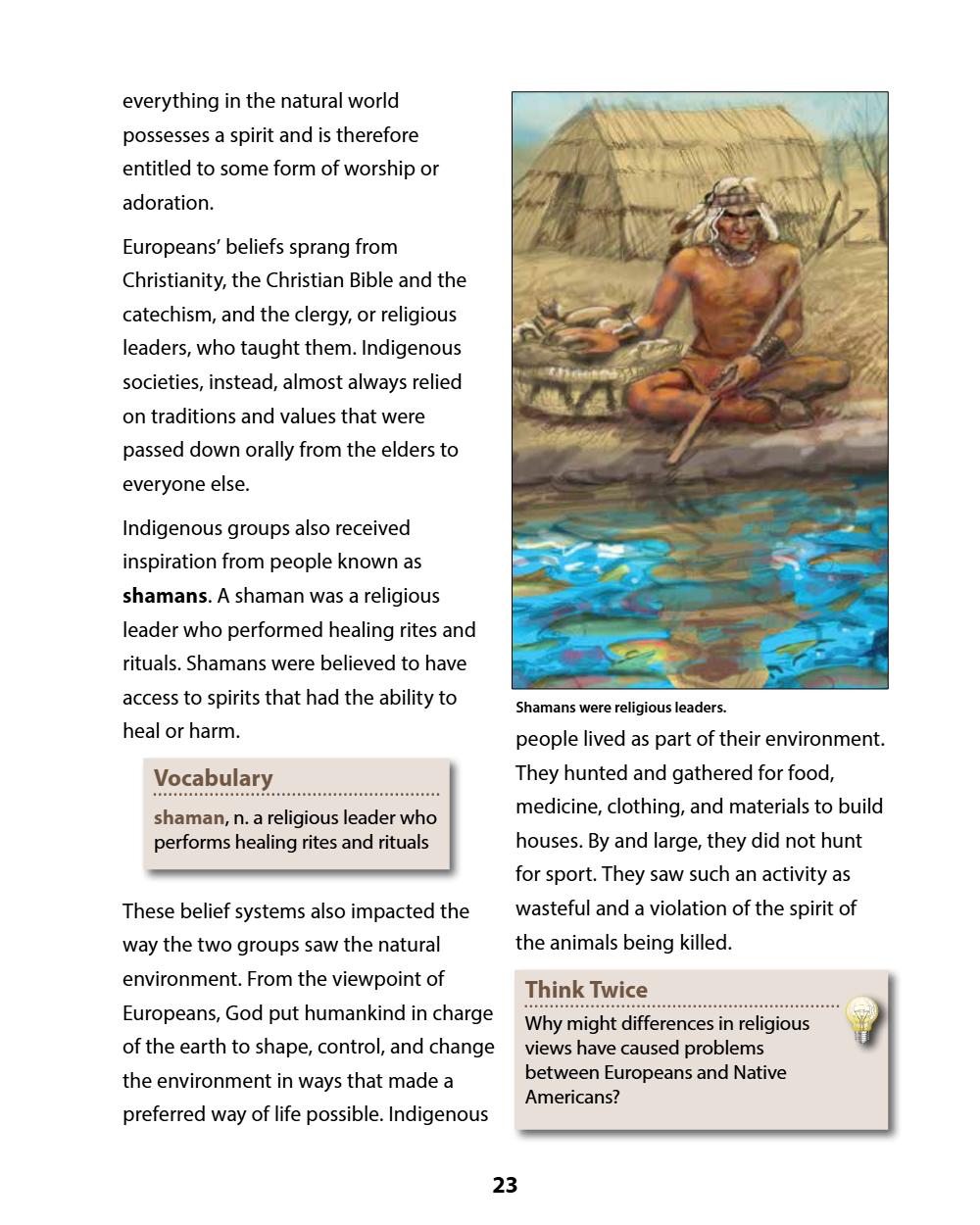
shamans. A shaman was a religious
leader who performed healing rites and
rituals. Shamans were believed to have
access to spirits that had the ability to
Shamans were religious leaders.
heal or harm.
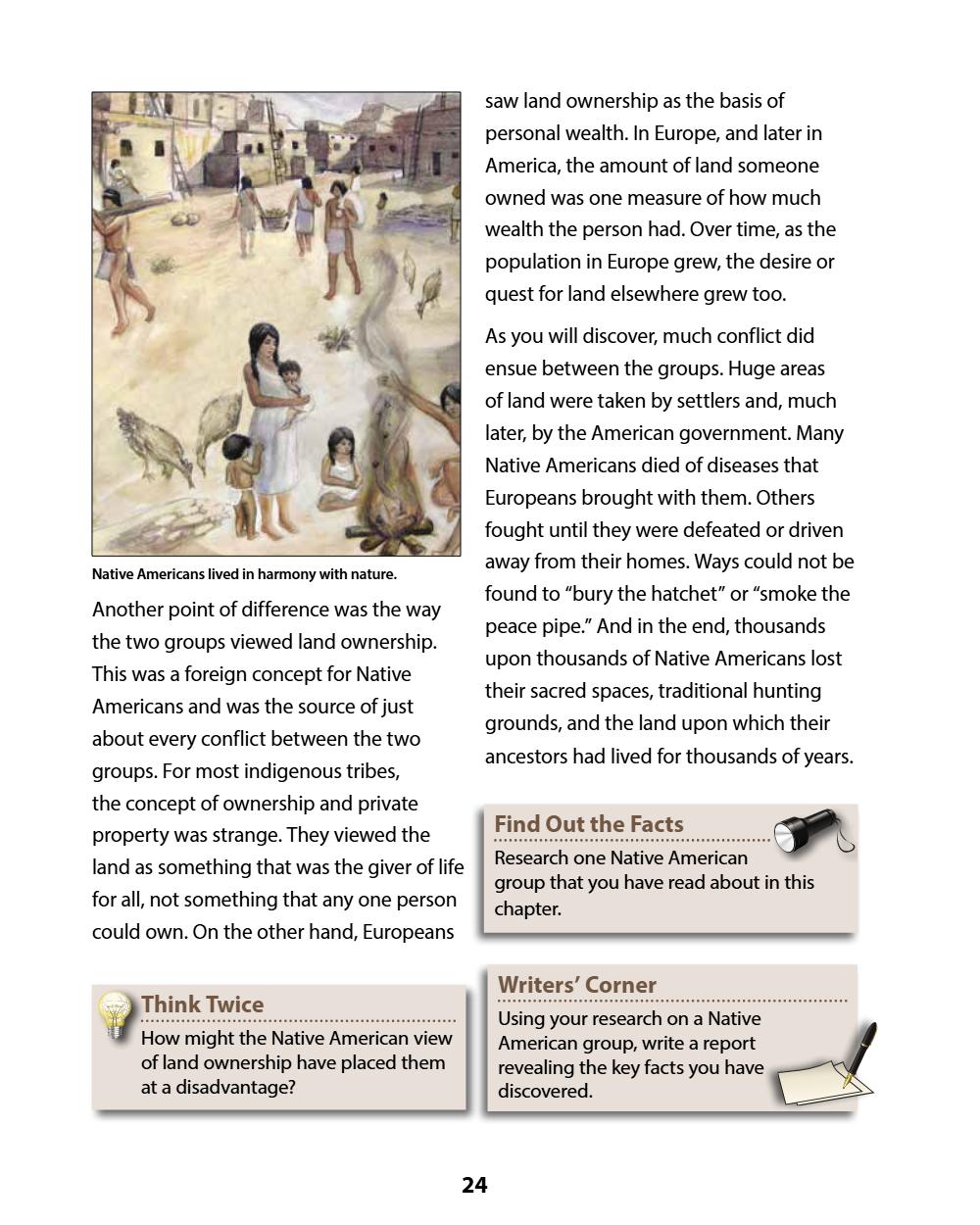
people lived as part of their environment.
They hunted and gathered for food,
Vocabulary
medicine, clothing, and materials to build
shaman, n. a religious leader who
performs healing rites and rituals
houses. By and large, they did not hunt
for sport. They saw such an activity as
These belief systems also impacted the
wasteful and a violation of the spirit of
way the two groups saw the natural
the animals being killed.
environment. From the viewpoint of
Think Twice
Europeans, God put humankind in charge
of the earth to shape, control, and change
the environment in ways that made a
preferred way of life possible. Indigenous
23
Why might differences in religious
views have caused problems
between Europeans and Native
Americans?
saw land ownership as the basis of
personal wealth. In Europe, and later in
America, the amount of land someone
owned was one measure of how much
wealth the person had. Over time, as the
population in Europe grew, the desire or
quest for land elsewhere grew too.
As you will discover, much conflict did
ensue between the groups. Huge areas
of land were taken by settlers and, much
later, by the American government. Many
Native Americans died of diseases that
Europeans brought with them. Others
fought until they were defeated or driven
away from their homes. Ways could not be
Native Americans lived in harmony with nature.
found to “bury the hatchet” or “smoke the
Another point of difference was the way
peace pipe.” And in the end, thousands
the two groups viewed land ownership.
upon thousands of Native Americans lost
This was a foreign concept for Native
their sacred spaces, traditional hunting
Americans and was the source of just
grounds, and the land upon which their
about every conflict between the two
ancestors had lived for thousands of years.
groups. For most indigenous tribes,
the concept of ownership and private
Find Out the Facts
property was strange. They viewed the
land as something that was the giver of life
for all, not something that any one person
could own. On the other hand, Europeans
Research one Native American
group that you have read about in this
chapter.
Writers’ Corner
Think Twice
Using your research on a Native
American group, write a report
revealing the key facts you have
discovered.
How might the Native American view
of land ownership have placed them
at a disadvantage?
24
The Earliest Europeans in America Were Vikings
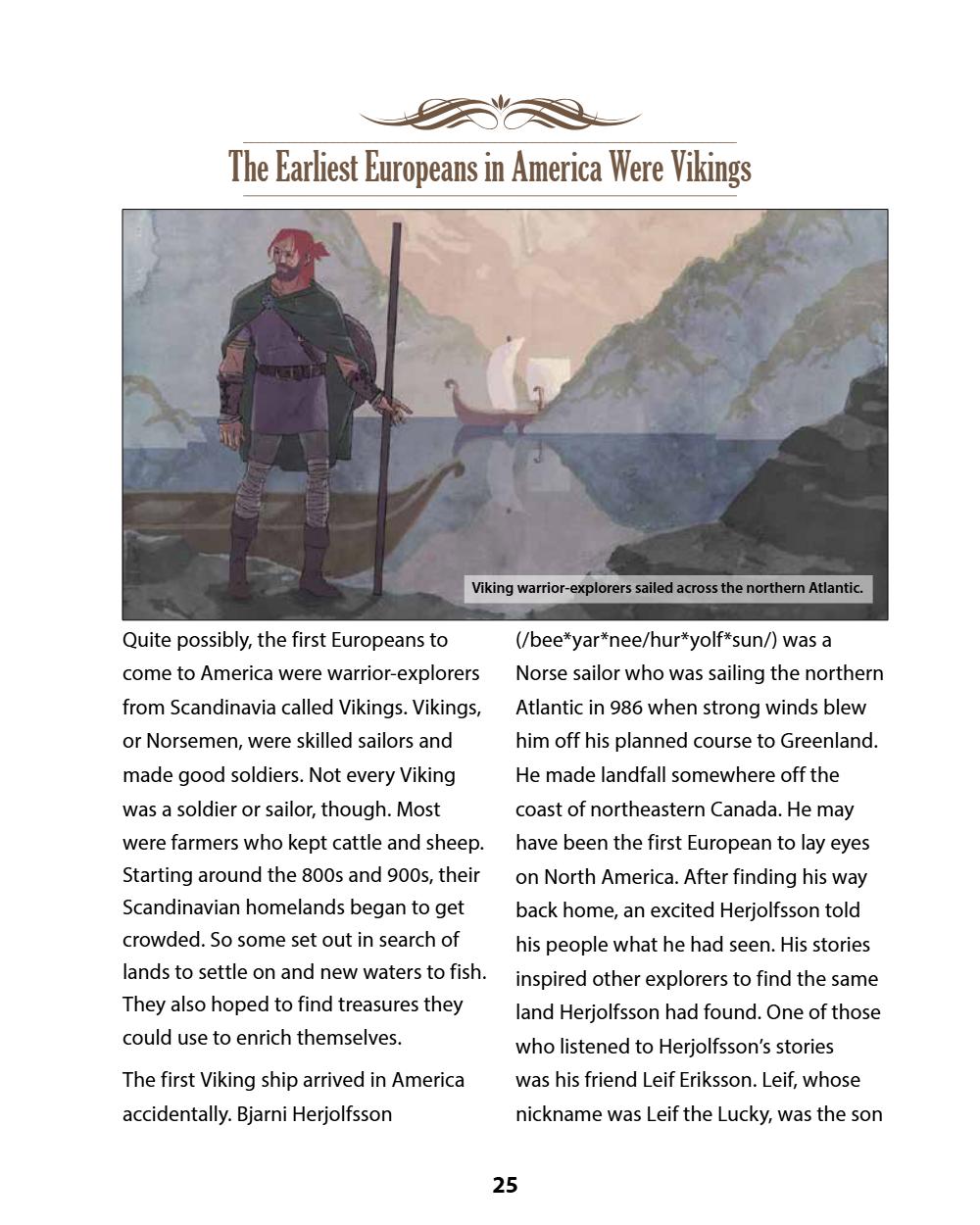
Viking warrior-explorers sailed across the northern Atlantic.
Quite possibly, the first Europeans to
(/bee*yar*nee/hur*yolf*sun/) was a
come to America were warrior-explorers
Norse sailor who was sailing the northern
from Scandinavia called Vikings. Vikings,
Atlantic in 986 when strong winds blew
or Norsemen, were skilled sailors and
him off his planned course to Greenland.
made good soldiers. Not every Viking
He made landfall somewhere off the
was a soldier or sailor, though. Most
coast of northeastern Canada. He may
were farmers who kept cattle and sheep.
have been the first European to lay eyes
Starting around the 800s and 900s, their
on North America. After finding his way
Scandinavian homelands began to get
back home, an excited Herjolfsson told
crowded. So some set out in search of
his people what he had seen. His stories
lands to settle on and new waters to fish.
inspired other explorers to find the same
They also hoped to find treasures they
could use to enrich themselves.
land Herjolfsson had found. One of those
who listened to Herjolfsson’s stories
The first Viking ship arrived in America
was his friend Leif Eriksson. Leif, whose
accidentally. Bjarni Herjolfsson
nickname was Leif the Lucky, was the son
25
of Erik the Red, who
was believed to be the first
European to discover Greenland.
Eriksson was a good sailor. He
followed Herjolfsson’s route
and landed in a place he called
Vinland because of the wild
vines he saw growing there.
Vinland was probably the modern
Canadian province of Nova Scotia.
The vines Eriksson saw were likely
berry bushes.
Eriksson’s expedition led the way
for others to follow, including
his brother Thorvald. As part
of another Viking expedition
some years later, a colony was
established that is believed to
have lasted roughly three years.
Find Out the Facts
Find out more about
Viking culture.
Writers’ Corner
Using your research,
write a report on
Vikings.
26
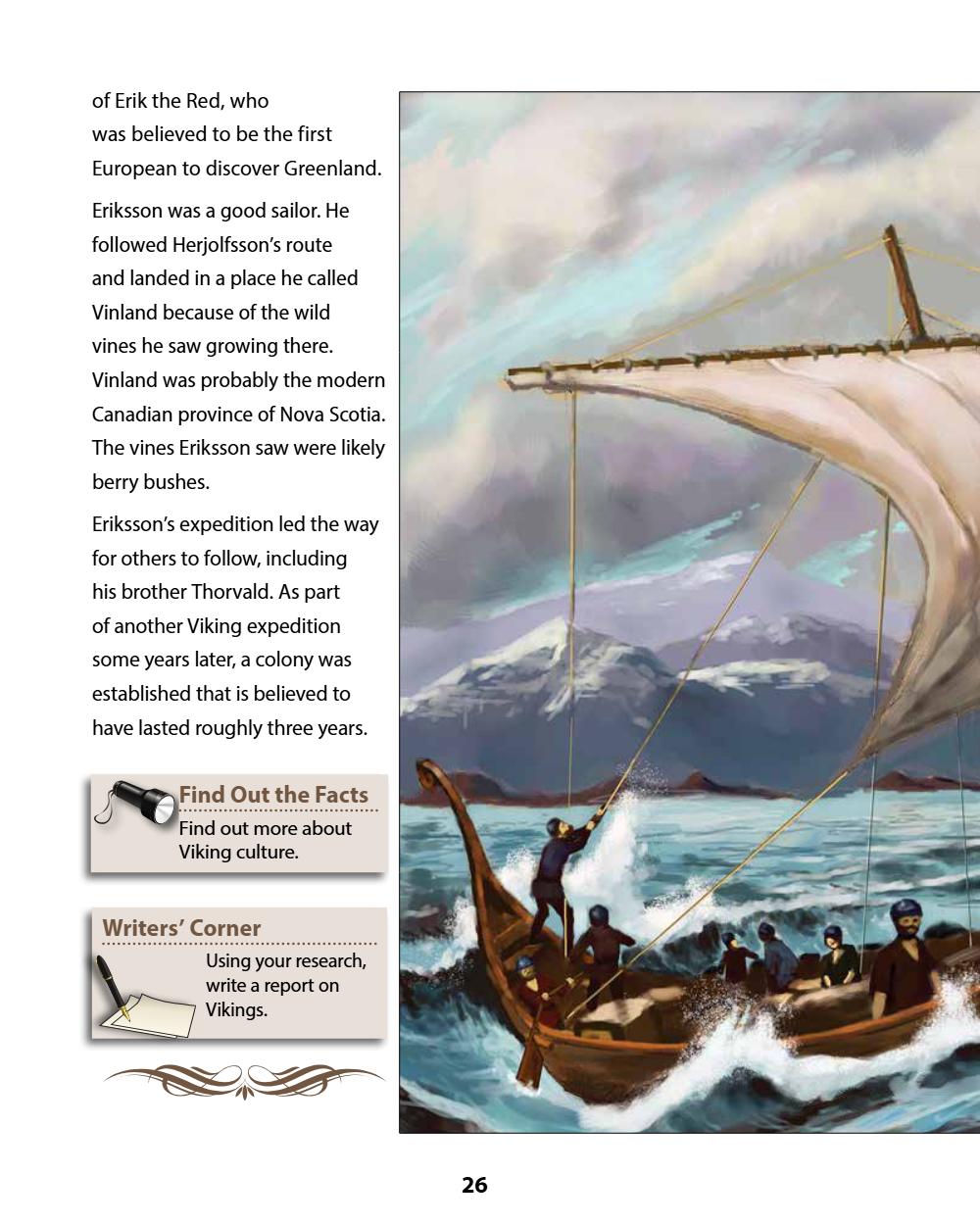
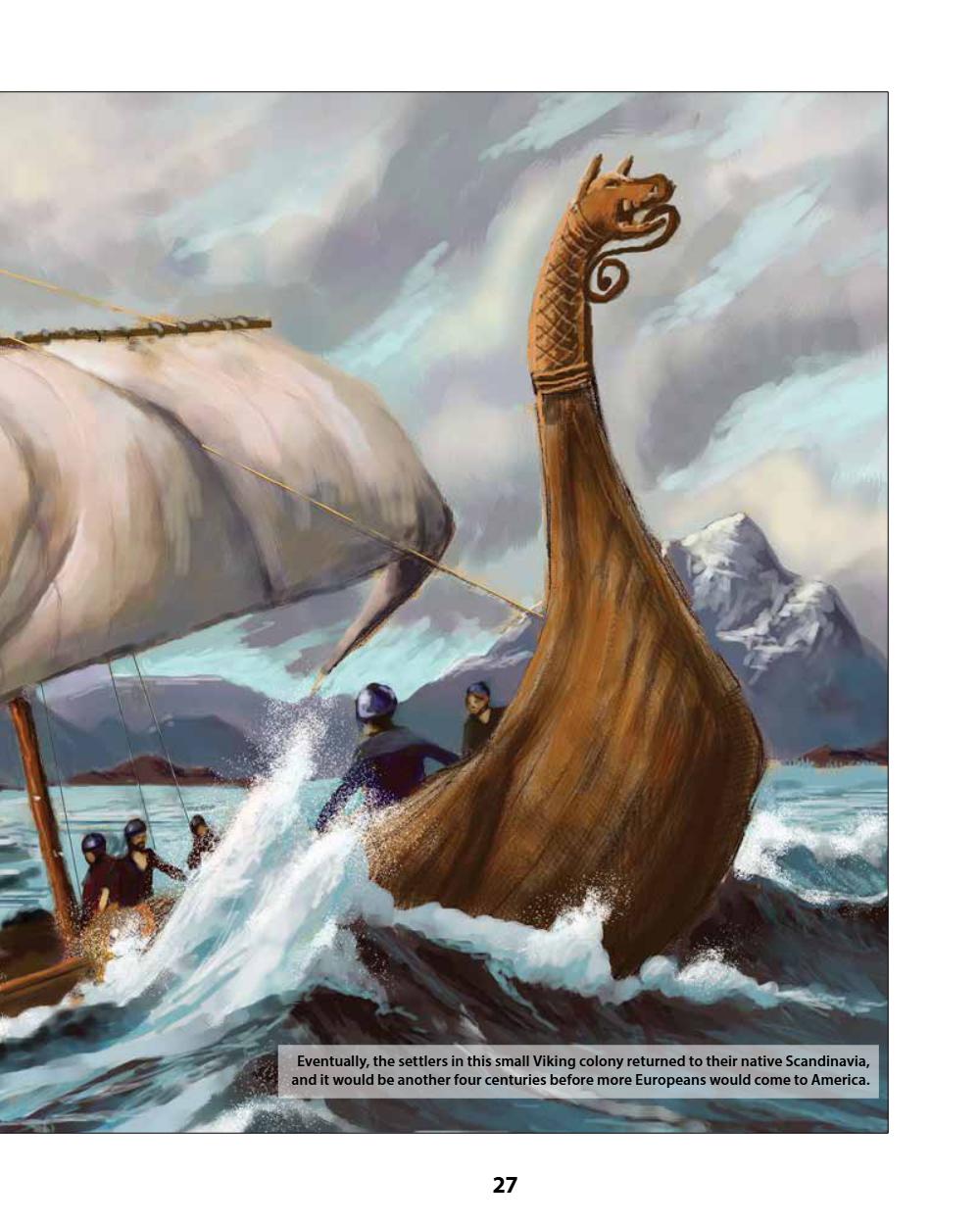
Eventually, the settlers in this small Viking colony returned to their native Scandinavia,
and it would be another four centuries before more Europeans would come to America.
27
Talk it over
Ask these as you read or afterward. Answers for the teacher are tucked under each question.
Why did Columbus name the people he saw indios?
Answer
Columbus thought he was in India and that the people he met were South Asian Indians.
What names are Americas’ original inhabitants known by today?
Answer
Today the Americas’ original inhabitants are known as Native Americans, First Nation Peoples, American Indians, or indigenous people.
What current U.S. state did the land bridge border?
Answer
The land bridge bordered the current state of Alaska.
What reason do some historians give for the move from Asia to America?
Answer
Some historians believe that early people may have followed herds of big game over the land bridge while they were hunting.
What other methods of migration might early people have used?
Answer
Some people may have traveled by boat or walked across frozen water.
How did the way of life of the different groups change as they moved to different parts of the Western Hemisphere?
Answer
The groups organized themselves differently and took on different ways of life. Some were hunters, while others farmed and formed highly structured societies.
What reasons do historians give for the Maya empire’s decline?
Answer
Historians blame environmental changes, an extended drought, constant warfare among rival city-states, and overpopulation or a combination of these.
What accomplishments did the Maya, Aztec, and Inca share?
Answer
The Maya, Aztec, and Inca all developed agricultural societies. They were also all builders. The Inca built roads, walls, and irrigation works. The Maya built pyramids. The Aztec built temples.
How were the Inca and Aztec similar?
Answer
Both the Inca and Aztec were skilled at warfare, and both were defeated by the firepower of the Spanish.
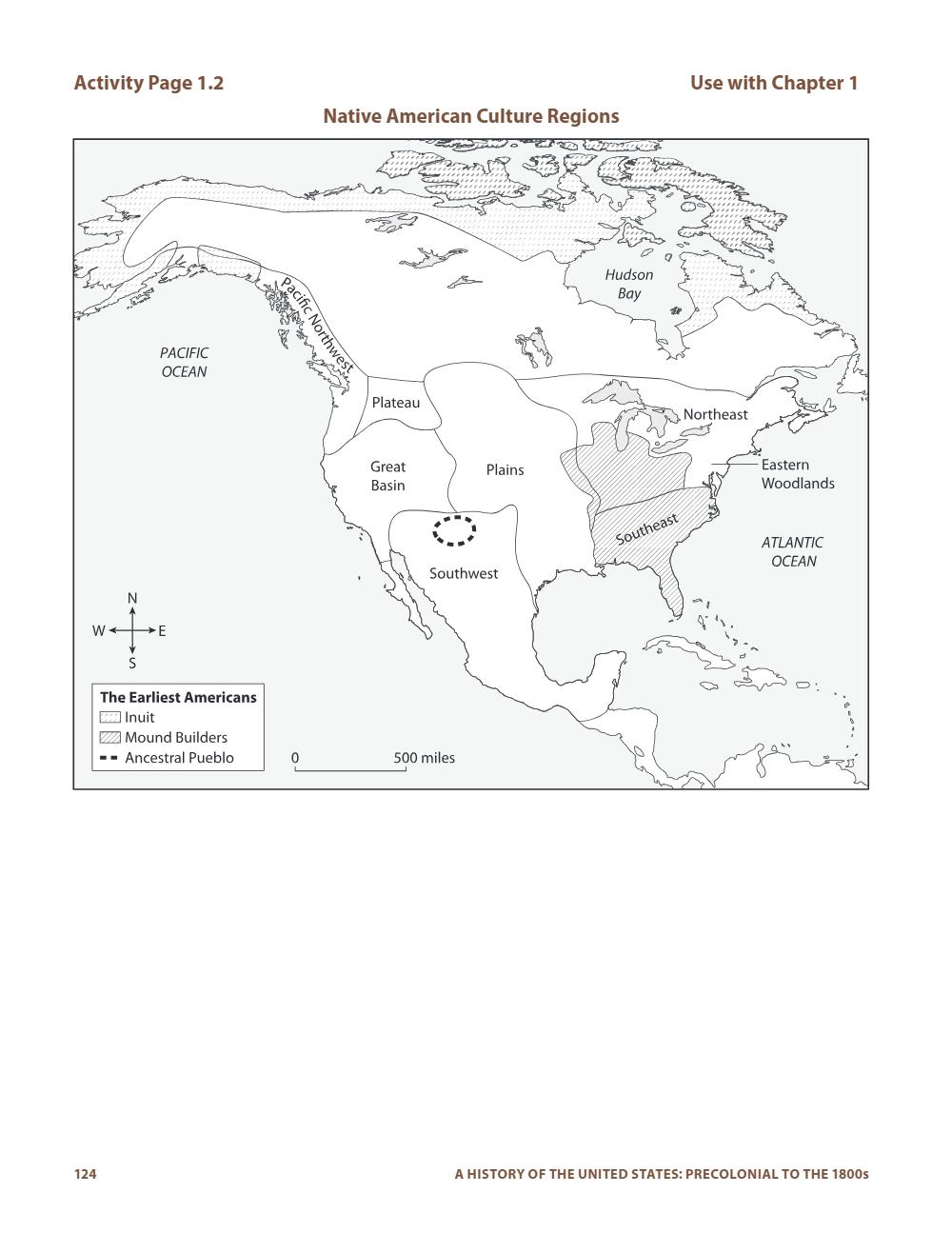
What are the four geographic regions of North America?
Answer
The four geographic regions are the Southwest, the Southeast, the Northwest, and the Northeast.
What was challenging about living in the American Southwest? How did native farmers meet this challenge?
Answer
The dry, arid climate made it difficult to live there. Native farmers learned to harness the power of the region’s rivers.
How was the lifestyle of the Navajo different from that of the Pueblos?
Answer
The Navajo lived in small villages, while the Pueblos lived in towns in close quarters.
How did the forests in the Northwest support the indigenous groups who lived there?
Answer
The forests provided wood for making shelters, boats, and religious artifacts.
How did the amount of water in their region make life for people in the Northwest different from the lives of people in the Southwest?
Answer
Water was plentiful in the Northwest and provided a source of food, while in the Southwest, people had to spend time getting water and food, which was far less plentiful.
How did the judicial style of government help the Iroquois?
Answer
The judicial style of government helped the Iroquois settle conflicts between neighbors and regulate commerce.
What country’s government was inspired by the Haudenosaunee Confederacy?
Answer
The United States government was inspired by the Haudenosaunee Confederacy.
What was the role of women in many northeastern Native American groups?
Answer
Many groups included all adults in making decisions. The women were also skilled farmers and produced much of the food for the community.
How did the Eastern Woodlands people use the materials around them?
Answer
The Eastern Woodlands people used wood for building and fuel and animals, fish, nuts, and berries for food.
Why is the way people of the Eastern Woodlands planted considered sustainable agriculture?
Answer
The plants were planted together to help each other grow: corn provided structure for the beans, and squash provided shade to keep the ground moist and prevent weeds.
What theory does the old Mahican story about traveling to their home match?
Answer
The Mahican story matches the theory of the Beringian land bridge.
What was the cause of the decline of Mound Builder civilizations?
Answer
The Mound Builders, like other indigenous people, died of diseases brought by the Europeans.
What people today are descended from the Mound Builders?
Answer
The Creek, the Cherokee, and the Choctaw are descended from the Mound Builders.
Where did members of the Creek Confederacy live?
Answer
The Creek Confederacy covered areas that are now North and South Carolina, Georgia, Florida, Alabama, Mississippi, and Louisiana.
What part of Creek culture is now known in cultures around the world?
Answer
The game the Creek played is like lacrosse, which is now played around the world.
Where were the Cherokee originally located?
Answer
The Cherokee were originally located in what is now western North Carolina, eastern Tennessee, and northern Georgia.
Why might it have been wise to have different chiefs for peacetime and wartime?
Answer
Leadership in peace and in war requires different skills, and with two leaders, the Cherokee could get the person who was most skilled in each job.
How were the organization of the Cherokee and Seminoles similar?
Answer
Both the Cherokee and the Seminoles were organized into different clans.
Where did the Europeans’ beliefs come from?
Answer
For many, European beliefs came largely from Christianity and the Bible, as well as the teachings of their religious leaders.
How did the Native American way of life connect to their spiritual beliefs?
Answer
Native Americans lived in a kind of harmony or synchronicity within their environments which connected them to the inherent value of our world.
How did the first Viking ship find America?
Answer
The first Viking ship found America when it was blown off course on a trip to Greenland.
Why did more Vikings come to settle in America after they learned of it?
Answer
Their Scandinavian homelands were beginning to get crowded.
Check for understanding
- Answer the Big Question out loud or in a sentence or two: What were some of the similarities and differences between the early indigenous or Native American groups of the Americas?
What a good answer includes
The early indigenous groups of the Americas all relied on the land, animals, and plants around them to survive, but depending on where they were, they had to survive in different ways; some groups mostly hunted, while others were farmers, and some, such as the Ancestral Pueblo, the Aztec, and the Maya, had complex societies and large cities. The groups had different types of government and ways of choosing leaders, but many of the societies involved all the adults in important decisions. The Iroquois Confederacy had a government on which the structure of the United States government is based.
- Pick one of today’s words and use it in a sentence of your own.
Activity pages
Print these from the Teacher Guide, or have your student answer on paper.
For offline study
Download these once and you can teach this unit without the internet.
This course is based on an original work of the Core Knowledge® Foundation (www.coreknowledge.org) made available through licensing under a Creative Commons Attribution-NonCommercial-ShareAlike 4.0 International License. This does not in any way imply that the Core Knowledge Foundation endorses this work. PGAMO added the lesson pages, study packs and quizzes layout, and shares them under the same license. CC BY-NC-SA 4.0 · Core Knowledge History and Geography. Free for everyone — this course may never be sold.